

Knowing how a story ends doesn’t necessarily make the journey any less compelling, but it does present a particular challenge for a franchise that has built its reputation on the uncertainty of survival. With The Hunger Games: Sunrise on the Reaping, director Francis Lawrence returns to Panem for another exploration of the cruelty, spectacle and political manipulation that have defined Suzanne Collins‘ dystopian universe, this time turning his attention to the tragic origins of one of its most beloved characters. And while its considerable 158-minute running time occasionally tests the patience, this is arguably the strongest entry in the series since Catching Fire, an often thrilling, surprisingly colourful and emotionally involving action-drama that understands the franchise has always been about considerably more than children killing each other for entertainment.
Set 24 years before Katniss Everdeen would volunteer as tribute, the film introduces us to a 16-year-old Haymitch Abernathy (Joseph Zada), whose modest existence in District 12 revolves around supporting his widowed mother and younger brother, and stealing whatever moments of happiness he can with his girlfriend, Lenore Dove Baird (Whitney Peak). Unfortunately, his sixteenth birthday coincides with the 50th Hunger Games, a particularly sadistic edition known as the Second Quarter Quell, which requires each district to surrender four tributes rather than the customary two. When a violent incident at the reaping sees Haymitch unexpectedly selected, he’s transported to the Capitol alongside fellow District 12 tributes Maysilee Donner (Mckenna Grace), Wyatt Callow (Ben Wang) and Louella McCoy (Molly McCann). What follows is a familiar descent into the machinery of the Games, where survival depends as much on understanding the people controlling the spectacle as it does on defeating those unfortunate enough to be trapped within it.
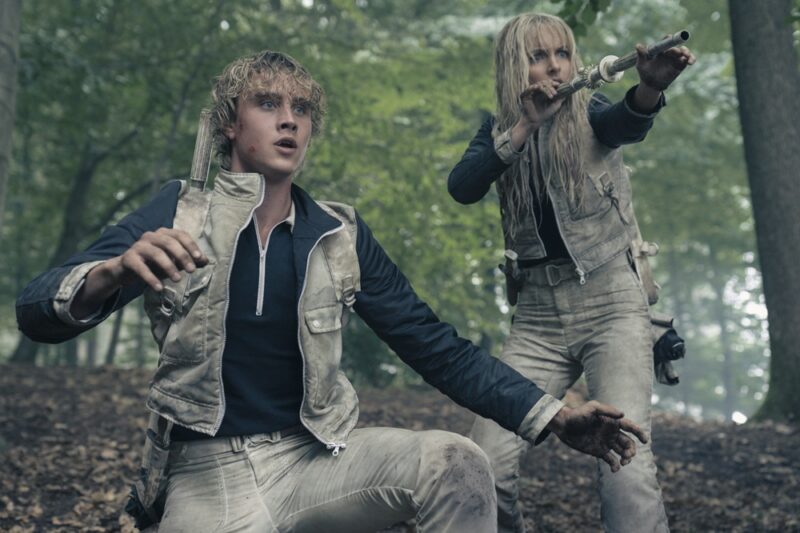
If the narrative structure feels reassuringly familiar, Lawrence at least finds renewed energy in its execution. The arena itself is a particular triumph, its deceptively idyllic landscape providing a striking contrast to the brutality unfolding within it. Lush greenery, expansive natural environments and an almost intoxicating vibrancy give the film a visual identity that distinguishes it from the increasingly artificial appearance of so many contemporary blockbusters. There’s something genuinely refreshing about watching a large-scale production that appears to have embraced actual locations rather than relying entirely on digitally manufactured environments. The action benefits enormously from that physicality, with the terrain becoming as much a threat as the competing tributes, and the film finding inventive ways to remind us that the Capitol’s greatest weapon isn’t necessarily the violence it encourages, but its ability to control every aspect of the environment. Beyond the immediate dangers, Haymitch’s growing determination to undermine the Games introduces a welcome element of rebellion, allowing the narrative to explore the difference between simply surviving an oppressive system and actively attempting to dismantle it.
Much of the film’s success rests on Zada, who proves an immensely appealing leading man without sacrificing the rougher edges that make Haymitch such an interesting character. There’s an instinctive warmth to his performance, but also a stubbornness and simmering resentment that suggest the cynical, alcohol-dependent mentor audiences will eventually recognise. His vocal work, in particular, is remarkably close to Woody Harrelson‘s distinctive delivery, an uncanny resemblance that never feels like a calculated impersonation. Grace, meanwhile, makes a considerable impression as Maysilee, bringing an intelligence and emotional directness to a character whose evolving relationship with Haymitch gives the arena sequences some of their most affecting moments. The Capitol’s inhabitants are equally well served by an ensemble clearly enjoying the opportunity to indulge in the franchise’s heightened theatricality. Kieran Culkin is having an absolute ball as Caesar Flickerman, embracing the character’s performative excess with infectious enthusiasm, while Glenn Close is deliciously wicked as Drusilla Sickle, practically unrecognisable beneath her intentionally stretched features. Elle Fanning is an especially welcome delight as a younger Effie Trinket, finding a bubbly, slightly more innocent energy that complements Elizabeth Banks’ eventual interpretation rather than merely imitating it.
For all its considerable strengths, Sunrise on the Reaping can’t entirely escape the limitations of its position within an already established mythology. At 158 minutes, the film is undeniably overextended, particularly when its abundance of characters, political manoeuvring and franchise connections occasionally threatens to overwhelm the more intimate story at its centre. More significantly, there’s an unavoidable sense of anticlimax in watching events whose ultimate consequences have already been established. We know Haymitch survives, we understand the damaged man he becomes, and the presence of so many familiar figures means certain dramatic possibilities are effectively removed before the story has even begun.
Lawrence manages to generate considerable tension within individual sequences, but the broader narrative struggles to manufacture the same sense of genuine unpredictability that made the earlier films so gripping. And while the connections to Katniss’ eventual rebellion provide a satisfying sense of continuity, the film occasionally feels a little too conscious of its responsibility to connect every narrative thread, when allowing certain moments to exist independently might have given them greater emotional weight.
Nevertheless, there’s something undeniably satisfying about returning to Panem when the storytelling is this assured and the world itself feels so vividly realised. Sunrise on the Reaping may not reinvent the franchise’s familiar formula, but it offers a compelling reminder of why that formula resonated so strongly in the first place. Beneath the elaborate costumes, grotesque pageantry and increasingly inventive methods of killing, Collins’ universe remains a pointed examination of power, propaganda and the disturbing ease with which suffering can be repackaged as entertainment.
By tracing Haymitch’s journey from an outspoken teenager with something worth fighting for to the broken man who would eventually help inspire a revolution, the film provides a suitably poignant companion to the original series, effectively bookending its central narrative while enriching our understanding of the sacrifices that preceded it. A little indulgent, occasionally predictable, but frequently exciting and anchored by a terrific central performance, this is a return to the arena that proves the odds can still be very much in the franchise’s favour.


THREE AND A HALF STARS (OUT OF FIVE)
The Hunger Games: Sunrise on the Reaping is screening in Australian theatres from November 19th, 2026, before opening in the United States on November 20th.
