

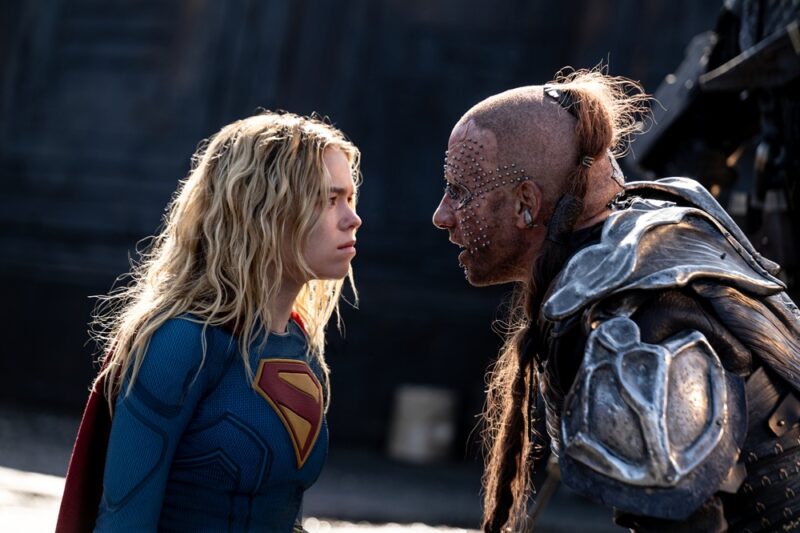
Following the colourful optimism and unapologetic comic-book exuberance of Superman, the next chapter of DC Studios’ cinematic universe takes an unexpectedly darker turn. Directed by Craig Gillespie (I, Tonya, Cruella), Supergirl is less concerned with saving the world than it is with the emotional cost of surviving one.
Drawing heavily from Tom King and Bilquis Evely‘s acclaimed Supergirl: Woman of Tomorrow comic, the film introduces audiences to a version of Kara Zor-El (Milly Alcock) far removed from the clean-cut heroism associated with her cousin, Kal-El (David Corenswet). Having witnessed Krypton’s destruction firsthand and carrying scars that Superman never had to endure, Kara has spent years drifting through the galaxy, numbing herself with adventure, alcohol and avoidance.
When her beloved dog Krypto is gravely injured during a brutal encounter involving the ruthless scavenger Krem (Matthias Schoenaerts), Kara reluctantly finds herself on a collision course with vengeance. Alongside her is Ruthye (newcomer Eve Ridley), a fiercely determined young girl seeking justice against the same man responsible for murdering her family. Their journey across planets, outposts and lawless corners of the galaxy becomes a story about revenge, accountability and the burden of deciding whether justice and vengeance are truly the same thing.
What may surprise audiences most is just how dark Supergirl is willing to become. Beneath its cosmic adventure framework sits material that explores trauma, exploitation and violence in ways that push the film into territory rarely visited by modern superhero blockbusters. At times, Gillespie’s vision feels closer to Mad Max: Fury Road than anything previously seen in the DC Universe, while Kara’s single-minded determination to save Krypto evokes more than a little of John Wick’s relentless emotional drive.
That darker tone won’t be for everyone, but it is also what allows Supergirl to establish an identity entirely separate from Superman. Rather than simply presenting a female version of an already established hero, the film repeatedly reinforces how different Kara’s worldview is from Clark’s. Where Superman believes in the inherent goodness of people, Kara has seen too much suffering to arrive at the same conclusion. Their few shared scenes are among the film’s most enjoyable, with Corenswet once again proving why he was such inspired casting as the Man of Steel. His warmth and sincerity bounce beautifully against Kara’s more cynical perspective.
Alcock takes a little time to settle into the role. Early on, Kara is presented largely as an unbothered party girl, seemingly uninterested in heroics or responsibility. It’s only as the film gradually reveals her Kryptonian past and the trauma she’s spent years suppressing that Alcock is given the material to truly shine. Once those emotional layers emerge, her performance deepens considerably, revealing a wounded, complicated hero who carries her grief like armour.
Ridley is equally impressive as Ruthye, providing the emotional counterweight to Kara’s detachment. Their relationship develops with a believable mixture of friction, admiration and reluctant affection, becoming the film’s emotional backbone.
Jason Momoa‘s long-awaited debut as Lobo proves worth the anticipation. Leaning heavily into the character’s comic-book absurdity, Momoa injects proceedings with his trademark charisma and mischief. The film smartly uses him sparingly; he arrives, causes chaos, steals a few scenes and leaves audiences wanting more. It’s a balancing act that prevents him from overwhelming the story while still planting intriguing seeds for future appearances.
Meanwhile, Schoenaerts delivers a suitably menacing turn as Krem. He lacks some of the larger-than-life flair audiences might expect from a comic-book villain, but his grounded cruelty serves the story well, particularly given the personal nature of the conflict driving both Kara and Ruthye.
Visually, Gillespie embraces a rougher, more lived-in aesthetic than many modern superhero films. The galaxy feels grimy and dangerous, filled with neon-soaked bars, battered spacecraft and frontier worlds that often resemble a space-western fever dream. It’s a welcome departure from the polished sheen that frequently dominates the genre.
Not everything works. The pacing occasionally stumbles, particularly in the first act, and some viewers may find the tonal shifts between irreverent humour and genuine darkness difficult to navigate. The film’s heavier themes also risk alienating those expecting a lighter adventure more in line with Superman.
Then again, Supergirl isn’t trying to be Superman; just as Gillespie isn’t attempting to clone James Gunn‘s temperament either.
For all the inevitable online discourse that has surrounded the project, Supergirl stands as a confident declaration that DC Studios intends for its heroes to feel distinct rather than interchangeable. It won’t convert those who have already decided they’re against it, but the film was never made for them. Instead, Gillespie delivers a bruised, emotionally driven space fantasy that allows Kara Zor-El to emerge from her cousin’s shadow and claim an identity all her own.
Messy, angry, funny and unexpectedly moving, Supergirl proves that being a hero doesn’t always mean being nice.


THREE AND A HALF STARS (OUT OF FIVE)
Supergirl is now screening in Australian theatres, before opening in the United States on June 26th, 2026.
