

Saccharine arrives with one of the strongest horror premises of the year. In an era where Ozempic, body positivity, calorie counting and algorithm-fuelled beauty standards dominate everyday conversation, a ghost story built around weight-loss pills made from human ashes feels both deliciously grotesque and eerily timely. It’s exactly the sort of concept that seems tailor-made for writer-director Natalie Erika James, whose excellent debut Relic proved she was less interested in cheap scares than using horror to externalise emotional trauma.
That ambition is still very much present here. Unfortunately, Saccharine never quite finds the balance between its social commentary and its supernatural horror, resulting in a film that’s consistently intriguing but frustratingly uneven.
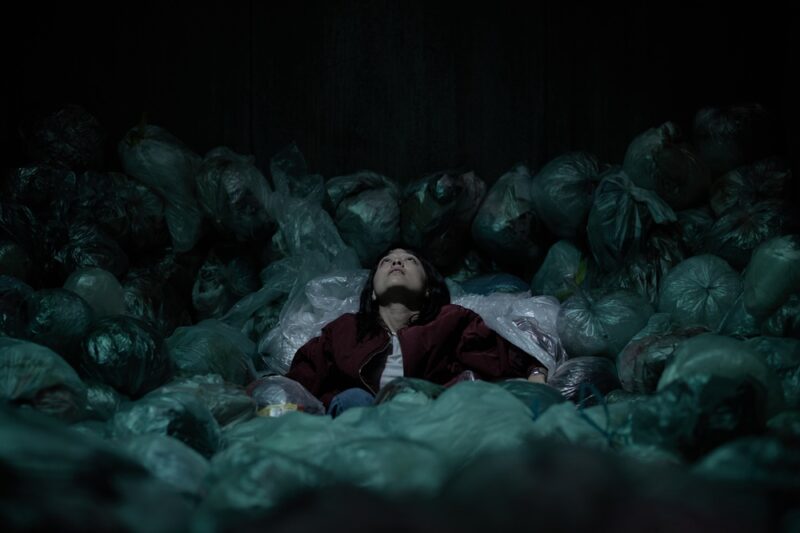
Medical student Hana (Midori Francis) is consumed by her inability to lose weight. Between anatomy classes, exhausting gym sessions and failed attempts to silence her binge-eating impulses, she becomes increasingly desperate for a solution. When a former classmate reveals the secret behind her own dramatic transformation, Hana discovers a weight-loss pill made from human ashes. Horrified but tempted, she recreates the formula herself using tissue from the cadaver assigned to her anatomy class. As the weight begins to fall away, the corpse’s former owner – whom Hana nicknames Bertha – starts appearing in mirrors, reflections and dark corners of her apartment, growing more aggressive the thinner Hana becomes.
James immediately establishes an unsettling atmosphere that rarely relies on loud jump scares. Instead, she leans into subtle dread: refrigerator doors creaking open, objects moving just outside Hana’s line of sight, distorted reflections that make you question what you’ve really seen. It’s patient, confident filmmaking that trusts tension over noise, and the result is some genuinely effective supernatural horror.
Visually, Saccharine is equally impressive. The anatomy labs are appropriately clinical yet deeply unsettling, with practical effects lending an uncomfortable authenticity to the dissections. James also finds clever ways to make ordinary food seem almost repulsive, reinforcing Hana’s fractured relationship with eating without ever needing to explicitly state it. Even something as innocent as leftover cake or takeaway chips carries an almost haunted quality.
Francis anchors the film with a committed performance that sells Hana’s desperation without reducing her to a stereotype. She’s intelligent enough to investigate the increasingly bizarre phenomena surrounding her, documenting Bertha’s appearances like a scientist even while knowingly continuing down a dangerous path. That internal contradiction – understanding the consequences but choosing them anyway – is arguably the film’s most compelling idea.
The problem is that Saccharine often struggles to know exactly what it wants to say about that contradiction.
Its central metaphor is obvious enough: the pursuit of impossible beauty standards comes at a terrible cost. Yet the script never digs deeply enough into Hana’s psychology or the culture that shaped her. We see glimpses of a difficult relationship with her mother, hints of childhood trauma and suggestions of lifelong body-image issues, but they’re introduced more than explored. Rather than enriching Hana’s emotional journey, these ideas remain surface-level observations.
The supporting cast suffers similarly. Danielle Macdonald‘s Josie feels positioned to become Hana’s emotional anchor, only for the film to repeatedly sideline her until she’s suddenly needed again. Madeleine Madden brings warmth to fitness coach Alanya, but their flirtation never develops into anything particularly meaningful beyond motivating Hana’s transformation. Even Hana’s family dynamics feel abbreviated, leaving relationships that should carry emotional weight oddly underdeveloped.
The biggest stumbling block, however, is Bertha herself.
Initially, the ghost works beautifully because James resists fully revealing her. Reflections and fleeting glimpses allow imagination to fill in the blanks. But the more Bertha appears, the less effective she becomes. What begins as an unnerving supernatural presence gradually drifts towards something unintentionally cartoonish, undermining both the scares and the film’s intended compassion. For a story attempting to critique society’s cruelty towards larger bodies, Bertha’s visual depiction occasionally feels uncomfortably close to reinforcing the very stereotypes it’s trying to dismantle.
That’s emblematic of Saccharine as a whole. It wants to condemn toxic beauty standards, but sometimes struggles to separate its satire from the imagery it’s employing. Its messaging isn’t offensive so much as muddled, leaving moments that should land with emotional clarity feeling strangely conflicted.
Still, James demonstrates enough filmmaking confidence to keep the experience engaging. There are clever moments of visual foreshadowing, unsettling body horror that arrives in carefully measured bursts, and a pervasive sense of unease that lingers even when the story itself starts wobbling. The film’s strongest sequences suggest there’s a sharper, more devastating version of Saccharine lurking just beneath the surface.
Like its title, Saccharine proves deceptively layered. It’s frequently stylish, genuinely creepy and anchored by an excellent lead performance, but its ambitious ideas never fully coalesce into the incisive horror satire they promise. Rather than biting deeply into the anxieties surrounding body image and wellness culture, it merely scratches the surface.


TWO AND A HALF STARS (OUT OF FIVE)
Saccharine is now screening in Australian theatres.
