

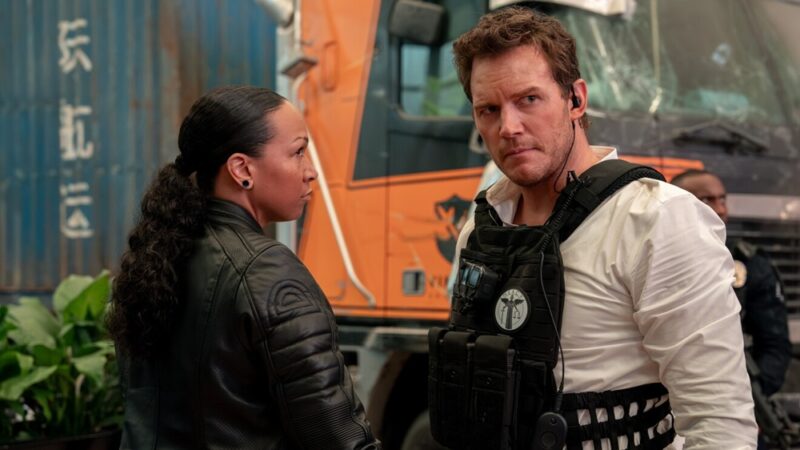
Mercy wants to be a slick, near-future morality play about the creeping dominance of artificial intelligence in modern life and, specifically, in the justice system. Instead, it plays like a film that can’t decide whether it fears technology, worships it, or just wants to use it as a convenient set of shiny props. Set around the “Mercy Chair,” a 90-minute AI-driven legal proceeding where defendants are assumed 98% guilty and must argue their innocence to an AI judge or face immediate execution, the premise is ripe with tension, but what unfolds is less a gripping thriller than a confused warning label slapped onto a thriller template.
The irony is that the film spends much of its runtime stressing the importance and value of AI – the efficiency, the certainty, the supposed freedom from human bias – only to end up clinging to the most predictable conclusion possible: that relying on intelligence without humanity is fundamentally flawed, and that human instinct, emotion, and moral reasoning will always prevail. That might be a valid takeaway, but here it lands with all the force of a pre-programmed motivational quote. Rather than interrogating its own system with any real complexity, the film defaults to a familiar “machines bad, humans good” mentality, as if it suddenly panicked about its own premise and retreated to safe ground.
Marco Van Belle’s script is the biggest culprit. It’s pedestrian in a way that’s especially damaging for high-concept sci-fi – the kind of writing that explains instead of reveals, that hurries from point to point without giving characters room to feel like people rather than chess pieces. The Mercy Chair setup screams for psychological warfare, ethical grey zones, and unnerving ambiguity. Instead, it often plays like a series of plot obligations: cue revelation, cue panic, cue last-minute pivot, cue emotional appeal. There are moments when the film begins to generate genuine intrigue, particularly in the slow tightening of its procedural noose, but it never sustains that energy long enough to become truly absorbing.
Chris Pratt, as LAPD Detective Chris Raven on trial for the murder of his wife (Annabelle Wallis), is unfortunately miscast in tone and underserved in construction. His performance is blunt and subtle-free, swinging hard at intensity without much modulation. It’s a kind of acting that demands the script do the delicate work around it – to shape, to shade, to layer – but the material doesn’t support him, leaving Raven as a loud emotional outline rather than a compelling inner life. To the film’s credit, things gradually improve as the story moves forward and the stakes sharpen, but Pratt never fully settles into the psychological specificity the premise requires. He’s meant to be a man being dismantled in real time; instead, he’s often just performing urgency.
Rebecca Ferguson fares significantly better. As Judge Maddox, the AI face of the Mercy program, she’s icy, stoic, and effortlessly controlled, finding menace in stillness rather than theatrics. She somehow manages to transcend the blandness of the dialogue, turning rigid, functional lines into something that feels deliberate and threatening. Where Pratt pushes outward, Ferguson pulls inward, making Maddox feel like an unblinking force rather than a gimmick. She’s the film’s clearest asset, and the closest Mercy gets to embodying the unnerving coldness it keeps gesturing toward.
Visually and structurally, the film leans hard on screens – phones, drones, feeds, surveillance overlays – to the point where it starts to resemble a feature-length scrolling panic attack. It’s clearly intentional, a thematic choice by director Timur Bekmambetov (Wanted, Abraham Lincoln: Vampire Hunter) meant to reflect the invasion of privacy and the suffocating omnipresence of modern tech. But the heavy reliance on these elements becomes monotonous, and eventually numbing, less like an aesthetic statement and more like a crutch. The film keeps insisting that technology is watching us, shaping us, judging us, and then it illustrates that idea with yet another screen, another feed, another digital POV. It’s emphasis-by-repetition, and it quickly loses its bite.
And then there’s the mystery. For a while, Mercy succeeds in planting just enough doubt to keep you curious; not necessarily invested, but curious about how the pieces will connect. The plot does begin to suggest there’s something more at play than a straightforward courtroom execution chamber, but the eventual reveal is ludicrous, the kind of twist that doesn’t recontextualise what came before so much as undercut it. It’s the narrative equivalent of the film throwing up its hands and declaring that it wants shock value more than coherence.
In the end, Mercy is a thriller with a sharp hook and dull teeth. It gestures toward provocative questions about automation, justice, and whether we’re outsourcing our morality to algorithms, but it rarely digs deeper than the surface of its own anxieties. Ferguson’s controlled precision gives the film occasional sparks of menace, and the concept carries a baseline tension almost by default. But the script’s predictability, the overdependence on tech-window dressing, and Pratt’s clumsy, unsubtle performance keep the film from ever becoming the gripping cautionary sci-fi it so desperately wants to be. It warns us about giving power to machines, while proving, unintentionally, that the bigger danger is trusting thin material to do heavy thinking.


TWO STARS (OUT OF FIVE)
Mercy is now screening in Australian theatres.
