

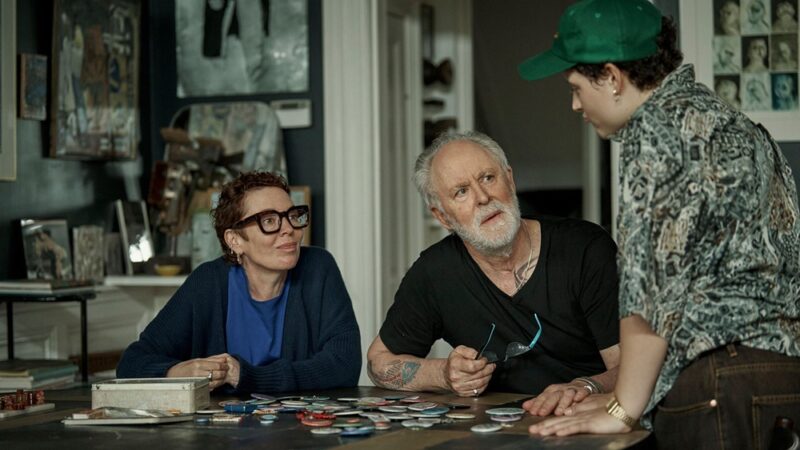
Sophie Hyde has always been drawn to intimacy – the kind that sits in the uncomfortable pauses between people who love each other but don’t quite know how to speak plainly. With Jimpa, arguably her most personal film to date, she turns that lens inward. The result is a warm, thoughtful and occasionally over-explanatory family drama that wears its heart very openly on its sleeve.
The story follows Hannah (Olivia Colman), who travels from Australia to Amsterdam with her husband, Harry (Daniel Henshall), and their 16-year-old child, Frances (Aud Mason-Hyde). The trip is meant to serve as a reconnection with Hannah’s father, affectionately known as Jimpa (John Lithgow), a proudly gay, politically engaged elder whose home is a hub for queer community. But what begins as a visit quickly shifts when Frances – trans and non-binary – announces their desire to stay in Amsterdam for a year, drawn to the freedom and visibility Jimpa’s world represents.
Hyde frames Amsterdam like a golden-hued dreamscape – sunlit canals, bicycles everywhere, cosy cafés – a place that feels both mythic and inviting. Inside Jimpa’s stylish townhouse, every object seems to whisper a story, suggesting a life lived expansively and defiantly. It’s easy to understand why Frances would be captivated; Jimpa’s orbit is vibrant, unapologetic and communal in a way that feels intoxicating for a teenager still forming their sense of self.
Where Jimpa is strongest is in its performances. Colman does what she does best: finding vulnerability in restraint. Her Hannah is protective, loving and quietly panicked, trying to do the “right” thing while suppressing her own fear. Lithgow, meanwhile, brings both charisma and fragility to Jimpa – he’s witty and assured, yet there’s an undercurrent of decline that complicates the fantasy Frances is falling in love with. And Mason-Hyde is a revelation: wide-eyed but never naïve, self-possessed without becoming precocious. Frances feels lived-in, not symbolic.
The film’s thematic ambitions are admirable. Hyde is interested in generational differences within the LGBTQ+ community – how a gay man who came of age in an era of activism and survival might differ from a trans teenager navigating identity in a more visible, yet still fraught, cultural moment. Their bond is rooted in shared community, but there are subtle tensions in how they each define freedom and belonging. The film understands that queerness is not a monolith, and that intergenerational dialogue can be both affirming and complicated.
If there’s a weakness, it’s that Jimpa occasionally spells out what it’s trying to say. Conversations can feel overly didactic, with characters articulating themes rather than simply embodying them. At times, the script edges toward caricature – older and younger perspectives neatly arranged for debate rather than organically clashing. Hyde’s closeness to the material may explain this instinct to clarify rather than trust implication.
Yet even when it becomes talky, the film’s sincerity is disarming. The strong language and frank discussions about sex feel organic to Jimpa’s world – not gratuitous, but reflective of a community that has long had to speak plainly about bodies, desire and autonomy. Sexuality here is portrayed with warmth and respect, neither sensationalised nor sanitised. It’s part of the texture of these characters’ lives.
What lingers most is the film’s central tension: love and conflict are inseparable. Hannah wants to protect her child. Frances wants to define themselves. Jimpa wants independence. Beneath the surface lies fear – of loss, of irrelevance, of letting go. Hyde suggests that families often avoid confrontation in the name of harmony, but that avoidance can create its own fractures. The film ultimately argues that love isn’t the absence of conflict, it’s the willingness to sit inside it.
As a semi-autobiographical work, Jimpa carries both the richness and risk of lived experience. The emotional stakes feel authentic, the details specific. But personal proximity can also make it harder to pull back, to allow silence to do the storytelling. Even so, Hyde’s generosity toward her characters, and her audience, is unmistakable.
Jimpa may not always trust its viewers to read between the lines, but it’s an emotive, compassionate portrait of a family trying – imperfectly, tenderly – to love each other well. And in a cinematic landscape that often reduces queer stories to trauma or triumph, there’s something quietly radical about a film that simply lets a family talk, argue, and stay.


THREE AND A HALF STARS (OUT OF FIVE)
Jimpa is screening in Australian theatres from February 19th, 2026.
