

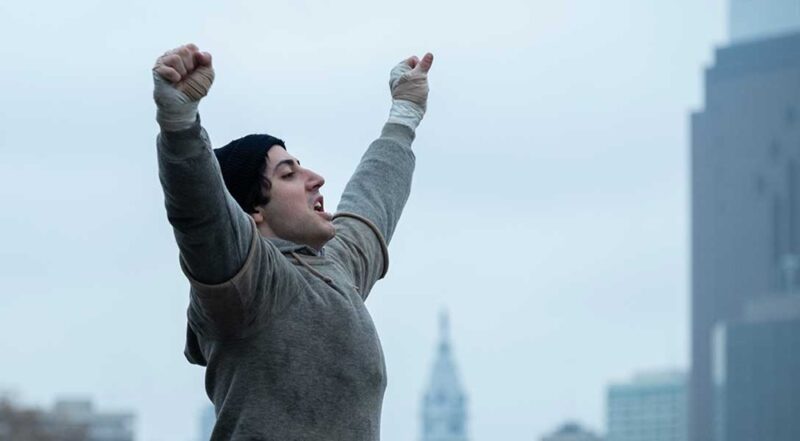
Before Rocky Balboa became a symbol of perseverance, before the triumphant run up the Philadelphia Museum of Art steps became one of cinema’s most enduring images, and before Sylvester Stallone established himself as one of Hollywood’s most recognisable leading men, there was simply an aspiring actor who refused to accept that his dreams were beyond his reach. It’s an appropriately romantic notion for a film about the creation of one of cinema’s great underdog stories, and one that director Peter Farrelly embraces with infectious enthusiasm in I Play Rocky, a tremendously entertaining, unabashedly sentimental and surprisingly moving celebration of artistic conviction.
The irony, of course, is that the story behind Rocky has become almost as mythologised as the film itself. Stallone’s journey from struggling actor to Oscar-nominated screenwriter and international movie star is the sort of Hollywood fairy tale that would seem almost impossibly contrived were it not rooted in reality. That Farrelly’s film occasionally embellishes the truth feels entirely appropriate for a story concerned with the power of believing in something long before anyone else considers it possible.
And while I Play Rocky is ostensibly about the making of a beloved American classic, its greatest achievement is reminding us that behind every seemingly inevitable success story lies a period when failure was not simply possible, but overwhelmingly likely.
The film introduces us to Stallone, played with remarkable commitment by Anthony Ippolito, at a time when the prospect of becoming a movie star seems considerably less realistic than simply making enough money to survive another week. Known as Mike to those around him, he’s an aspiring actor whose distinctive appearance, unconventional speaking voice and stubborn personality hardly align with the polished leading men Hollywood is looking to embrace.
Auditions prove frustrating, employment is precarious, and the indignities of pursuing an acting career have become an increasingly familiar part of his existence. Even a willingness to appear in an adult film does little to improve his circumstances, and his refusal to compromise his ambitions eventually leaves him without a permanent place to call home.
Yet what makes Stallone such an appealing protagonist isn’t simply the adversity he encounters, but the extraordinary certainty with which he approaches a future that nobody else can quite imagine; he doesn’t necessarily believe that success will come easily, he simply refuses to entertain the possibility that it shouldn’t come at all.
It’s a distinction that Ippolito understands beautifully, finding something enormously endearing beneath Stallone’s sometimes abrasive determination. His performance is undoubtedly built upon an impressive physical transformation, with the actor capturing the familiar gravelly cadence, heavy-lidded expressions and particular physicality that have become synonymous with Stallone. But the real pleasure comes from watching him move beyond those recognisable characteristics to suggest the vulnerable, occasionally insecure young man beneath the bravado.
There’s an almost childlike sincerity to his ambition, a quality that makes even his most unreasonable demands feel less like arrogance than an instinctive understanding of what he needs to accomplish.
Ippolito, who previously portrayed a young Al Pacino in the series The Offer, could easily have approached another portrayal of a cinematic icon as an exercise in impersonation. Instead, he brings a warmth and emotional accessibility to Stallone that allows the audience to forget, at least periodically, the famous figure he’s destined to become.
It’s an especially important quality given that the film’s central dramatic conflict revolves around a decision that, viewed without the benefit of hindsight, could reasonably be described as professional suicide.
After finding inspiration in the extraordinary determination of boxer Chuck Wepner during his 1975 fight against Muhammad Ali, Stallone channels his frustrations, aspirations and understanding of the overlooked American dream into a screenplay about a small-time Philadelphia fighter given an improbable opportunity to challenge the heavyweight champion of the world.
Written in a matter of days, Rocky attracts the attention of producers Irwin Winkler (P.J. Byrne) and Robert Chartoff (Toby Kebbell), who recognise its commercial and emotional potential. Unfortunately, their enthusiasm comes with a complication: Stallone insists that he must play the title character himself.
For an industry accustomed to treating unknown actors as interchangeable commodities, the idea that an unproven performer would refuse to sell a potentially lucrative screenplay unless he was guaranteed the leading role is practically unthinkable. And yet Stallone remains unmoved.
What follows is less a conventional account of a film’s production than an unexpectedly engaging battle over creative ownership, as the aspiring star finds himself negotiating with an industry that recognises the value of his imagination while remaining reluctant to acknowledge his worth as a performer.
Farrelly has considerable fun exploring the absurdity of these negotiations, particularly through Tracy Letts, who delivers a wonderfully slippery performance as a studio executive whose determination to separate Stallone from his own creation provides the film with one of its most entertaining antagonistic forces. Letts is particularly effective because his character’s objections aren’t entirely unreasonable. From a commercial perspective, entrusting a potentially valuable property to an unknown actor with an unconventional screen presence hardly represents sound business judgment.
It’s precisely this tension that gives I Play Rocky its dramatic momentum. We know Stallone will eventually prevail, but Farrelly makes the obstacles sufficiently entertaining that the inevitability of the outcome rarely diminishes the pleasure of watching events unfold. Indeed, one of the film’s more interesting observations is that creative success often depends upon an uncomfortable combination of talent, timing, persistence and an almost irrational refusal to recognise one’s limitations.
Stallone’s greatest advantage isn’t necessarily that he’s more talented than everyone around him. It’s that he understands something about the character of Rocky Balboa that nobody else can fully appreciate: the role isn’t merely an opportunity to establish himself as an actor. It’s an expression of his own experiences, disappointments and determination to be taken seriously.
To surrender the character would mean surrendering the very thing that made the screenplay worth writing.
Providing the film with much of its emotional grounding is AnnaSophia Robb as Sasha Czack, Stallone’s girlfriend and eventual wife, whose unwavering belief in his potential proves just as significant as his own ambition. Robb is a particularly lovely presence, bringing an intelligence and gentle assertiveness to a character who might otherwise have been relegated to the familiar biographical role of the supportive woman standing behind a successful man.
Instead, Sasha emerges as an important creative influence in her own right, encouraging Stallone to recognise that the frustrations of his acting career might be transformed into something meaningful through writing. Their relationship provides some of the film’s most affecting moments, particularly when the romantic idealism of pursuing a dream collides with the less glamorous realities of financial insecurity and professional disappointment.
Robb and Ippolito share an easy, believable chemistry, and their scenes together allow the film to briefly escape the mechanics of Hollywood dealmaking to consider the personal sacrifices involved in chasing an uncertain future. There’s something particularly touching about the suggestion that Sasha recognises the man Stallone might become before the rest of the world has been given any reason to believe in him.
The supporting ensemble is similarly well assembled, with Byrne and Kebbell providing an appealing combination of industry pragmatism and genuine enthusiasm as the producers attempting to shepherd Rocky towards production. Jay Duplass brings an understated authority to director John G. Avildsen, while Stephan James makes a memorable impression as Carl Weathers, whose portrayal of Apollo Creed would become an essential part of the original film’s enduring appeal.
Farrelly also understands that part of the attraction of a film such as I Play Rocky lies in the audience’s familiarity with the work being created. Rather than resist the temptation to revisit some of Rocky‘s most iconic moments, he enthusiastically leans into the nostalgia, recreating familiar sequences with an attention to detail that should delight longtime admirers.
The legendary Philadelphia training montage, in particular, is handled with an almost disarming sincerity. Watching Ippolito recreate Stallone’s run through the city, culminating in that unforgettable ascent of the museum steps, produces precisely the emotional response Farrelly intends. We know the sequence. We know the music. We know the cultural significance of the moment.
And somehow, it still works.
Perhaps that’s because Farrelly understands that nostalgia is most effective when it serves an emotional purpose beyond simple recognition. These recreations aren’t merely opportunities for audiences to congratulate themselves on identifying familiar imagery. They represent the culmination of everything Stallone has endured to reach a point where the world might finally see him as he has always imagined himself.
The achievement isn’t simply that Rocky gets made. It’s that the man who refused to relinquish his place within it finally gets to prove why he belonged there.
Having previously navigated the crowd-pleasing biographical territory of Green Book, Farrelly is clearly comfortable working within a cinematic tradition that favours emotional accessibility over historical complexity. His direction here is energetic and affectionate, maintaining a brisk sense of forward movement even when the narrative becomes preoccupied with contracts, negotiations and production logistics.
There are, admittedly, moments when the film’s determination to celebrate its subject comes at the expense of a more complicated examination of Stallone’s personality and professional relationships. The distinction between historical fact and Hollywood mythology is frequently blurred, and viewers hoping for a particularly revealing or challenging portrait of the actor may find the film’s approach a little too reverential. But I Play Rocky is hardly pretending to be a definitive historical document. It is, in many respects, a film about the emotional truth of an underdog story rather than the precise chronology of its creation.
And within those parameters, it proves remarkably effective.
What ultimately distinguishes Farrelly’s film from the many Hollywood biopics that have attempted to dramatise the origins of familiar cultural phenomena is its understanding that success itself is rarely the most interesting part of the story. We already know that Rocky becomes a phenomenon, that Stallone earns Academy Award nominations for acting and writing, and that a character conceived from personal frustration eventually transforms into a cinematic institution.
The fascination lies in returning to a moment when none of those achievements was guaranteed, when the future action star was simply another struggling performer confronting an industry seemingly designed to convince him that his ambitions were unrealistic.
There’s a lovely symmetry in the idea that Stallone’s own story so closely resembles the character he created. Neither man was the obvious favourite. Neither possessed the conventional advantages that might have made victory seem inevitable. And neither was particularly interested in accepting somebody else’s assessment of what he could accomplish. More importantly, both understood that winning wasn’t necessarily about defeating an opponent. Sometimes it was simply about being given the opportunity to prove that you deserved to be there.
It’s a sentiment that could easily descend into empty motivational rhetoric, but Farrelly’s affection for his subject, combined with Ippolito’s winning central performance, gives the film an emotional sincerity that’s difficult to resist.
In an industry increasingly fascinated by established intellectual property and the reassurance of familiar names, there’s something rather wonderful about revisiting a time when one of cinema’s most beloved franchises existed only because an unknown actor refused to allow anyone else to become its star. That the film celebrating his determination is itself anchored by a relatively unfamiliar performer delivering a potentially career-defining turn adds another pleasing layer to the experience.
Whether Ippolito’s career ultimately follows anything resembling Stallone’s extraordinary trajectory remains to be seen, but I Play Rocky certainly makes a persuasive argument for his abilities as a leading man.
Funny, heartfelt and unapologetically uplifting, I Play Rocky is the sort of old-fashioned Hollywood crowd-pleaser that wears its emotions proudly and understands the enduring appeal of watching someone achieve what the world insists is impossible. It may not possess the dramatic complexity or cultural significance of the film whose creation it celebrates, but it shares something arguably more important: an enormous heart and an unwavering affection for those brave enough to keep fighting when the odds are stacked against them.
After all, the most satisfying part of an underdog story isn’t always watching someone win. Sometimes it’s watching them refuse to give up. And on that front, I Play Rocky goes the distance.


THREE AND A HALF STARS (OUT OF FIVE)
I Play Rocky is now playing in theatres in the United States, before opening in Australia on New Year’s Day, January 1st, 2027.
