

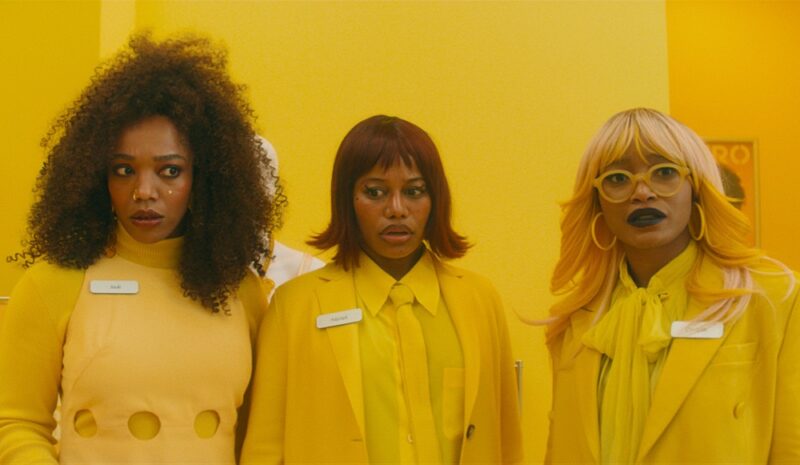
Subtlety has never been particularly high on Boots Riley‘s list of priorities, and thank goodness for that. With I Love Boosters, the filmmaker behind the gloriously unhinged Sorry to Bother You returns with another unapologetically anarchic assault on capitalism, corporate greed and the increasingly absurd lengths people will go to in the pursuit of wealth. Part heist comedy, part science-fiction fever dream and part revolutionary manifesto dressed in designer clothing, Riley’s latest is a film of such relentless visual and narrative excess that keeping up with its increasingly ridiculous developments can feel like a challenge in itself. But there’s something undeniably exhilarating about a filmmaker so committed to his own peculiar wavelength, particularly when the result is this colourful, confrontational and gleefully unpredictable.
At the centre of the madness is Corvette (Keke Palmer), an aspiring fashion designer whose creative ambitions have been repeatedly frustrated by an industry more interested in exploiting originality than rewarding it. Alongside fellow thieves Mariah (Naomi Ackie) and Sade (Taylour Paige), she operates as part of the Velvet Gang, a stylish collective of shoplifters who liberate obscenely priced designer clothing and redistribute it at considerably more affordable prices. Their preferred target is Metro Designers, the fashion empire overseen by Christie Smith (Demi Moore), a spectacularly self-absorbed mogul whose carefully cultivated image as a creative visionary conceals some decidedly ugly business practices. When Corvette discovers that Christie has stolen one of her designs, what begins as an exercise in entrepreneurial rebellion becomes something considerably more personal. And when a disgruntled factory worker named Jianhu (Poppy Liu) enters the equation with technology capable of teleporting merchandise, the group’s ambitions expand well beyond anything resembling a conventional robbery.
What makes I Love Boosters such a fascinating, if occasionally exhausting, experience is Riley’s refusal to separate its political convictions from its more outrageous comic instincts. His characters inhabit a world where exploitation is so thoroughly embedded in everyday life that the only reasonable response seems to be complete absurdity. Fashion becomes both an expression of individuality and a commodity ruthlessly stripped of its original meaning, while the distinction between theft and legitimate business grows increasingly difficult to defend. Riley is particularly interested in the hypocrisy of an industry that celebrates artistic innovation while profiting from the people whose labour and imagination make it possible. And because this is a Boots Riley production, those observations arrive alongside teleportation devices, increasingly deranged corporate schemes and a sexually predatory, soul-devouring demon played by LaKeith Stanfield. It’s a lot to process, certainly, but there’s a wicked intelligence beneath the silliness, even when the film appears determined to bury its own arguments beneath another layer of outrageous spectacle.
Holding this wonderfully chaotic enterprise together is Palmer, whose seemingly inexhaustible charisma makes Corvette an immediately engaging presence, even as the narrative threatens to spiral beyond her control. She brings a scrappy determination to the role, balancing the character’s creative frustrations with an infectious confidence that makes her increasingly audacious decisions feel entirely natural. Ackie and Paige prove equally valuable, their easy chemistry with Palmer giving the Velvet Gang a sense of genuine camaraderie that grounds the film’s more fantastical diversions. Moore, meanwhile, appears to be having a thoroughly enjoyable time as Christie, embracing the character’s vanity and moral bankruptcy with an appropriately heightened theatricality. She’s the embodiment of an industry that has confused financial success with artistic importance, and while the character occasionally feels more like a walking indictment than a fully realised person, Moore understands precisely the kind of movie she’s inhabiting. The supporting ensemble, including Will Poulter and Stanfield, only adds to the feeling that everyone involved has been encouraged to embrace the madness rather than question it.
Visually, there’s an almost intoxicating quality to Riley’s approach. At a time when so much contemporary filmmaking appears determined to drain the personality from its imagery, I Love Boosters practically attacks the screen with colour, texture and invention. Its extravagant costumes and elaborately conceived environments are more than decorative indulgences; they’re extensions of a story fundamentally concerned with who gets to create beauty, who gets to own it and who ultimately profits from it. The propulsive music from Tune-Yards further enhances the film’s restless energy, lending even its most politically charged moments an unexpectedly playful rhythm. Unfortunately, Riley’s appetite for invention also proves to be his greatest weakness. As the film barrels towards an increasingly extravagant climax, its competing interests in labour exploitation, consumer manipulation, creative ownership and revolutionary action begin fighting for attention. The introduction of one bizarre development after another occasionally dilutes the emotional investment established through Corvette and her friends, and some of the comedy struggles to land when there’s barely enough time to register one joke before the next arrives. What begins as a sharply focused act of rebellion gradually becomes so consumed by its own escalating absurdity that the people at its centre risk getting lost in the noise.
And yet, there’s something rather wonderful about I Love Boosters being so spectacularly uninterested in restraint. Riley’s ambition occasionally exceeds his ability to contain it, but the alternative would be a far less interesting film, and certainly a less memorable one. Beneath the psychedelic excess and unapologetically confrontational politics is an unexpectedly hopeful belief in collective action, artistic ownership and the possibility of challenging systems designed to keep ordinary people powerless. It’s a film that understands anger can be funny, rebellion can be fashionable and even the most outrageous fantasy can expose something uncomfortably truthful about the world we inhabit. Not every creative gamble pays off, and its exhausting final stretch may test the patience of those hoping for a little more narrative discipline, but there’s no denying the sheer personality coursing through every frame. Messy, provocative, frequently hilarious and bursting with ideas, I Love Boosters is the kind of gloriously excessive cinematic oddity that could only come from Boots Riley. And in an industry increasingly governed by familiarity and caution, that’s something worth celebrating.


THREE AND A HALF STARS (OUT OF FIVE)
I Love Boosters is now screening in Australian theatres.
