

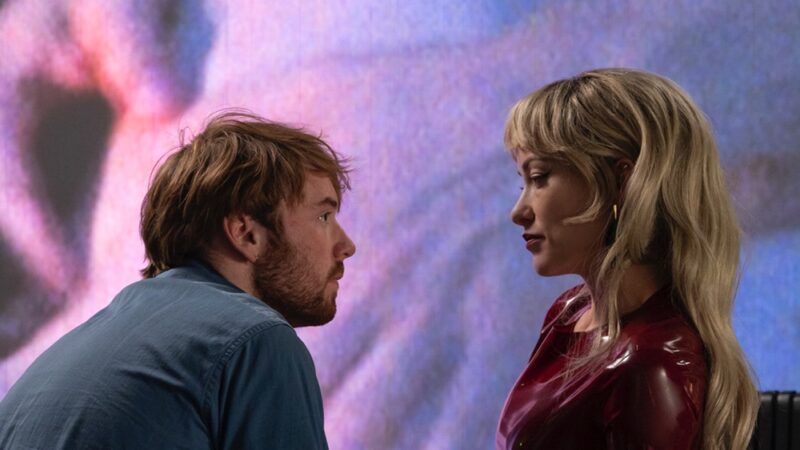
After more than a decade away from feature filmmaking, Gregg Araki returns with I Want Your Sex, and the wonderfully provocative filmmaker has lost none of his appetite for pushing buttons. Brash, colourful, sexually charged and gleefully inappropriate, this is Araki operating in a considerably more playful register than something like Mysterious Skin, but still interrogating the generational, sexual and cultural anxieties that have long fascinated him.
And, perhaps most importantly, it’s an absolute blast.
Co-written with Karley Sciortino, I Want Your Sex centres on Elliot (Cooper Hoffman), a directionless twenty-something who lands an unlikely job working for celebrated contemporary artist Erika Tracy (Olivia Wilde). Surrounded by people who appear infinitely cooler, more experienced and more comfortable in their own identities, Elliot initially seems spectacularly ill-equipped for Erika’s orbit. It soon becomes apparent, however, that his awkwardness may be precisely what attracted her attention.
Erika’s art is unapologetically obsessed with sexuality, as is Erika herself. She sees little distinction between provocation, pleasure and artistic expression, and Wilde attacks the role with delicious confidence. When Erika initiates a dominant/submissive relationship with her considerably younger employee, Elliot discovers that whatever uncertainty he has about the rest of his life certainly doesn’t extend to his curiosity about her.
Araki could have fashioned a relatively straightforward sex comedy from this premise, but straightforward has never particularly interested him. I Want Your Sex instead wraps its central relationship inside an increasingly chaotic mystery, opening with a bloodied Elliot discovering a body in a swimming pool before being hauled in for questioning by detectives played, in an inspired pairing, by Margaret Cho and Johnny Knoxville. His interrogation provides the framework through which we piece together exactly how his employment with Erika went so spectacularly off the rails.
The structure allows Araki to have considerable fun with the inherently questionable dynamics at play. Elliot is adamant that everything between himself and Erika is consensual, but consent becomes complicated when one participant is considerably older, wealthier and, crucially, the other’s employer. Erika possesses almost every conceivable form of power within their relationship, even before the pair deliberately incorporate power into their sexual dynamic.
Rather than offering an easy moral judgement, Araki seems far more interested in making everyone uncomfortable enough to start arguing about it afterwards.
This extends to the film’s generational divide. Erika is horrified by what she perceives as Gen Z’s increasingly cautious relationship with sex, whilst Elliot represents a generation far more accustomed to discussing boundaries, identity and emotional wellbeing than hers ever was. Araki occasionally pushes this commentary too forcefully, particularly when Erika starts sounding less like a character and more like the filmmaker delivering a lecture through her. Yet I Want Your Sex is smart enough to avoid simply presenting Erika as unquestionably correct.
If anything, the tension between those perspectives is where the film becomes most interesting. Is sexual liberation automatically progressive? Can caution itself be empowering? Has increased awareness around consent made younger people healthier about sex or simply more frightened of it? Araki throws these ideas into the room, turns up the music and leaves everyone else to fight over them.
Fortunately, the film never allows its thematic ambitions to overwhelm its primary purpose as entertainment.
At 90 minutes, I Want Your Sex moves with the caffeinated energy of someone who has consumed three cocktails and suddenly decided everyone at the party needs to know their sexual history. The production design is gloriously garish, the costumes become increasingly outrageous, and Araki gleefully punctures the self-importance of the contemporary art world. There’s an appealingly handmade quality to its excess too; however stylish the film becomes, it retains the queer-punk personality that has always separated Araki from filmmakers merely trying to manufacture transgression.
And the soundtrack, naturally, is immaculate.
Yet the film’s greatest weapon is arguably Wilde.
Following her work in The Invite, Wilde once again demonstrates how well she understands characters who weaponise confidence whilst harbouring considerably more complicated emotional machinery underneath. Erika could easily have become a caricature – a latex-clad collection of provocations masquerading as a person – but Wilde gives her an enormously entertaining sense of command. She can make Erika magnetic, ridiculous, intimidating and unexpectedly vulnerable, sometimes within the same scene. There’s an almost old-school movie-star quality to the way Araki photographs her, and Wilde clearly relishes being given permission to go this big.
Hoffman proves an ideal counterweight.
There’s an inherently shambling sweetness to the actor that makes Elliot’s journey particularly amusing. He isn’t presented as some secretly confident sexual dynamo waiting to emerge; he’s awkward, overwhelmed and frequently several steps behind everyone around him. Hoffman commits completely to that vulnerability, and his lack of vanity makes the film’s more outrageous situations considerably funnier. More importantly, he and Wilde generate the peculiar chemistry the movie requires – part attraction, part fascination, part generational collision.
The supporting cast is equally game. Chase Sui Wonders scores some of the film’s biggest laughs as Elliot’s roommate, whilst Daveed Diggs understands exactly how deadpan he needs to be amid the escalating insanity. Charli XCX makes an amusing impression as Elliot’s increasingly incompatible girlfriend (even if her American accent can’t entirely hide her natural British cadence), and Cho and Knoxville are such an unexpectedly enjoyable comic pairing that their police interrogation scenes could sustain an entirely separate movie.
Like many of Araki’s films, I Want Your Sex becomes somewhat less controlled as it barrels towards its conclusion. The final act rushes through developments that could have benefited from slightly more room, whilst the crime plotting isn’t nearly as interesting as the sexual and generational arguments surrounding it. But there’s something almost appropriate about a movie this deliberately messy refusing to tie itself into a perfectly respectable bow.
Because respectability is the last thing Araki is interested in.
For all its BDSM imagery, sexual politics and intentionally provocative dialogue, I Want Your Sex ultimately feels surprisingly joyous. Beneath the outrageousness is a sincere argument for curiosity – about sex, about other people and about experiences that might frighten or embarrass us. Araki isn’t necessarily demanding that everyone adopt Erika’s worldview; he’s suggesting that a culture terrified of making mistakes risks becoming terrified of living altogether.
After twelve years away from feature filmmaking, I Want Your Sex proves Araki hasn’t mellowed so much as refined exactly how he wants to cause trouble. Powered by a fearless Wilde, an endearingly game Hoffman and enough queer, colourful chaos to satisfy longtime devotees, it’s funny, provocative and proudly imperfect.
Gregg Araki is back.
And thankfully, he’s still horny for an argument.


FOUR STARS (OUT OF FIVE)
I Want Your Sex is screening in Australian theatres from August 27th, 2026.
