

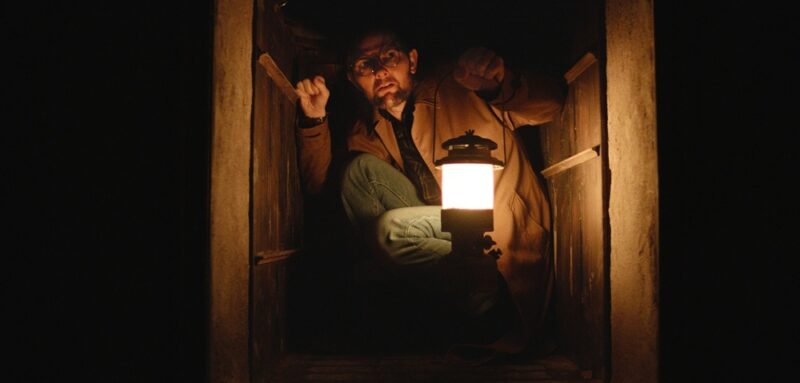
After the breakout success of both Caveat and Oddity, expectations were understandably high for Irish filmmaker Damian McCarthy’s next move. With Hokum, he steps into a more expansive, studio-backed arena – bringing with him the same commitment to atmosphere and unease, but struggling to sustain it across a film that ultimately feels more familiar than frightening.
At its core, Hokum is built on an intriguing foundation. Adam Scott plays Ohm, a successful author grappling with grief as he travels to rural Ireland to scatter his parents’ ashes. McCarthy initially leans into this emotional terrain with confidence, crafting a slow-burning first act that is as much about isolation and unresolved trauma as it is about the supernatural. The early stretches are genuinely absorbing – moody, deliberate, and anchored by Scott’s most compelling big-screen performance to date. Known largely for his comedic work and more recently for Severance, Scott proves he has the dramatic weight to carry something far more internal and psychologically driven.
For a while, Hokum seems poised to become a deeply personal piece of horror, where grief manifests in ways both literal and abstract. McCarthy’s control of tone is evident: the Irish countryside feels isolating without becoming overly stylised, and there’s a quiet dread that creeps into even the most mundane moments. When the story shifts toward a remote inn rumoured to be haunted, the film finds its most striking imagery – chalk circles, shadowy figures, and fractured glimpses of something lurking just out of sight.
But as the narrative expands, the focus begins to splinter. What starts as an intimate character study gradually gives way to a more conventional haunted house framework, complete with genre staples that feel overly telegraphed. The film’s marketing promises something deeply unsettling, yet much of what unfolds will feel instantly recognisable to seasoned horror audiences – echoing the rhythms and aesthetics of entries in The Conjuring Universe more than carving out its own distinct identity.
That familiarity wouldn’t necessarily be a flaw if the film’s emotional throughline remained as strong as it is in the opening act. Instead, the screenplay begins to pull in multiple directions, introducing folklore elements and supporting characters who never quite evolve beyond archetypes. Despite a talented ensemble, most of the figures orbiting Ohm feel underwritten, serving more as functional pieces of the plot than meaningful presences within it. The result is a story that becomes increasingly cluttered, losing the clarity that made its early moments so effective.
Even so, McCarthy’s eye for composition and atmosphere never fully falters. There are flashes of genuinely eerie imagery scattered throughout, and a handful of well-timed scares demonstrate his understanding of pacing and tension. Yet these moments feel isolated rather than cumulative, unable to build into the kind of sustained dread the film seems to be aiming for.
Ultimately, Hokum is a film caught between two identities: a meditative exploration of grief and a more traditional supernatural thriller. It never quite reconciles the two. What lingers is less a sense of terror and more a recognition of what the film could have been had it stayed focused on its strongest elements.
Still, Scott’s performance alone keeps it watchable, elevating material that too often settles into well-worn genre territory. He brings a rawness and vulnerability that hints at a more emotionally resonant film beneath the surface – one that occasionally breaks through, but never fully takes hold.


TWO AND A HALF STARS (OUT OF FIVE)
Hokum is now screening in Australian theatres, before opening in the United States on May 1st, 2026.
