
There’s something quietly radical about a filmmaker as singular as Jim Jarmusch making a film that feels this small. Father Mother Sister Brother doesn’t announce itself with narrative urgency or emotional fireworks – instead, it invites you to lean in, to notice, to sit with the awkward silences and half-truths that define family. And in doing so, it becomes one of his most gently affecting works.
Structured as a triptych, the film unfolds across three countries, three family units, and three variations on the same quiet ache: the distance between parents and their adult children. In “Father,” siblings Jeff and Emily (played with beautifully restrained tension by Adam Driver and Mayim Bialik) travel through a snow-blanketed American countryside to visit their estranged father, embodied with enigmatic stillness by Tom Waits. What begins as a simple reunion slowly reveals itself as a delicate dance of concealment – financial secrets, emotional avoidance, and the subtle performance of independence. The detail of a hidden Rolex becomes emblematic: a small, glinting clue that there’s always more beneath the surface than anyone is willing to admit.
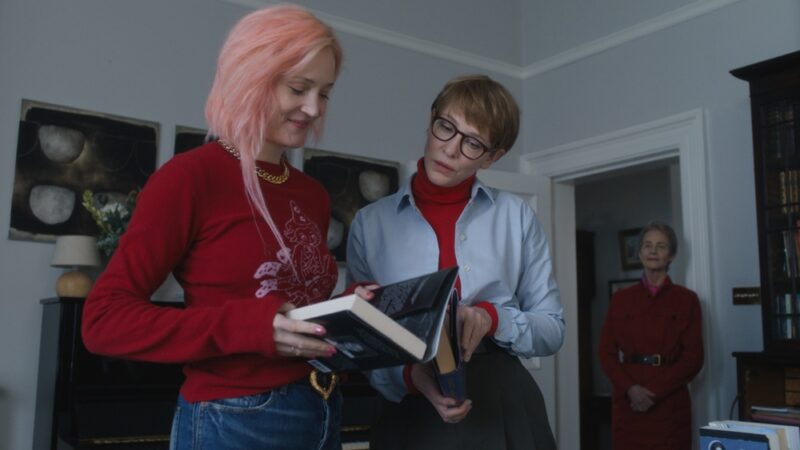
The Dublin-set “Mother” shifts the perspective but not the emotional terrain. Here, an aging literary figure (Charlotte Rampling) hosts her annual tea with daughters Timothea (Cate Blanchett) and Lilith (Vicky Krieps). It’s the only day they see each other all year – an idea that immediately tells you everything about their relationship. Jarmusch finds both humour and heartbreak in the polite façades: career updates that feel rehearsed, financial struggles disguised with Uber lies, and generational disconnects that play out in something as simple as the word “influencer.” The sequence unfolds with exquisite restraint, culminating in a silence at the front door that says far more than any confrontation could.
By the time we arrive in Paris for “Sister Brother,” the film opens outward emotionally, if only slightly. Skye and Billy (Indya Moore and Luka Sabbat, respectively) sift through the remnants of their parents’ lives after a sudden tragedy; old photos, fake IDs, a mysterious Rolex – again, Jarmusch returning to objects as vessels of memory and secrecy. Their journey through the city becomes less about grief in the traditional sense and more about reconstructing who their parents were beyond the roles they played. Even in loss, there’s a quiet revelation: we never fully know the people who raised us.
What makes Father Mother Sister Brother so compelling is its refusal to judge or dramatise. Jarmusch observes. He lets moments breathe. The comedy – dry, awkward, often rooted in social discomfort – emerges naturally from character rather than punchline. And yet, woven through it all is a gentle melancholy, a sense that these relationships are defined as much by what’s left unsaid as what’s shared.
Visually, the film is as composed as its storytelling is loose. Collaborating with cinematographers Frederick Elmes and Yorick Le Saux, Jarmusch crafts images that feel almost incidental but are in fact meticulously arranged – like the “delicate arrangements” he describes. Interiors become emotional landscapes; doorways and thresholds take on symbolic weight. It’s cinema that asks you to look twice.
Within Jarmusch’s body of work, Father Mother Sister Brother can easily be described as mellow, even minor, but that modesty is precisely its strength. Like Paterson, it finds profundity in the everyday. Like Mystery Train and Night on Earth, it uses its structure to explore variation and repetition across cultures. But here, the focus feels even more distilled – less about the world at large, and more about the intimate, often unknowable lives of families.
By the end, the film doesn’t offer catharsis in any conventional sense. There are no reconciliations, no grand revelations, just a lingering sense of recognition. These are people who love each other, imperfectly and at a distance, carrying small secrets that hint at entire unseen lives. And perhaps that’s Jarmusch’s quiet thesis: that family isn’t defined by clarity or closeness, but by the fragile, enduring threads that connect us despite everything.
It’s a film to savour – unassuming, wryly funny, and unexpectedly moving in the way it sneaks up on you.


THREE AND A HALF STARS (OUT OF FIVE)
Father Mother Sister Brother is screening in Australian theatres from April 2nd, 2026.
