
There’s a particular kind of grime that clings to the best grindhouse horror – the sense that if you wiped your hand across the screen, it would come away sticky. Dolly, directed by Rod Blackhurst, leans into that filth with feral enthusiasm. This is not polite horror. It’s blood-caked, sun-bleached, and proudly nasty; a love letter to 1970s hicksploitation that howls its influences rather than whispering them.
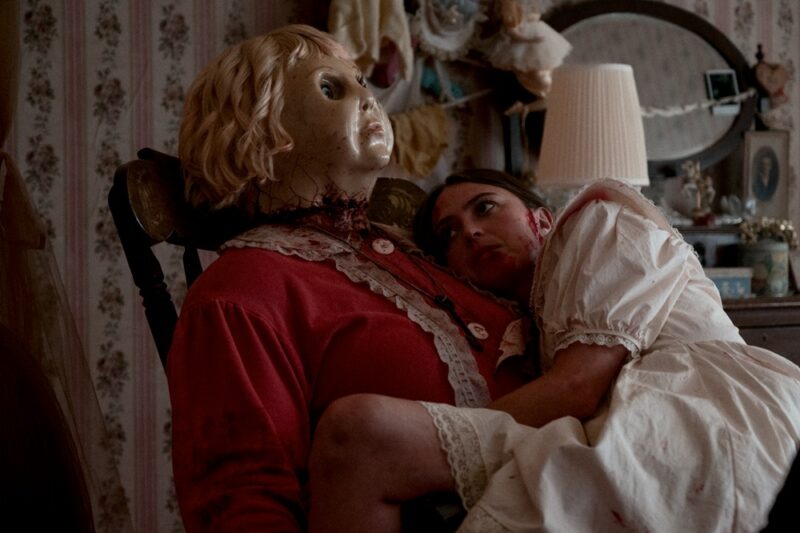
The setup is deceptively simple: Macy (Fabianne Therese) and her boyfriend, Chase (Seann William Scott), head into the woods for what’s meant to be a romantic hike-turned-proposal. Instead, they cross paths with Dolly (professional wrestler Max The Impaler), a masked sadist who dresses like an oversized porcelain plaything and harbours deeply warped maternal instincts. Her goal isn’t just to kill – it’s to keep. Macy is to become her “baby,” confined inside a decaying house that feels less like a home and more like a festering wound.
From its opening frames, Dolly makes its thesis clear. The film is steeped in the aesthetic and moral rot of ‘70s exploitation cinema: grainy textures (it’s filmed in 16mm), oppressive heat, and that unnerving suggestion that true horror lives not in distant castles but in America’s backyards. The shift from open woodland to claustrophobic interior is handled with queasy precision. Blackhurst creates an atmosphere so tactile you can almost smell the mildew and old blood. Macy’s captivity becomes a sensory assault, and there’s a pointed subtext that her physical imprisonment mirrors her emotional paralysis about marriage and adulthood.
If there’s a crown jewel here, it’s the practical effects. The gore is unapologetically visceral – not slick studio splatter, but chunky, tactile, stomach-churning carnage. The violence feels handmade, in the best and worst ways. Dolly herself is a grotesque creation: cracked doll mask, childish frocks, and explosive brutality. Max The Impaler brings a hulking physicality to the role that makes every lurch forward feel catastrophic. Yet beneath the savagery, there’s an unsettling thread of pathos. Like many great horror villains, Dolly feels born of trauma – twisted by her upbringing into something monstrous. The film flirts with sympathy without ever asking for forgiveness.
Where Dolly perhaps stumbles slightly is in how tightly it clings to its inspirations. The shadow of The Texas Chainsaw Massacre looms large – sometimes too large. The dilapidated house, the familial rot, the manic final girl energy in the closing moments – it’s all knowingly referential. Homage is one thing; near-mirroring is another. There are stretches where the film feels less like it’s carving its own identity and more like it’s enthusiastically cosplaying a classic.
Still, even when it edges toward imitation, Dolly has enough ferocity to justify its existence. It commits. It sweats. It bleeds. And in an era where so much horror feels sanded down for algorithmic comfort, there’s something refreshing about a movie that wants to punch you in the face and then cackle while doing it.
It may not completely escape the long shadow of its grindhouse ancestors, but as a blood-slicked, mean-spirited throwback with a villain you won’t soon forget, Dolly is an unrelenting ride. And if the teased continuation comes to pass? One suspects Dolly’s playtime is far from over.


THREE AND A HALF STARS (OUT OF FIVE)
Dolly is screening in theatres in the United Kingdom and the United States from March 6th, 2026, before opening in Australia on March 12th.
