

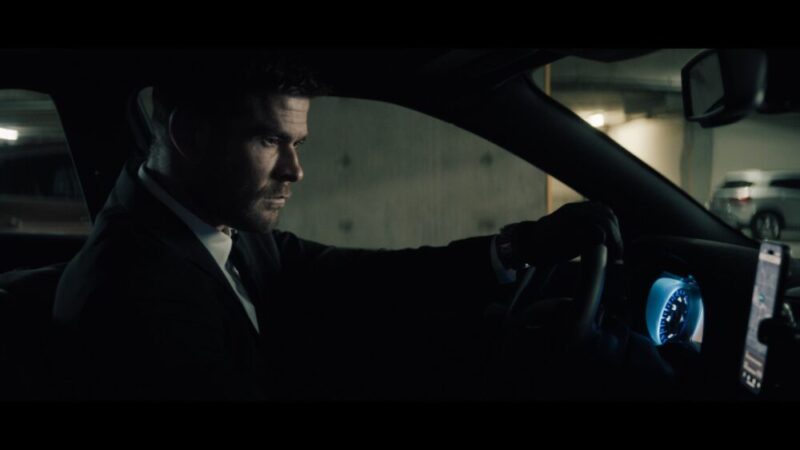
A sleek exercise in neo-noir, Crime 101 knows exactly how cool it wants to be – and mostly earns it.
Set along California’s Highway 101, the film uses its coastal sprawl as both a backdrop and thematic spine, turning beach towns and long asphalt stretches into part of the story’s DNA. Here, the geography matters: this is a crime film shaped by distance, routine, and repetition, where movement itself becomes evidence. From the opening act, writer/director Bart Layton (American Animals) – working off Don Winslow‘s novel of the same name – establishes a measured confidence, favouring quiet tension and interlocking perspectives over flashy spectacle.
Chris Hemsworth anchors the film as Mike Davis, a lone-wolf jewel thief who lives by his own personal code of sorts; the actor leaning hard into stoicism, with his deep, deliberate voice making even the thief’s self-mythology feel convincing. Across from him, Mark Ruffalo plays Detective Lou Lubesnick as a man consumed by pattern recognition and professional obsession, convinced that a string of robberies scattered along the highway can only belong to one perpetrator. Their parallel trajectories – hunter and hunted – give the film its structural backbone, and Layton smartly alternates between them, letting inevitability creep in rather than explode all at once.
Halle Berry‘s Sharon Colvin adds an emotional counterweight to this duel, a disillusioned insurance broker drawn into the orbit of the crime just as her own life hits a breaking point. Her role introduces a quieter melancholy into the film, suggesting that everyone here is negotiating some version of escape, whether from the law, from routine, or from themselves. By contrast, Barry Keoghan brings volatile unpredictability, injecting scenes with nervous energy, reminding audiences how fragile Davis’ carefully curated rules truly are. And whilst the remaining ensemble players speak to the film’s lived-in texture as operators in a world populated with intermediaries and enablers – Corey Hawkins as Lou’s partner, Jennifer Jason Leigh as his exasperated wife, Nick Nolte as Davis’s handler, and Monica Barbaro as his potential love interest – their characters aren’t always afforded the depth they deserve.
Structurally, Crime 101 is at its strongest in the first half of its 140 minute running time, when the film luxuriates in its process: the accumulation of clues, the tightening of surveillance, and the quiet ritual of planning and execution. Layton’s direction is precise and unhurried, allowing the story’s interconnectedness to feel organic rather than gimmicky. As the film moves towards its climax, it trades some of that procedural sharpness for introspection. The stakes become more emotional than mechanical, and though this shift lends the film an unexpected sentimentality, it also diffuses some of the tension the setup promises.
Crime 101 is ultimately less interested in the spectacle of the perfect heist than in the psychology of people who believe in systems – rules, patterns, careers – and what happens when those systems fail them. Not every character is fully utilised, and the final act doesn’t quite the match the elegance of the build-up, but the film’s atmosphere, performances, and structural intelligence carry it through. Crime 101 is a thriller that values mood and character over bombast, delivering a cool, contemplative ride, even when it leaves some potential on the table.


THREE AND A HALF STARS (OUT OF FIVE)
Crime 101 is now screening in Australian theatres, before opening in the United States on February 13th, 2026.
