

It’s been something of an arduous trek to the screen for one Ballerina – or, as it’s been marketed, From the World of John Wick: Ballerina – a serviceable action film that hopes to elevate its own being by attaching itself to a lucrative, acclaimed franchise, even though it originated as something else entirely.
To the untrained eye, Ballerina feels as if it can slot itself into the timeline of the John Wick series without disrupting too much continuity. Essentially John Wick 3.5 – Ballerina is sandwiched, narrative wise, between the third and fourth Wick films – the Len Wiseman-directed, Shay Hatten-penned actioner takes the exaggerated, violent action mentality of the Keanu Reeves-led films, but forgoes much of a plot, leaving the Ana de Armas vehicle to survive off her pluck.
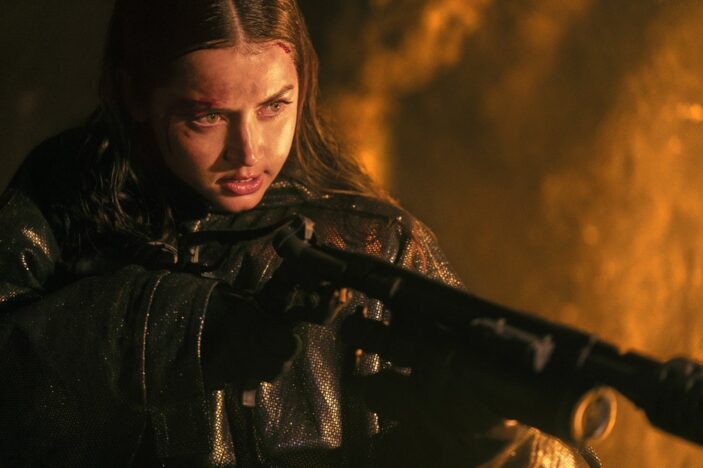
In regards to de Armas, she’s fantastic as the titular moniker, effortlessly kicking, punching, shooting, flame-throwing and grenade-ing her way through two hours of violent choreography that speaks to her dedication as a genre performer; there’s so much of this film where it’s difficult to decipher where she ends and her stunt double begins. But such action can only take you so far, and as much fun as it is to see her completely dominate the field, the universe Ballerina has dropped itself into had more going for it than just spectacle.
The world building that screenwriter Derek Kolstad created with the original film, further encompassed by series director Chad Stahelski, opens itself up to a plethora of possibility, and there are moments where Hatten’s script (he earns sole writing credit here) flirts with such throughout Ballerina. It’s why we’re able to enjoy the presence of long-time series players Ian McShane and the late Lance Reddick, why the Continental Hotel earns a brief showcase, and why Reeves agreed to come back – even if his appearance as Wick feels more like a glorified cameo and ties into the behind-the-scenes whispers that Wiseman’s original edit was looked upon as a “franchise killer.”
Originally packaged by Hatten as a standalone action flick about a female assassin that was going to heavily lean into graphic violence and nudity, his script was then picked up by the Wick family and seen as a potential to offshoot the Ballerina character that was briefly introduced in the third John Wick film, Parabellum; professional dancer Unity Phelan playing the role originally. After Promising Young Woman scribe Emerald Fennell was allegedly brought in for rewrites, and both Chloe Grace Moretz and Lady Gaga were considered for the role, de Armas secured her position as the film’s lead.
Whatever ultimately transcribed didn’t pan out, as word circulated that the original cut was a disaster, and Stahelski, not willing to let his series go down in such a savage manner, oversaw mass reshoots without Wiseman’s input. Given that Reeves’ appearance as Wick doesn’t feel altogether organic and is relegated to the back-end of the film, alongside a mass action sequence that feels far more Stahelski coded, it doesn’t seem far fetched that Ballerina‘s finale is his work. If he truly saved the film is another question as we don’t know what Wiseman was originally going for, but it never feels too jarring in tonal shift for the uninitiated who are simply going to enjoy de Armas on a violent rampage in her quest of revenge.
Yes, as to be expected, Ballerina is a revenge-driven movie, but there’s so much fighting going on that you’d be forgiven for forgetting what started the whole ordeal in the first place; it all stems from de Armas’s character, Eve, witnessing the death of her father at a young age by an underworld crew of sorts, and she devotes the years in between to being trained as a perfect assassin. “Fight like a girl,” is the advice she’s given, and, indeed, she puts her skills to good use, leading to her handler, The Director (Anjelica Huston, another John Wick familiar returning), promoting her from the ranks of ballerina to full-fledged killer.
The irony is that The Director doesn’t advise Eve to go after those that murdered her father, but she doesn’t take kindly to such rules and sets out on a killing spree to find who’s responsible, leading her to The Chancellor (Gabriel Byrne) and his literal town of goons. Eve breaking protocol means The Director has to call in Wick, but given that we already know Wick’s line of thinking from his own films, we’re unsurprised that he confronts Eve without cocking any trigger.
Given the high bar set by the John Wick films, it was always going to be something of an uphill battle for Ballerina, and it’s ultimately best viewed on its own accord. And on said accord it’s enjoyable, violent escapism that finds a certain savage glee in letting de Armas loose, flexing her extremely capable action muscle in the process. She’s ultimately why Ballerina is as watchable as it is, and if you’re willing to separate Wick-level expectation from this film’s reality, you’ll enjoy the ride that much more.


THREE STARS (OUT OF FIVE)
From the World of John Wick: Ballerina is now screening in Australian theatres, before opening in the United States on June 6th.
