


Going into last weekend’s Coachella (the first of its two planned weekend events), it seemed that Lady Gaga was inevitably going to steal all the expected focus. And, certainly, the Grammy-winner did the most, with a near-20 song set that largely celebrated her new album (Mayhem), but served as a memory lane stroll for her legion of fans, with the likes of “Bad Romance”, “Shallow”, “Paparazzi” and “Born This Way” peppered throughout. It was a suitable slay (as the kids call it), and certainly played into the hype surrounding her latest tour; with tickets for her Australian leg going on sale not long after the Coachella festivities.
All that being said, as much as Gaga’s superstar status remains intact, there was another pop power player – a “Rockstar“, even – who absolutely demolished the stage in a manner that her loyal fans expected, but the largely uninitiated general population weren’t. To many she’s one quarter of the top-selling K-pop group Blackpink. To others, she’s become known as Mook from the most recent season of The White Lotus. Now, to all, she’s Lisa – a bona fide headliner and stage stealer who, in one show, has solidified herself as a music mainstay.
Whilst two of Lisa’s Blackpink cohorts, Jennie and Rosé, have arguably had greater success on paper in recent years – the former, also a performer at Coachella this year, has held the number one position for the past three years as being the most streamed female K-pop soloist in America, whilst the latter has achieved major accolades with the release of her single “Apt.”, which became the second-fastest song in history to cross a billion streams (coincidentally behind Gaga’s “Die with a Smile”, a collaboration with Bruno Mars, who was a feature on “Apt.”) – Lisa made an impact that transcends sales and stats.
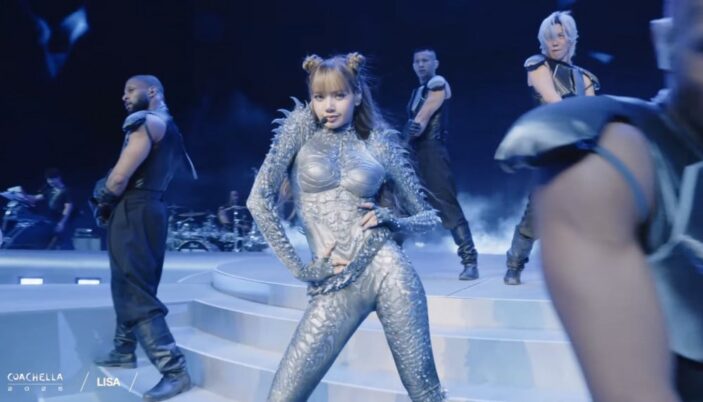
For starters, her stage – the Sahara stage – isn’t considered a main stage. It’s often hosted major electronic acts, and it has grown significantly in the last few years, being catered in a way that allows a wider field of views for attendees, but with 100,000 people fixated on the Thai entertainer (Coachella itself usually houses 125,000 people in total), she effortlessly silenced any of her critics that threw around the chronically-online phrase that is “industry plant”; an undermining term that largely started when Lisa appeared on the cover of Vanity Fair’s Hollywood issue alongside the likes of Nicole Kidman, Glen Powell and Zendaya. At the time of its issuing, the third season of The White Lotus, in which Lisa (credited by her full name, Lalisa Manobal) appears as resort employee Mook, hadn’t aired, and many questioned just who she was and why she was rubbing shoulders with actors who are far more well known – at least in the US.
Much like the way in which her album detractors had to eat their words following her Coachella set, Lisa’s Vanity Fair spread was all forward thinking and part of a much larger play she was wise enough to strategically orchestrate. Sure, even her appearance in the widely acclaimed third season of the HBO black comedy resulted in little of impact – her character didn’t have brotherly incest, a tragic love story or Parker Posey’s viral cadence to keep her ahead of the curve – but the show’s success and herself turning in a fine performance meant it’s only a further feather in a multi-hyphenate cap.
As for that aforementioned album, Alter Ego (released in February this year), whilst it managed numerous Top 10 placings across the globe (in the US it debuted at #7 with first week sales of 45,000, whilst it managed a #5 position in Australia), some reviews saw the product as being “neutered” by letting her guest collaborations steal her spotlight (“Born Again“, arguably the album’s most acclaimed track, features Doja Cat and Raye, who very much make their presence felt on the disco-tinged outing) and that it lacked a certain personality when looking at the singer’s identity as a whole.
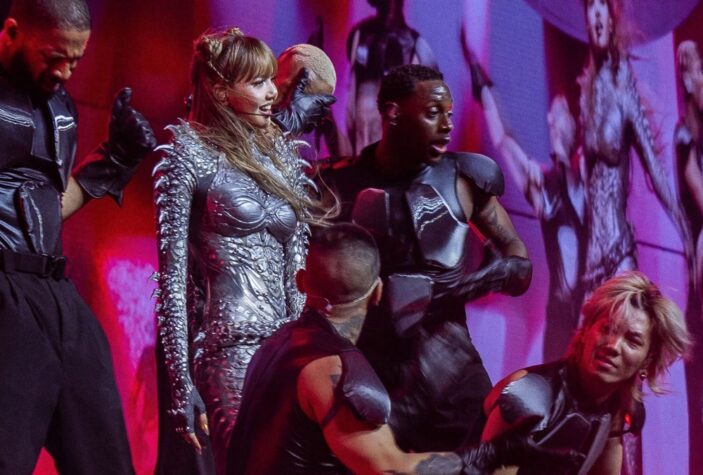
But on her Coachella stage, Lisa’s Alter Ego concept came full circle. This was the artist on full display, and if you knew her game or not, she absolutely obliterated expectation with a presence often reserved for performers seemingly far more experienced in the industry. It was quite telling that during the opening number (“Thunder“) she and her dancers arrived on stage chained. By the time she moved on to the follow-up (the decidedly aggressive rap track “Fxck Up The World“), they were unshackled. Lisa was no longer “Blackpink’s Lisa”, but a full fledged soloist with an artistic vision and a musical story to be told through methodical chapters that embraced a series of conceptual characters the album embraced; Roxi, the Rockstar, Sunni, a free spirit, Kiki, an internet lover with a Y2K aesthetic, Speedi, who’s built for the rush of life, and Vixi, the villain of her created characters. Who’s lacking personality now?
Then there was the vocals. Lisa’s vocal ability has often come under scrutiny, and, admittedly, she’s made it an easy criticism to be thrown her way with some questionably lip-synched performances in the past. That being said, as a predominant rapper, singing has been a bit more of a foreign concept for her, and she’s so often downplayed her ability. Whilst the Coachella set was aided by a backing track, and she would often stop singing to either catch her breath or focus on the intricate choreography, the mic was very much on. Sure, her voice may not be the most unique, but the manner in which she took ownership of her instrument is impressive, with the slower moments of album ballad “Dream” truly encapsulating why she’s as captivating a performer as she is. Anyone can just sing a song. It takes a true artist to make their audience connect with it. And as she lit up the stage – her outfit literally doing so – Lisa singlehandedly owned such a status.
Alter Ego is available now through Lloud and RCA Records. Lisa will be performing at this weekend’s second planned set for Coachella on April 18th, 2025.
