

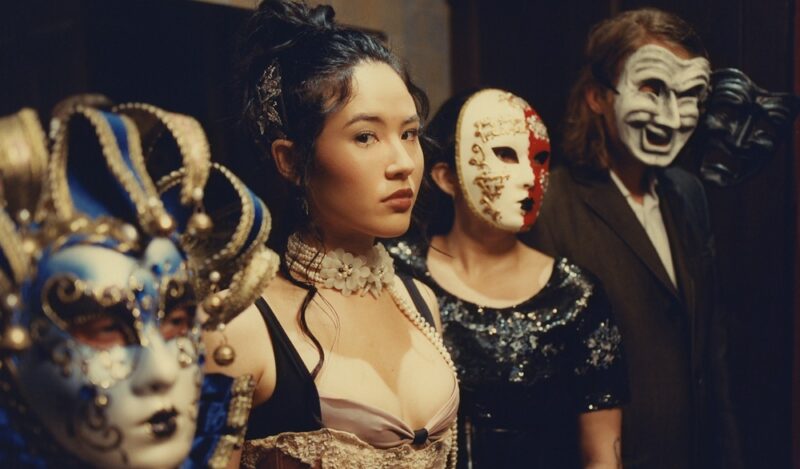
TikTok may have introduced the world to Emei through the irresistible hooks of “Late to the Party” and “Scatterbrain,” but Night at the Opera reveals an artist far more interested in emotional honesty than algorithmic moments. The EP marks a conscious return to her musical theatre roots, embracing melodrama, humour and heartbreak in equal measure while asking a surprisingly complex question: who gets to be the hero of your own story?
Fresh from joining Warner Music APAC’s inaugural Listen Up artist accelerator program and performing in Sydney, Emei spoke with our Peter Gray about treating the EP as a “villain’s hero journey,” finding catharsis through songwriting, resisting the pressure to overshare, and why the most authentic version of herself turned out to be Emily – not the pop alter ego she thought she had to become. The result is a conversation as funny as it is deeply reflective, exploring grief, identity, performance and the freedom that comes from sounding like nobody but yourself.
I wanted to ask about Night at the Opera as a concept, because I know that you’ve described it as returning to your “theatre kid” roots. Throughout the EP it feels like you’re constantly asking whether you’re the protagonist, the villain, or the comic relief. Has writing these songs changed which role you play in your own life?
Whoa! What a great question. Nobody’s ever asked something like that. I’m shocked. When I was making the project, I remember doing a lot of it with Ricky Reed, and he asked me who the protagonist was. That became a really big thing that we discussed, and for a while I wasn’t sure. I think it’s because, when I first started writing the project, I was actually the antagonist. I’ve come to think of it as a bit of a villain’s hero journey – that’s how I’ve kind of treated it. Through writing it, I think I’ve gained a lot more empathy for myself and for what I was going through. It’s weird talking about yourself like that, but I think it helped me understand myself and going through a hard time a lot better.
The opening track starts with, “Am I cursed?” By the end you’re almost directing the audience, because you say, “If you like act one, you’re gonna love act two.” Was that shift intentional? Is this EP really about reclaiming authorship on your own story?
I think so. All I knew was that this EP is not talking about a whole thing in full. It’s definitely touching upon a surface. There’s a lot more to be squeezed out of this.
I feel like musical theatre teaches performers to make huge emotions feel beautiful, and pop music usually asks artists to make them relatable. Did making this record ever make you feel like those two instincts were competing with each other?
For sure. I think even with “Simple Request,” which is the last song on the project, it’s definitely different from my normal stuff because I didn’t write it in a way that was like, ‘Let me explain this exact feeling to you. Here’s the storyline, and here’s this, and let me show you something you can relate to.’ Instead, I feel like it just captured a feeling. I used art to capture that moment, and I think that’s actually more theatrical in a weird way, even though it’s probably my least, quote unquote, ‘theatery’ song. But it really was the merging of those two worlds the entire time I was writing the project.
The title “Night at the Opera” has this very glamorousness about it. But inside the songs there’s grief and revenge and anxiety and heartbreak. If someone walked into your opera, what emotion do you actually hope they leave humming?
Ooh, I just feel like, with the project… okay, I’ve always felt that when I go into a theatre production, the biggest thing I take away from my favourite ones is this sense that something cathartic has happened. I feel like I’ve seen my own emotions reflected on stage, and by experiencing the storyline, or crying because of the characters, you kind of work through your own emotions too.
Then you leave feeling like there’s a little less pressure on your shoulders. I think that’s what I’d love listeners to feel when they listen to my music. These songs are journal entries – they’re about my life – but I hope people can hear them and experience that same kind of release too.
Looking at that idea of performing pain, there’s the line – “I hope my suffering will sell some tickets in the mezzanine.” It’s a funny line, but it’s also a very biting observation about modern artists. Do you ever catch yourself wondering where the line is between processing your life and then packaging it?
Oh, for sure. Honestly, I feel like it’s been the conversation of the year for me. I only signed this year, and that’s been very different from being an independent artist. There are a lot more opinions now, a lot more mentors, and all these different voices, you know? A big part of it has been thinking, ‘Okay, I want to be the best artist I can be,’ and that means putting parts of my life on display, diving into my emotions, and doing all those things. But at the same time, I have to protect my life – my personal life. I’m still a private person in the world, right?
So I’ve been trying to find that balance, especially with these songs. This project really begins that process of asking myself, ‘How deep do I want to go? How vulnerable am I willing to be? And how vulnerable do I actually need to be?’ Because I don’t necessarily think you have to put every single detail of your life out there to be the best artist possible, you know?
I feel like social media rewards oversharing, streaming rewards vulnerability, and then audiences want authenticity. Do you ever feel pressure to stay emotionally wounded because wounded artists tend to get listened to more?
For sure. I mean, the problem is that when I’m at my saddest, I tend to write more because I have all these emotions that I need to get out somehow, and that’s the best way for me to do it. So there is this tempting element of never really healing – of thinking, ‘Oh, I’m upset. Maybe I should stay in this feeling and ruminate for as long as I can.’ But I think this past year I’ve also learned that I can’t do my best work when I’m struggling mentally. I can’t show up for my fans in the same way. I can’t put on the best show, and there are a lot of things I just can’t do when I’m in that darker mental space.
So, all that is to say, I think it’s really important to be okay as a human first. There’s this whole idea of the ‘suffering artist,’ and I think there’s some truth to it sometimes – but not all the time. We shouldn’t romanticise suffering or act like it’s a requirement for making great art.
One of the EP’s really great lines is, “My therapist went on maternity leave so I’m out here raw-dogging life.” It’s amazing…
(Laughs) Facts, just facts.
It’s funny, but it immediately opens into genuine grief. How do you know when you found that balance when the joke earns the emotion instead of distracting from it?
I’ve actually been thinking about this a lot. It’s funny because it’s so timely. Right before I came to Australia, I had a bunch of writing sessions where I was trying to figure out how to sound like myself. I’ve been trying to figure out how to talk about serious things and be vulnerable while still sounding like me, because I think that’s really hard. It’s hard to be lighthearted and funny, and then balance that with really serious emotions. I struggle with it all the time in my music.
What I’ve noticed is that it works best when I’m just completely honest – honest in the sense that I’m literally saying whatever naturally comes out of my mouth. Like, completely unfiltered. I remember in one session I was crying and talking about grief and all these genuinely horrific, sad feelings I was having, and then I just blurted out, ‘Yeah, now I’m just raw-dogging it.’ I think I literally said, ‘I’m out here raw-dogging it.’ That’s just how I talk. And I realised that’s how I balance it – you talk about really real things, but you say them in a way that still sounds like you.
And you sing, “R.I.P. Miss Innocence,” and it made me wonder if you think innocence is actually something we lose forever? Or does it just come back looking different as we get older?
Whoa, that’s a really good question. It’s so existential.
I think we have a lot of different kinds of innocence. That’s probably how I’d answer it. We lose certain parts of it in different areas of our lives through different experiences.
For me, when I wrote that line, it was really about grief. I don’t think I truly understood what grief felt like until last year. I mean, I could always imagine losing people and think, ‘Of course that’s sad.’ I lost my grandpa when I was much younger, and I was sad. I cried. It was heartbreaking. But last year was the first time I felt like, ‘Whoa.’
It felt like I’d lost this belief that everything was always going to be okay – that you’d love people, they’d leave, and somehow everything would work out. That belief was just gone. Instead, it became this realisation of, ‘Oh my God, you love people… and then they leave.’ It felt like this huge veil had been lifted, and that was the innocence I lost. I don’t think I’m ever going to get that particular part back.
But at the same time, I don’t know, because I think there are other kinds of innocence that you can gain. My sister just had her second child, and I feel like when you have kids, there’s this innocence that comes back through them. You’re suddenly looking at the world differently again. Life has all these different cycles, you know?
With the song “Bloom,” you ask the haunting question of “Who is she?” Was that song written about becoming someone new? Or grieving someone you used to be?
I think it’s more about grieving the person I used to be than becoming someone new. I actually feel like that part is happening now. During that time, though, I hadn’t reached the next chapter yet. It felt like I’d lost who I was before my grandma passed away, and after that I just… didn’t know who I was anymore. It was a really strange feeling. I remember looking at photos of myself when I was writing “Bloom,” and thinking, ‘I don’t know where that brightness in my eyes went.’ It felt like it had disappeared because I was just so sad.
(That song) was written during that period when I genuinely wondered, ‘Am I ever going to stop feeling this sad?’ Thankfully, I am less sad now – which is great. It took a while, but I got there. At the time, though, it wasn’t just losing my grandma. I also lost some very close friendships. There was just so much loss all at once. It was incredibly intense. So, yeah… that’s what that song is about.
There’s the lyrics, “My eyes had light before the battery died,” and it feels like a very visual line. When you’re writing songs, do you hear melodies first, or do you see scenes playing out like little movies?
It totally depends on the song, to be honest. With “Bloom,” the melody and the lyrics kind of came together. They were written at the same time, and then we edited them quite a bit afterwards. But the ‘battery’ line was there from the very beginning. I think it came with the melody – it was one of the original ideas, and it was just genuinely how I felt.
That’s another example of me just talking. I’m a big talker, you know? I was just talking and talking about how I felt and trying to describe those emotions. I think I literally said something like, ‘It felt like the batteries died.’ I don’t even know – I was just trying to explain that there had been this light inside me, and then… it just went out.
I hope you don’t mind me going through the songs…
No, please.
With “Noah,” one of the reasons it works so well is because it never turns the other woman into the enemy. It’s almost a rescue mission. Was it important to you that the villain wasn’t another woman, but the behaviour itself?
Yes, for sure. Fun fact: the original version of “Noah” wasn’t “Noah“ at all. It was about warning another woman. It was the same basic concept, but it made the other girl more of a villain. That was the original version, and I just remember thinking, ‘I don’t like this.’ There was something about it that didn’t sit right with me. I was like, ‘This feels wrong. It doesn’t align with how I actually feel.’ So we completely reworked it. It was honestly a 180 – so much of the song changed. The version it became feels much more accurate to how I actually feel about Noah.
I feel like the internet has created a new shared vocabulary around love bombing, gaslighting, and manipulation. Do you think songs like “Noah” can kind of only exist now because audiences have become more emotionally literate?
For sure. And that’s the thing – my songs are really just a lot of the words that come out of my mouth. Take the ‘love bombing’ element, for example. That’s only there because I’m consuming social media. I’m on the internet. I’m part of that world, right? So I’m naturally influenced by what I’m seeing and the environment I’m living in. That inevitably finds its way into my writing, and that’s a really big part of it, you know?
You mentioned “Simple Request.” I feel like after all the highs and emotional chaos of the EP, that song feels almost surprisingly quiet. Did writing it teach you that intimacy isn’t necessarily about saying more; it can actually be about asking for less?
Whoa! (That) was one of those songs where there was basically no thinking involved. It was just… yeah, it was a crazy session. Nate Mercereau produced it. He’s this really interesting guy – a total genius, just incredibly musical. I don’t even know how to describe him. He’s just… different.
I went into the session, sat down with him, and at first I was thinking, ‘Oh man, this isn’t going well. I don’t really know how to talk to him. This is kind of awkward.’ So I ended up writing the song in one corner of the room while he was in the other corner, playing instruments and doing his thing. I was writing the topline, he was making music, and we barely spoke to each other.
A few hours went by, and I remember thinking, ‘Oh my God, we’ve hardly even talked. This is so awkward.’ Then we came together, and he said, ‘Okay, I guess just record what you’ve got into the mic.’ I was like, ‘Okay.’
I recorded it – it was literally the first take. I was sitting on the floor, using a pretty basic microphone. It wasn’t some fancy setup or anything. Then we listened back, and we both just looked at each other like, ‘What just happened?’ We were both completely shocked. We were like, ‘This is awesome. I don’t know how that happened.’ It felt like the song had just hatched on its own. We didn’t overthink it. It was purely the emotion, the tension, and the feeling in the room that created it. I love that song. It’s such a weird one.
I wanted to ask about identity, because your earlier songs introduced people to Emei, the witty pop writer. This EP almost feels like introducing Emily again. Did making this record blur the line between the performer and the person? Or did it separate them even more?
I definitely leaned into Emily more, and I think that was really important to me on this project. That was a big part of the theatre influence, too. When I first started making pop music, it almost felt like I had an alter ego. I wanted to be cool. I was like, ‘Ooh, let me whisper into the mic,’ and I cared a lot about creating that image.
But I think because of everything I was going through, it felt like that veil disappeared. I just didn’t have the energy – or even the desire – to overthink it anymore. Ricky Reed was also a huge part of that shift. He kept saying, ‘You can sing. Why aren’t you singing?’ That was a big thing for him. He’d say, ‘We’ve got to write songs that are actually hard to sing. You have to really sing them.’ That was a huge influence on me.
I also learned a lot from my manager, Steve, whom I love and honestly couldn’t do any of this without. He’s always been such an important guide in my music. The biggest question he asks whenever he hears a song is, ‘Does this sound like Emily? Does it sound like you? Does it sound like it came out of your mouth?’ That’s how we know whether it’s something worth pursuing. Because if it doesn’t sound like me, then what are we doing?
You’re here for the Listen Up showcase, and it’s very much built around artists who can connect globally. Your songs are very specific, but they resonate everywhere. Do you think specificity has become pop music’s universal language?
I think so. I really do. Because I think, with music, everything has been said a million times. Every emotion has been written about from every possible angle. So I think the only way to make songs that feel new, unique, or refreshing is to say those things in your own way, because nobody else can say them the way you can. You know what I mean? That’s really how I’ve come to think about it.
And industry showcases can sometimes feel like everyone is trying to prove they’re the next big thing. Coming from theatre where collaboration is everything, do you approach those rooms differently as an artist now?
My main thing is that my band and I have to be having the time of our lives. If we’re having a blast, then the room will have a blast too. It honestly doesn’t matter who’s in the audience. If we feel off – if we’re nervous or anxious or whatever – the audience can sense it. That’s always been a really big thing for me.
My band and I have been playing together since the very beginning, since my very first show, and I never really want to change that. I want to be on stage feeling as comfortable and as much like myself as possible. We have so much fun together, and that’s everything to me. So, yeah, I don’t really care who’s in the audience because it’s going to be fun no matter what. If you give me a stage, I’m all set. I’m good.
And just before letting you go, and I want to thank you so much for chatting with me, but throughout this EP you’ve turned your worst experiences into performances. Almost like something painful can become a song because then it can’t defeat you. I’m curious, has there ever been an experience that was so personal where you thought, “This doesn’t belong on a stage,” and what convinced you to let audiences in anyway?
Are you a psychic? (Laughs) What’s going on? I feel like you’ve asked so many questions where I’m like, ‘I was literally just talking about this last month.’ But to answer your question – yes. I’ve definitely written songs that I don’t think are meant to be public.
That’s actually been a big conversation for me lately. It’s been difficult because, as an artist, my instinct is to think, ‘Well, if I’ve made something incredible, I should share it, right?’ But I don’t necessarily think that’s true anymore. I don’t think I owe everything to the world. I think I have to do what’s authentic to me. And to end on that, if something doesn’t feel aligned with my values or doesn’t feel right to share, then I won’t – even if I think it’s a really good piece of art.
Night at the Opera is available now through Warner Music Australia.
