

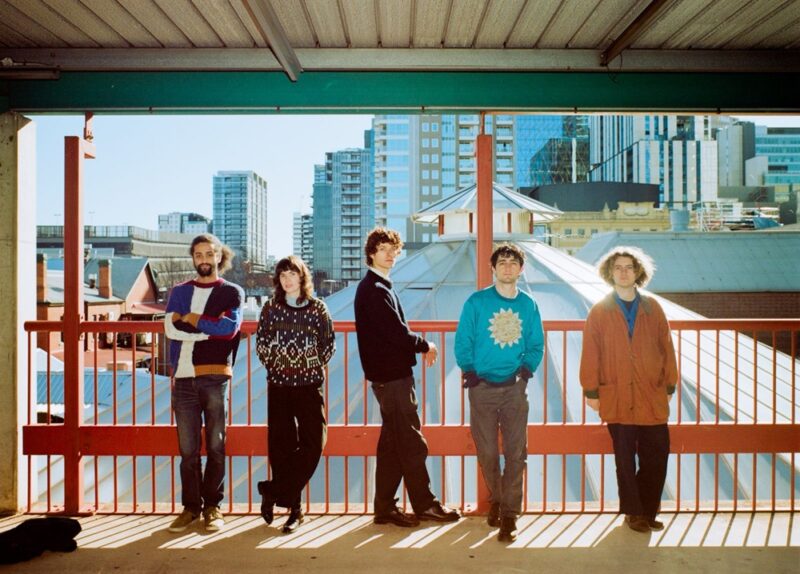
At a time when music is increasingly defined by algorithms, immaculate production and digital precision, Any Young Mechanic have arrived with something refreshingly human. The Tarntanya/Adelaide five-piece have quietly built a reputation as one of Australia’s most exciting new acts through captivating live performances and richly textured songwriting, culminating in their remarkable debut album, The Modern Shoe Is Ruining The Foot.
Recorded live without edits, the album embraces the beauty of imperfection, allowing every instinct, interaction and musical conversation between the five members to breathe. It’s a record that feels both timeless and unmistakably of this moment, balancing intricate folk traditions with contemporary ideas about community, technology and what it means to make art together.
To coincide with the album’s release, Peter Gray caught up with the band to discuss making “folk music for now”, why imperfections matter more than ever, the stories hidden inside everyday objects, and how creating music together can be a quiet act of resistance in an increasingly polished world.
I wanted to open this question to all of you because I know that you have all described yourselves as making folk music “for now,” and that feels like a very deliberate definition. If somebody hears this record in 20 years, what do you hope feels timeless about it, and what do you actually hope feels quite dated?
Jay Eliot Mee: Ooh, that’s a good question.
Luka Kilgariff: It’s a two-pronged answer. The first answer would be that, aesthetically, it’s calling back to music of the 60s and 70s. Probably in 20 years time, it’ll still ring true as not prestige, per se, but definitely being inspired sonically by music from a long time ago. I think the issues that it’s dealing with lyrically, and then by extension how the music supports very much the times that we’re living in currently. I think that it’s reflecting back on time. That those issues will be the lyrical subject of reflecting the time we’re living in. Maybe it’ll still be relevant to whatever is happening in 20 years’ time.
Sam Wilson: I guess my short answer would be that I hope in 20 years, people relate to it less. If people listen to the record and go, “They seemed really concerned about this stuff, and it ended up working out. So that’s good.” But I don’t have high hopes.
And looking at the album title, because The Modern Show is Ruining the Foot is a very evocative title, because it suggests that instead of adapting the world to people, we’ve started adapting people to the world. What is the “shoe” on this record? Is it technology, capitalism, ambition, or is it something more personal?
Sam Wilson: Kind of all of those things. And then there’s also the personal element. I think we like to talk about the record, I don’t know if vaguely is the right word, but we talk about it in quite broad terms as to what it’s trying to achieve thematically. But the reality is, nobody writes songs thematically. I’m not going home and saying, “Okay, I’m going to write something with these themes and be really prescriptive.” I’m going to write about myself or something that I’m experiencing, and then hopefully draw more universal themes out of that experience. I think you pretty much seem to already know it’s personal and political.
Jay Eliot Mee: A lot of people are getting hung up on footwear (laughs). That’s great, but it’s not about footwear.
Sam, you’ve said that you’re going to need to make more mistakes in music because it might be the only signifier somebody actually made it. Do you worry that we’re reaching a point where audiences won’t actually value humanity and they’ll just value polish instead?
Sam Wilson: I think we’ve already lost those people. There are audiences that only care about that stuff. I definitely know people who listen to music that way. But I don’t think we’re in danger of losing anybody that we haven’t already lost. I think we’re definitely seeing people who are getting disillusioned with how clean things sound, or, you know, the fact that you can’t distinguish certain mainstream sounds from what AI is relatively good at duplicating. They’re looking for something that feels more humanistic, something that you can experience in person that actually feels like it’s happening in the moment. I think more people will veer towards that than the opposite.
Thea Martin: I hope young people get more and more opportunities to go to shows because I worry that, for a lot of teenagers, their first experience of live music is just hearing a 30-second audio snippet that’s become popular on their phone. Obviously, sometimes that still works. I think Alex G has had that strange experience of going viral through snippets of his songs, so there are a lot of new faces at his shows. But then he puts on a fantastic live performance, and I’m sure those young people walk away thinking, ‘Wow, shows can be like this. This is what live music should be like.’ So I really hope we keep giving young people opportunities to experience live music. Because once you’re in a room watching a band or an artist perform, we all know what live music does for people and how it makes them feel. I don’t think that’ll ever change.
Absolutely. Looking at collaboration, because listening to the record it never feels like there’s one person leading and everyone else accompanying. At what point did you stop thinking of yourselves as five musicians playing songs and start thinking of yourselves as one instrument together?
Luka Kilgariff: I think we’re still figuring it out. I think the process has definitely changed from when this album was recorded, and we’ve got another one recorded in the bank. We’re still working on new stuff, and I think we’re still figuring out and trying new things to come together as a collective.
Thea Martin: I’ve said this a few times, but I keep comparing the rehearsal process to chamber music, which I grew up playing. I think I naturally went into that mindset because of the instruments we used on this record. I’m used to playing those acoustic textures and thinking about my role in terms of, “How can I best support everything else that’s happening?”
That felt really comfortable to me, and it became the goal going in – making something that felt cohesive and had that chamber music approach, where everyone’s parts support each other and contribute to a bigger picture. It’s about not playing constantly, bringing parts in gradually, taking them out gradually. That all felt really intuitive to me, and it seemed to serve the songs well. Sam brought the songs to us, and then we built on them together.
I also think we’ve become more and more collaborative as a band. We’re genuinely interested in each other musically and in what each person has to offer. We talk about trust a lot – really trusting each other as musicians and leaning into that wherever possible. That’s honestly the coolest part about making music. It’s not that much fun to only be interested in what you’re doing as an individual. It’s so much more rewarding to be invested in what everyone else is doing.
As you said, you’re getting a lot of comments on footwear for the album title, but across songs like “Snug Barber” and “I Never Met An Engine…” there are constant images of ordinary objects. There’s razors and bins and cups and trains…why were you drawn to objects instead of emotions? Is that something you found in writing your music?
Sam Wilson: Yeah, I think I’m quite oriented towards objects. I collect a lot of things – records and DVDs in particular – and objects have always been a big part of how I remember things. Songs are kind of like memories too, so there’s definitely an element of putting objects that are significant to me, or that were significant when I was experiencing something, into the songs. They’re almost like set dressing, or part of the mise en scène.
But I also wanted those domestic details to feel politically important. Living in Adelaide, one of the things you really notice is how many people’s goals are centred around domestic life. It’s often about buying a house, furnishing it, and the choices that come with that. To some degree, those decisions end up defining a lot of people’s lives there. I was seeing a lot of that around me and wanted to examine that process in my own way, because I’m not particularly drawn to the traditional structure of buying a house and settling down.
Thea Martin: Useful context, but Sam grew it up in Tokyo, so then coming to Adelaide and experiencing that suburbia for the first time and kind of experiencing it as an observer…I think it gave (him) an interesting lens to see it from a slightly distanced perspective.
One of the lyrics that stood out was, “These aren’t walls at all, they’re painted over windows.” It feels like it could almost be the thesis statement of the album. Were you consciously writing about hidden possibilities? Or did that image reveal itself afterwards?
Sam Wilson: I think…ooh, that’s a good question
Thea Martin: That’s nice. I also feel that way, actually. That’s a nice observation.
Sam Wilson: Yeah, I guess I tied that into it being a thesis statement for the rest of the record. I guess part of the reason is that they are these little moments of cohesion.
I feel like one thing about the writing here is that there’s something heartbreaking, but then it’s almost undercut with a joke. Do you trust people who never laugh?
Sam Wilson: I guess the intention is to be sincere, but also realise that a lot of funny things are truthful, or that you can’t just shy away from humour in certain situations. Real things feel surreal or unusual, and that usually makes you feel kind of funny.
I have an individual question for Jay, because I know you’ve said that you wanted to rethink the drum kit because everyone else was repurposing traditional instruments. When you’re writing drum parts, are you thinking rhythmically or almost orchestrally?
Jay Eliot Mee: For me, I’m always thinking about the song. I think a lot of drummers have a big YouTube presence because they’re often a little bit limited by what’s put in front of them, but I’ve only ever really wanted to play drums on songs that are good and have the drums feed into what the melody is doing. If I can, I even think about the lyrics, because that’s really what I’m responding to.
If Sam came in and said, “We’re doing pots and pans on this record,” I’d be like, “Okay,” because it’s whatever you’ve got in front of you. The drum kit is this cliché that’s evolved because it’s so versatile, but I think the important thing is to always be responding – to listen more than you play, and react to what’s happening in the song.
When I’m writing a drum part, I’m always asking, “How can I make this interesting in a way that supports what the song is trying to do?” If the song is trying to say something or achieve a certain structure, and those intentions are clear to me, then I just try to reflect that as creatively and as melodically as I can, whether I’m playing a drum kit, a barrel, a tambourine, or whatever happens to be put in front of me.
And Luka, I know that you’ve said about learning banjo as a student rather than treating it like another guitar. Is curiosity actually more valuable than mastery once you’re in a band like this?
Luka Kilgariff: Oh yeah, absolutely. Some of the greatest musical experiences of my life – the most euphoric moments – have been the ones where you feel completely out of control of what you’re doing. It’s all about experimenting and seeing what comes out in a really fluid, in-the-moment way.
The banjo was a good example of that. I felt comfortable playing guitar because I’d been doing it for a long time, but I didn’t want to be pig-headed and treat the banjo like it was just another guitar. It has its own language and its own way of being played. I still don’t think I play it particularly well, but I tried to surrender myself to the instrument rather than approach it naively or arrogantly.
That mindset ended up being really helpful. It also let me focus more on what everyone else was doing instead of thinking, ‘I’m going to rip this amazing banjo solo.’ It became much more about serving the music than showing off what I could do.
And Allan, you’ve described bass players as naturally absurd people, and it made me think of comedy in music. Not necessarily comedy songs, but do you feel musicians understand timing, surprise, and relief in the same way that comedians do?
Allan McBean: Oh, definitely. I actually think that’s some of the hardest stuff to do in music – to imbue it with a sense of comedy, or the kind of timing you get from a great comedian. Embedding that within music is incredibly difficult, and I think it’s a really noble goal. There are only a handful of artists I can think of who do it really, really well.
That comment was probably made a bit flippantly, but the philosophy behind it is that expressing a comedic idea is just as legitimate as expressing any other idea. Like Sam was saying before, things are funny and absurd, and that’s a perfectly valid thing to explore through music. And, honestly, maybe it’s just a trend among bass players because the instrument itself is so cumbersome. It’s kind of hilarious. When you look at it, it almost feels ridiculous that someone has to operate this enormous thing to make music.
And Sam, you’ve said something that was fascinating. You’ve said that you couldn’t just sit down and write a certain arrangement. Has trusting other people’s instincts made you a better songwriter? Or has it made you less precious about songwriting altogether?
Sam Wilson: I think I feel more confident now. When I was a less experienced songwriter, I was probably a lot more controlling about arrangements because, subconsciously, I knew the songs maybe couldn’t stand on their own as well as they can now. At least, I hope they can.
A big part of it is also learning to trust the people you work with. With this band, it really feels like I’ve found the perfect group. Everyone is committed to playing their instrument in a way that interests them, while also responding thoughtfully to what I’m trying to achieve as a songwriter.
To tell the truth, it hasn’t really changed how I write because the writing itself still feels very personal. What has changed is how I present a song. I think I’m much more open with that process than I used to be. I hope that’s true, anyway, but it’s an interesting thing to think about.
Thea, you’ve spoken previously really quite beautifully about moving from classical performance into noise performance and then into this band. Do you think classical music trained you to pursue perfection, while this band taught you to pursue truth?
Thea Martin: To some extent, yes. Classical music was both a comfortable and an uncomfortable place for me growing up. The pursuit of perfection – or at least technical excellence – gave me a really strong sense of identity and a way of validating myself. I loved the discipline of classical music and the conventional teaching methods that have been part of it for so long.
At the same time, though, I don’t think I considered myself a creative person because of that upbringing. Those two ideas became quite detached. Allan and I have talked about this a few times, and a lot of my friends from classical music feel the same way. If you go into orchestral performance, it can almost become vocational – like a trade. You’re using a highly developed skill to serve music that already exists, whether that’s your own interpretation of it or, more often, the conductor’s interpretation. It’s incredibly rewarding in its own way, but it’s a very different kind of creativity from writing your own music.
It became less and less interesting to me as I got older. I also became really passionate about arts education and realised that the kind of education I was lucky enough to have – starting when I was three and asked my parents if I could learn the violin, even though no one in my family had played – just isn’t accessible to most people. It’s a fairly hierarchical and elitist model of arts education. That made me much more interested in the idea of giving young people agency, and in the belief that everyone can be creative and make things. In a lot of ways, playing in bands feels like an extension of that worldview.
I definitely never thought this is what I’d be doing with my life, and I couldn’t be more grateful that it has turned out this way. Over the last few years, being in this band has also given me the chance to play some really cathartic noise rock and post-rock, which completely reshaped my relationship with music and with my instrument. More recently, it’s been nice to focus really intensely on the technical side again, because I think that often serves the music better. It’s not about valuing one style over another – it’s just about the aesthetic goals of the band and asking what’s going to best serve the songs.
Listening to the record and hearing you all speak, it’s so comforting to know there are artists that play real instruments and real music. In a time when AI is becoming unfortunately more of a normal thing, which hurts as someone who loves music and film. Keep doing what you’re doing. It’s amazing. And just before I let you go, I know that you’ve all spoken about wanting to make something unmistakably human at a time like this. When people leave one of your shows, what do you hope that they’ve been reminded of about being a person and not just about the music?
Luka Kilgariff: They’ve probably seen us make a mistake on stage and then laugh at each other, and they think, “Oh, that’s cool.”
Jay Eliot Mee: For us, it really comes back to community. I know it’s almost become a buzzword, but it’s true. It’s about being able to make things together and also just hang out. That’s the joy of life, really – sharing experiences with other people. If polish in music ever starts to represent a lack of human connection, then I hope we can show the joy that comes from genuine human connection instead. If someone walks away from seeing five goofballs on stage who are trying their best to make something that’s sincere, thoughtful and good, and it reminds them to seek out or prioritise that kind of connection in their own life, then that’s a pretty worthwhile value system to put out into the world.
Luka Kilgariff: I will say, I felt like a major phony recently because people have come up to me after shows and been like, “You inspired me to play banjo.” I’m flattered, but I don’t really know…I’m just faking it as well. Maybe that’s what makes it so inspiring (laughs).
The Modern Shoe is Ruining the Foot is now available through 23 Recordings/Warner Records.
