

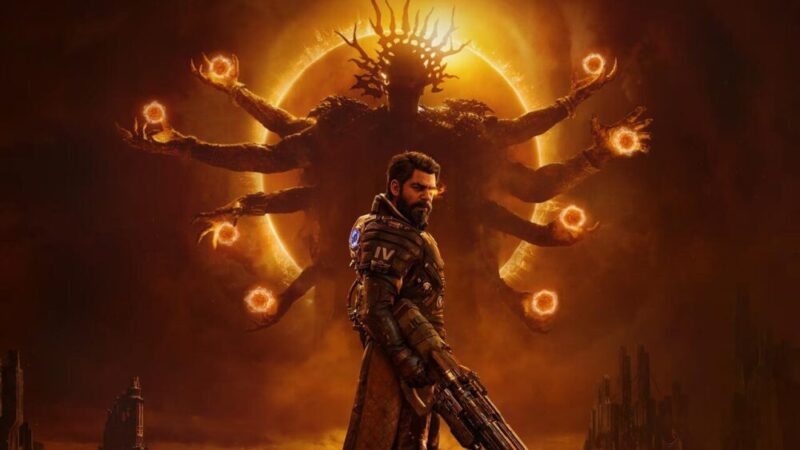
Developer Housemarque are back with Saros, a spiritual successor to Returnal, which still stands as one of the best roguelite games available on the PlayStation 5. In many ways, Saros is a strong follow-up to Returnal, one that’s filled with incredible combat, polished visuals and an addictive gameplay loop.
While Saros is its own experience, it’s clear that Housemarque have their target audience in mind, which makes this review feel a little more prompt and direct. If you liked Returnal, you’ll love Saros. If you didn’t, I feel as though most of those flaws or aspects that may have bugged you back then will do so again here.
Where Are We Again, Again?
Players assume the role of Arjun Devraj, portrayed by actor Rahul Kohli, who awakens on the planet with half the crew he came to the planet of Carcosa with. On a mission to find a missing colony on the planet, Arjun, a Soltari Enforcer, must not only unravel the mystery of the planet’s strange origins as he returns from the dead time and time again, but also peel back the layers of his own mysterious past, as not all is as it seems.
I don’t really want to spoil the story of Saros any more than that, for as ambiguous as it is, there’s a decent mystery to unpack here. It does admittedly lose a little steam towards the middle of the narrative, but it does a fine job at moving you along as you slowly uncover pieces of the story, that ultimatey feel less ambiguous as you progress.
The imagery, though, that presents itself in small flashes between deaths, is incredible. Shots of a particular eclipse, above a landscape marred in fire, are absolutely stunning, and somewhat unsettling.
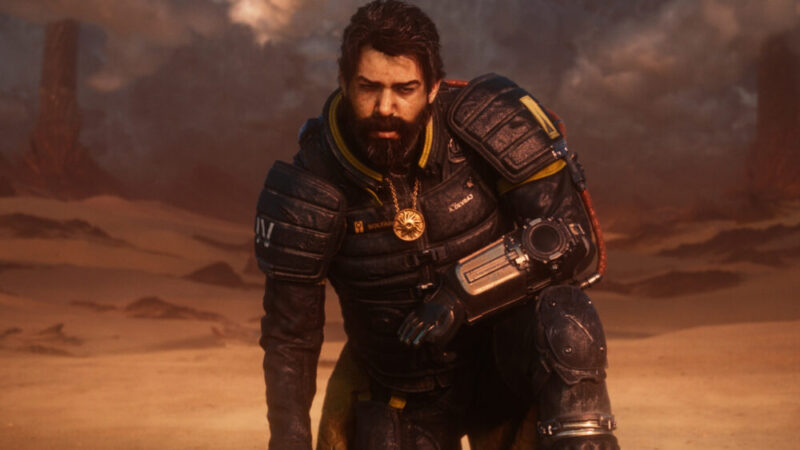
It’s ultimately a very personal tale, that while not as deep and mind-bending as Returnal is (seriously, go and play Returnal), it’s a fine story that kept me engaged throughout its 20-or-so-hour runtime.
Rahul Kohli also puts in a great performance as Arjun, one that’s met with confusion and anger, which soon turns to despair and grief. While the supporting characters you’ll come across are nowhere near as interesting, they thankfully never attempt to steal the limelight.
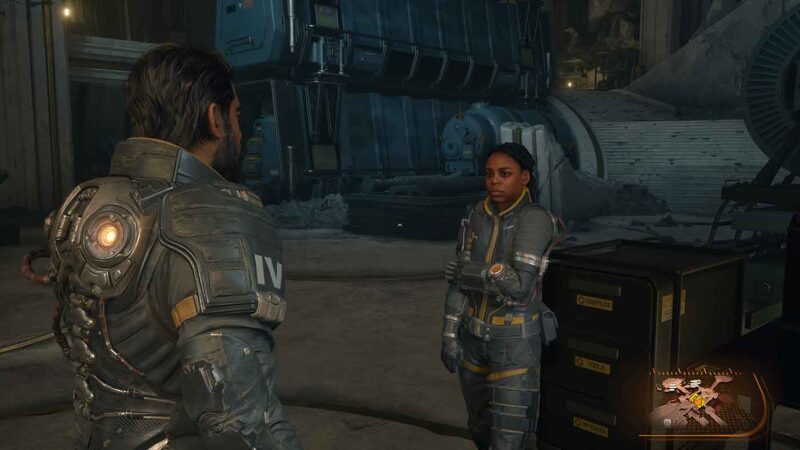
In hindsight, Saros presents a narrative that feels a little more linear in places than Returnal did, but I feel like it’s a serviceable attempt at justifying the amount of action and chaos on display here.
The Tools of the Trade
Much like Returnal, however, the real star of the show in Saros is the action. Gunplay is absolutely king here, and it’s an absolute testament to the good folks at Housemarque, who really know how to create a satisfying gameplay loop while balancing multiple mechanics and encounters.
Players will undoubtedly die multiple times in Saros, completing runs that can generally last anywhere between 15 and 45 minutes. Players will take on various enemy types on their way to bosses, progressing through and unlocking multiple environments as they play through the story. Certain aspects of levels are also randomly generated with each run, but ultimately lead to unchanged central areas, pivotal to either major conflicts or important story beats.
While this was a thing in Returnal, I felt as though levels were drastically altered, leading to new pathways to objectives, where in Saros, it only feels like a new front garden of a house, even if you’re walking up to the same porch.
That being said, Saros wastes no time in getting you to pull that trigger. And pull that trigger, you will. With a variety of weapons to find on your travels, including assault rifles, hand cannons and shotguns, Saros makes every encounter and weapon feel tight and responsive, blending a dance of movement and action that feels consistently satisfying.
Much like Returnal, weapons in Saros will have a primary and secondary fire, the latter of which can be accessed by pressing L2 on the Dualsense controller halfway down. The trigger locks slightly at this point, so you’ll never have issues with the mechanics of each weapon.
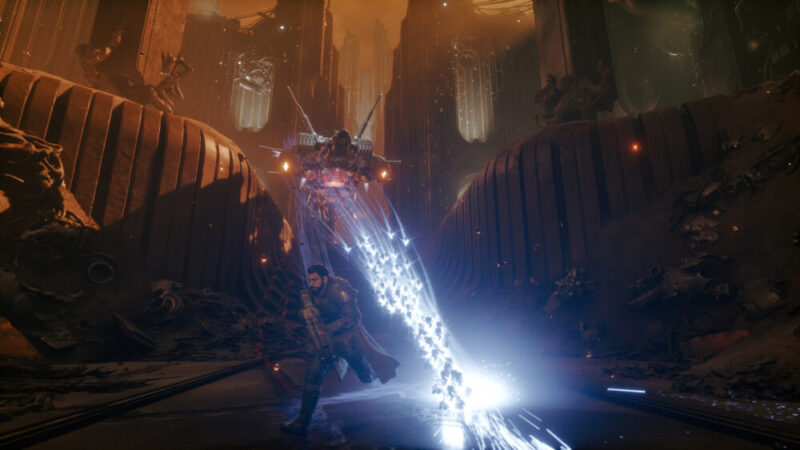
Holding down the L2 trigger fully, however, will grant you access to your power weapons, which are stronger internal abilities that Arjun can use with devastating effects when given the chance. These power weapons can be found and upgraded throughout each run. However, it’s worth noting that, like regular weapons, these power weapons are also randomly generated, which can at times really make or break your run.
Enemies will also drop a currency the game calls Lucenite when defeated, which can be used to purchase more permanent boosts and upgrades at the end of each run. There are also special items referred to as Halcyon that Arjun can collect to unlock further exclusive abilities.
There is a massive skill tree on offer here, but the abilities you unlock only buff you ever so slightly, so it’s important to be on the lookout for both Lucenite and Halcyon and upgrade your skills whenever possible, as this will help you push further through each run.
If that wasn’t enough, players can also collect Carcosan Modifiers during each run, which are also randomly generated. These modifiers will grant Arjun both positive and negative abilities, so it’s worth weighing up what to take and what to leave. Arjun can collect and equip multiple modifiers during any run, but it must be said, the balance here is absolutely paramount.
For as powerful as you may feel by collecting these, you can also feel equally vulnerable, which is a hard feeling to emulate.
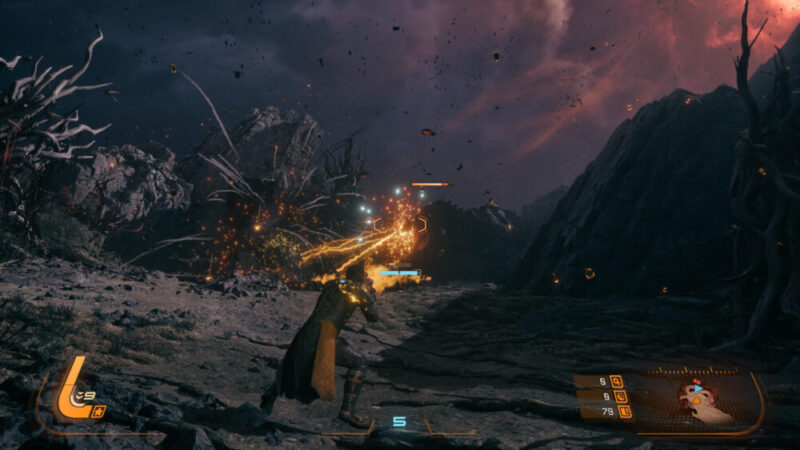
These modifiers will generally boost or impede one of three stats, including Resilience/Corruption, which manages how yellow projectiles from enemies corrupt Arjun’s suit and limit his maximum health levels, Drive, which determines how quickly Lucinite increases weapon effectiveness, and Command, which determines how much damage your shield can take.
Finally, Arjun will have access to two special abilities immediately, being the dash and shield, and these are generally the most important abilities you’ll use at any given moment throughout the game.
While the shield can be used to block certain enemy projectiles, the dash can be used throughout combat and traversal, with various light platforming sections throughout. Arjun will gain other abilities, like a Grapple and Parry, as he progresses, along with a devastating OverDrive ability that can clear out an entire room once available.
Combat is fast and furious, but I feel that, unlike Returnal, most encounters don’t feel as difficult. Instead, the game saves its difficulty spikes for its various boss battles. While these are consistently awesome, I found that I wasn’t nearly as held up as I was in Returnal, but that can obviously be a positive or negative factor, depending on how much you enjoyed Returnal’s difficulty.
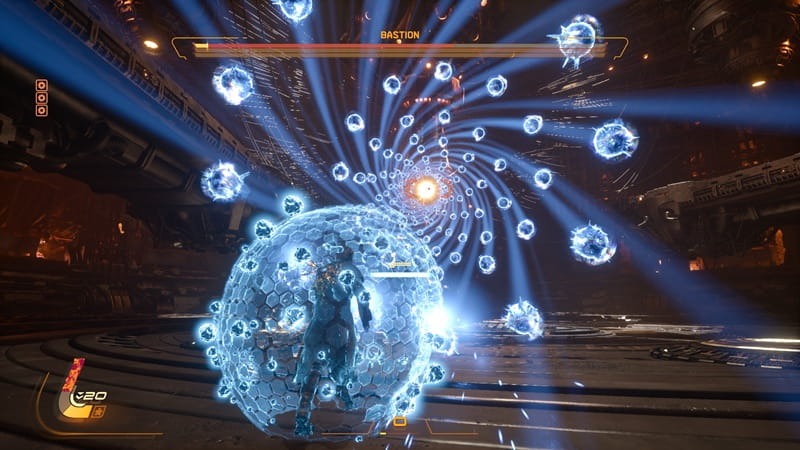
For as much as Saros is balancing at any given time in the way of mechanics, its action never feels confusing, frustrating, or overbearing, which deserves all the credit I can give it. At times, it’s some of the best action I’ve ever experienced, and it barely overstays its welcome or feels stale in any way. It’s simply sublime.
Look the Part
Saros is also one of the best-looking games on the PlayStation 5, in a few different ways. For one, the various environments all look incredible, complete with plenty of detail and jaw-dropping landscapes. The character models are probably the weakest link in the chain, but they, too, look great.
Multiple enemy types are also packed with plenty of detail, and the fact that things can look this good in the midst of waves of projectiles, explosions and gunfire amazes me. And that brings me to the performance. I reviewed this on the PlayStation 5 Pro and really had no issues with it.
PSSR2 upscaling brings with it some decent lighting effects, which add more polish to environments, but the game simply runs at 60FPS at a 1440p resolution throughout, with very minimal frame rate drops.
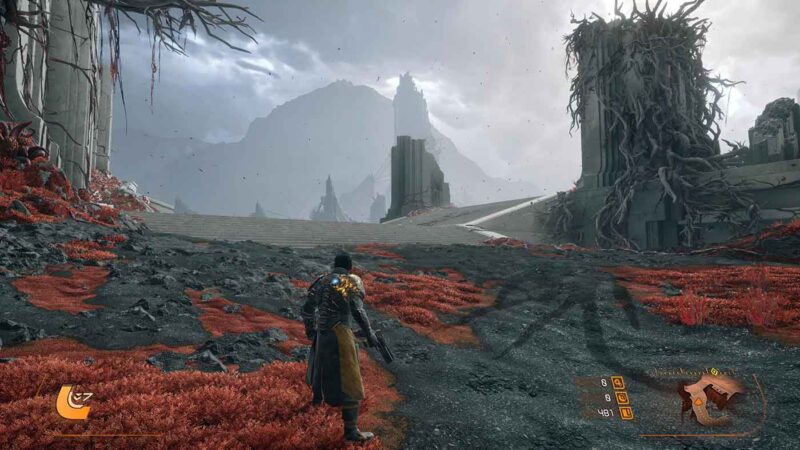
The only real gripe I have with the visuals is that real-time cutscenes drop the frame rate to 30FPS, which can feel a little jarring. But given it doesn’t affect the gameplay, I’m willing to give it a pass.
Final Thoughts
Overall, Saros is an incredible follow-up to Returnal, which should be heralded in its own right as one of the most robust and satisfying roguelite games on the market today.
While I would argue that most of its successes are owed to Returnal in terms of its gameplay structure, I would also argue that there’s never been a better time to jump on board with Housemarque’s offerings, given the slightly more forgiving difficulty and linear nature.
Either way, Saros is an absolute blast to play.


FOUR STARS (OUT OF FIVE)
Highlights: Addictive gameplay loop; Incredible combat; Polished visuals; Engaging narrative
Lowlights: RNG drops may frustrate players; Story loses a little steam in parts; Generally easier than Returnal
Developer: Housemarque
Publisher: Sony Interactive Entertainment
Platforms: PlayStation 5
Available: Now
Review conducted on PlayStation 5 Pro with a code provided by the publisher.
Featured header image also provided by the publisher.
