

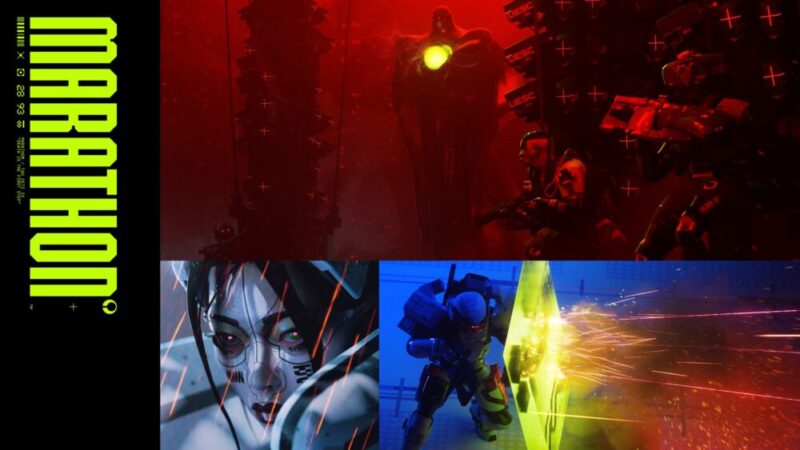
Live service games are a dime a dozen these days, and it feels like extraction shooters aren’t that far behind. From the early days of Escape From Tarkov to the wildly popular Arc Raiders that took over multiplayer charts only a few months ago, it’s clear that Bungie’s latest project, Marathon, has its work cut out for itself.
In many ways, Marathon is a competent, gorgeous and at times, downright satisfying extraction shooter, but like any live service game, it’s a work in progress, and it always takes a little more time than usual to sink your teeth into. While I feel certain parts of Marathon’s gameplay loop are empty and at times repetitive, I can’t deny how good it actually feels to play.
While I’ve heard those same sentiments echoed from friends and early previews alike, Marathon does have the building blocks of something special, even if it remains to be seen just how far it can go in terms of both variety and overall longevity.
Welcome to Tau Ceti IV
Set in the year 2893, as a loose sequel/ spiritual successor to the original Marathon games that launched back in 1994, players take control of a Runner, a former human who has opted in to undergo certain cybernetic enhancements in exchange for superhuman abilities. Players begin their journey on Tau Ceti IV, the home of the UESC Marathon, a large ship housing 30,000 inhabitants en route to start a new colony.
After receiving a distress call from the ship’s AI, it’s soon revealed that all 30,000 inhabitants have disappeared without a trace. Your job as a Runner is to search through Tau Ceti IV and its surrounding areas, in order to track down resources and ultimately more infortantion in regards to finally deciphering what has really taken place in the events leading up to this distress call. While Marathon’s plot is certainly interesting, it’s told largely through long blocks of text-based conversations between runs or upon completing contracts.
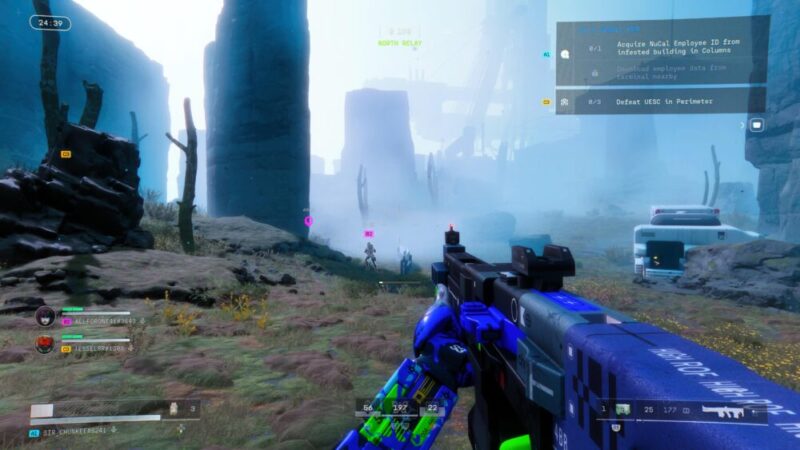
While I love Marathon’s art style, which designer Joseph Cross refers to as “Graphic Realism” or what is more commonly seen and interpreted as a Y2K/Cyberpunk aesthetic, it doesn’t really do much to propel the story forward in any new and interesting ways. Sure, you’ll have a few interesting chats with ONI, the Onboard Navigational Intelligence, but these feel few and far between, especially after a few hours. I get that this is a multiplayer experience at its core, but the lore is so engaging that I wish it were given a little more love and attention.
Shoot, Loot, Repeat
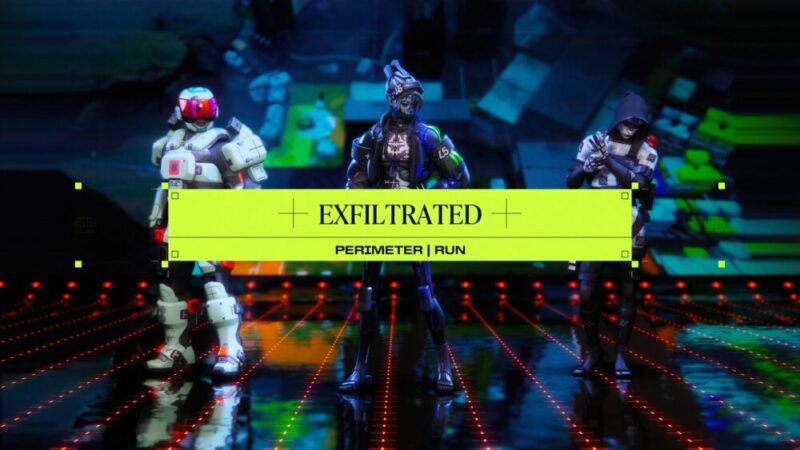
We’re obviously quite deep into extraction shooters at this stage, as far as variety is concerned, but it’s clear that Marathon is favouring the basics when it comes to its gameplay structure. At its core, players will go into a selection of areas solo or in groups of three, across both PVP and PVE encounters, to acquire as much loot as possible, before extracting to end what is referred to as a “run”.
Marathon does go a little deeper with its offering of contracts, which can be taken on before going on a run, adding one or more objectives to complete whilst looting, shooting and ultimately extracting. These contracts also offer exclusive rewards upon completion, in addition to propelling the story forward at times, strengthening and building upon the introductory lore.
Most of these contracts are also confined to certain maps, referred to as Zones, ensuring that you’re able to explore each one adequately, even if some of the later options increase the overall difficulty level.
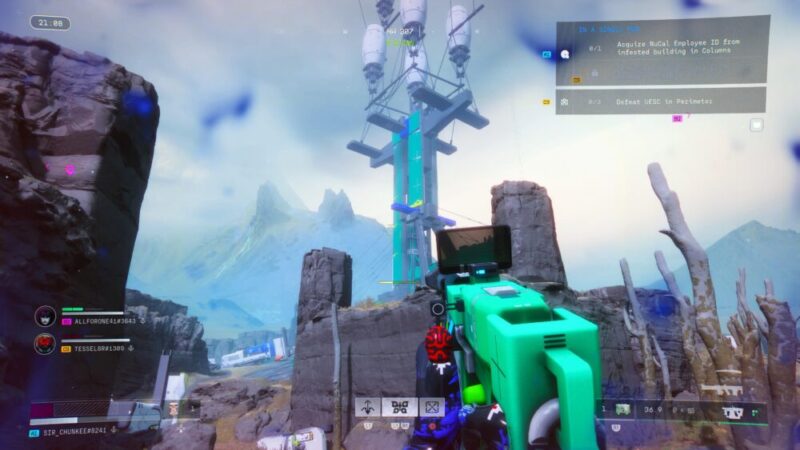
What you’ll be doing above all, however, is shooting guns. Big guns, small guns, you name it. In many ways, Marathon features some of the best and most satisfying gunplay mechanics that I’ve experienced in a game in recent memory. While I would honestly trust Bungie with such a task, given their history with both Halo and Destiny, it’s on full display here.
Weapons feel punchy and responsive, and the time to kill, particularly for PVE or NPC enemies, feels just right. There’s a fantastic range of weapons on offer to you, and while you’ll have to manage resources like ammunition for various weapons, you’ll always have a few favourites at your disposal.
All of this considered, I still have a few gripes with Marathon. Across each of the four Zones at launch, it can be hard to escape the feeling of emptiness between certain encounters. Runs will see you taking on waves of UESC enemies that are coming in via dropship as you’re alerted to their presence. This could involve a handful of standard soldiers, or some even tougher enemies with shields and special abilities. These moments are fun, and generally amplified by PVP encounters as you scurry about to gain the upper hand, be it through positioning, team tactics or general skill.
But what I just described isn’t all that consistent. There are times when you’ve taken on waves of enemies in a particular area, only to be left alone, undiscovered by other players or UESC forces. While it does yield a sense of tension, this brings me to my second gripe. When you are left alone to loot, there’s very little context in the opening hours as to what you’re actually lootin’.
There is a Codex in the main menu to allow you to get your bearings, but in the midst of shield and health boosts, weapon attachments and perks, types of ammunition, physical perks across your arms, torso and leg areas known as Cores and Implants, and various scraps which are sold upon exfiltrating, it can really make your head spin. After a couple of hours, you do admittedly find your way, but it all just feels a little overbearing as you try to pack as much into your backpack without knowing what it really is.
I just wish Marathon gave me a few more options to explore its mechanics across a variety of other gameplay modes. Take Destiny, for example. While those mechanics also felt fantastic, you had story missions to take on alone, Raids to complete with friends and even The Crucible to wrap it all up. It just felt a little more dynamic in terms of multiplayer interactivity, and while I respect Marathon for its more modern extraction shooter approach, I feel it could have offered something a little more traditional to round things out.
Your Shell, Your Way
While players can customise their loadouts with a range of weapons, Cores and Impants, they can also choose from six different classes of Runners, referred to as Shells. Each Shell gives players a main Prime ability, a secondary Tactical ability, and two unique Traits.
These Shells include the Destroyer, made for action-packed assaults, the Assassin, made for those using stealth, Recon for tracking down enemies and items, Triage for keeping players alive and in the fight, the Thief for whipping about and scanning loot, and the Vandal for those focused on smooth movement. There is also an additional Shell known as the Rook, which does allow you to disguise yourself as a UESC soldier, but can only be used solo when joining in-progress matches.
Each of these Shells comes with its own unique abilities, which can really shake up how you approach areas and encounters. I stuck to the Destroyer for raiding towers without a second thought, thanks to its main Prime ability, which fires a collection of homing missiles at enemies. I could then use my Tactical Riot Shield ability to weather the storm if I got in trouble.
That being said, I soon fell in love with the Thief, mainly due to the Tactical Grapple ability, which lets you zip about the environment, and the Prime Pickpocket Drone to attack enemies from afar and steal loot. Either way, while the gameplay remains uncompromised, it’s nice to see how these Shells intertwine and cooperate in certain situations, even if most of these encounters are better coordinated via in-game chat or in sessions with your friends.
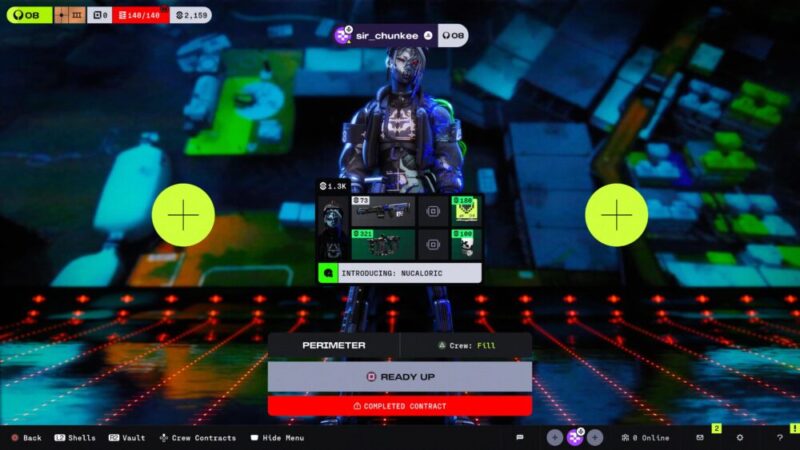
If that wasn’t enough, you’ll be able to complete contracts and upgrade skill trees for each of the six major corporations or factions that exist within the world of Marathon. While those contracts bring you exclusive rewards, your loot can be sold for credits that can unlock additional skills in each of these skill trees.
Like the Shells, each of these major corporations, including Traxus, CyberAcme, Sekiguchi Genetic, MIDA, NuCaloric and Arachne, has its own unique skill trees packed with skills that suit various playstyles, which feels like it yields the most rewards for longtime players who wish to stick around.
It does bring into question the sheer amount of lore that can be accessed via the game’s Codex, which feels essential here, but does require a significant amount of reading and researching, should you wish to understand how these factions operate within the broader Marathon universe.
Finally, Marathon does have a Rewards Pass in which players can pay for and unlock seasonal content via premium currency known as Silk, but thankfully, these are only cosmetic and generally include weapon decals and Shell skins.
Look the Part
It’s safe to say that Marathon is doing its own thing, visually speaking. While I’ve seen the Y2K Cyberpunk aesthetic in various places, I’ve never seen it used like this, or to this degree at least. From its vibrant colours and trippy patterns, to the creepy, realistic imagery that seeps through them, it’s a joy to look at, and it put me into a trance more times than I’d like to admit.

That also applies to the actual game, though. Colours are incredibly vibrant across the board, and certain visual markers like buildings in the distance stand out in this way, bringing a sense of depth and scale to environments in the process. Customisation elements and unlockable skins aside, I’m also a huge fan of the distinct character models and unique design of certain weapons, which add the game’s futuristic look and feel.
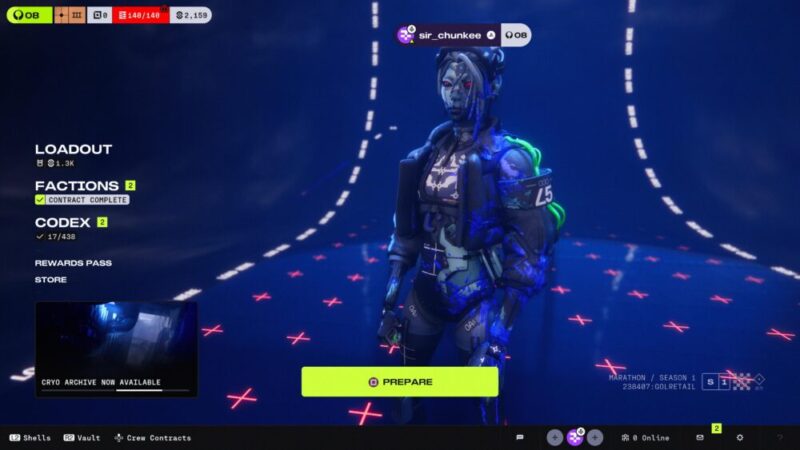
On the PlayStation 5 Pro, Marathon also runs like a dream. I got a really consistent 60 FPS at 4K, and the PSSR does wonders for lighting and particle effects. While I imagine a base PlayStation 5 or even the Xbox Series X might scale down the resolution or lose details that something like PSSR brings to the table, it seems as though a 60 FPS target is met across the board, which I feel is crucial for a game like Marathon.
Final Thoughts
Like most live service games, there are only so many final thoughts we can give, as opposed to ongoing thoughts. Marathon has all the building blocks in place for an incredibly engaging and rewarding extraction shooter. Its mechanics and visuals are certainly strong, amd its using plenty of existing tropes and structures that you’re always building towards something.
While I do wish there were a little more to do in terms of its moment-to-moment gameplay, it’s a decent start, and given that it keeps its player base, there’s plenty more to unpack and build upon over time.


THREE AND A HALF STARS (OUT OF FIVE)
Highlights: Fantastic gunplay; Unique selection of Runners keeps gameplay feeling fresh; Cool art style and gorgeous visuals
Lowlights: Empty areas lead to pacing issues; Story and lore get lost in waves of text and menus
Developer: Bungie
Publisher: Bungie
Platforms: PlayStation 5, Xbox Series X/S, Windows PC
Available: Now
Review conducted on PlayStation 5 Pro with a pre-launch code provided by the publisher.
Featured header image also provided by the publisher.
