

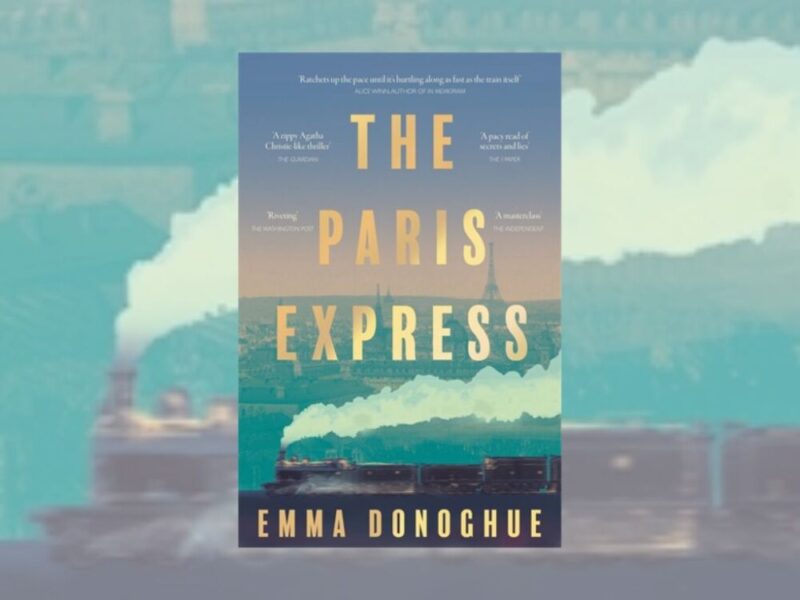
Emma Donoghue‘s latest historical novel The Paris Express was inspired by an unusual photo. In an age of AI-manipulated images, the photograph of a train hanging out of the second-storey of the Gare Montparnasse train station could easily be dismissed as a fake.
But this photograph captures the chaos of the Montparnasse derailment, a real historical incident which occurred on the 22nd of October, 1895, when the Paris Express over-ran its buffer stop and crashed through the wall of the concourse, falling into the street below and killing a young woman selling newspapers. Donoghue, who was due to spend some time living in Montparnasse, and who had not heard of the derailment before, wrote in an article for Lit Hub that as soon as she saw the image, she knew that she had her next novel.
The author is no stranger to writing about real historical events – her novel The Wonder was heavily inspired by the Victorian ‘fasting girls’ phenomenon, and The Pull of the Stars was set during the 1918 influenza pandemic. She describes her work as fact-based historical fiction, and her dedication to research has led to an impressive back catalogue of works which immerse their readers in the time and place she has chosen to write about.
But something about The Paris Express feels a little different. Perhaps it is that the action takes place over a single train journey, and starts off deliberately slow, as Donoghue wanted the momentum of the story to build like a train building up speed, something which is so subtly done the reader does not even notice it happening. Yet, to force a reader to ease their way into a book like this one can be risky. In an era where readers have so many other claims on their attention, a book which starts chugging away from the station, so to speak, may cause some readers to put down the book and go do something else, particularly with no discernible protagonist to latch on to. Donoghue’s narrative is peopled by a large cast of passengers- all of whom are given fairly equal billing, if not equal berths on board the trains.
With so many characters, and so many points of view, it is difficult to distinguish between them at times, or to develop any kind of bond. Still, Donoghue manages to create a sense of impending tragedy by dipping into the lives – albeit briefly – of a cast of characters including a young woman who wants to be a doctor, an African-American artist, a poor but thrifty elderly Russian emigre, a secretary with ambitions bigger than seducing her boss, a small boy travelling alone, two men working in the engine compartment of the train, and a woman with a homemade bomb in her lunch pail. All of them very different from one another – or so they seem to think – and yet united in the fact that it seems likely they are speeding towards tragedy.
The narrative works its way back and forth through the carriages of the train, including all classes and the staff. Sometimes, the point of view head hops at a dizzying speed. While it is possible to orient yourself in which character’s life you are peering from context, sometimes picking up the thread of what has already taken place can be difficult – was it the would-be anarchist who grew up in a corner shop, or was it the doctor? And which passenger is pregnant again? These were the kinds of questions which distracted me as I read, disrupting my ability to sink into the journey.
The sections functioned best as vignettes, rather than as interwoven storylines, and the level of detail provided within them on a range of fascinating subjects (such as the concept of ‘Station Time’ and how early film cameras worked) really leant a level of intrigue to the novel. But more than half way through the book, when a private carriage is added to the train, and several MORE characters are put in the mix, it began to feel like too many elements to keep track of. At times, the omniscient narrator took on the persona of the train herself, speaking as if she were some majestic beast, nobly carrying all of these people. At these points, my disbelief could be suspended no more. There were too many characters to keep track of and none to love (or none to love to hate…)
While the book shows of Donoghue’s impressive research skills and ability to evoke fin de siecle Europe, with all its preoccupations, and class and political struggles, for some readers, the lack of one dominant character will most likely spoil the overall enjoyment of this book. It had the potential to be a powerful short story, and even as a shorter novel, may have worked well, but perhaps there is a reason that this historical event is less well-known than other railway tragedies. There simply is not enough to sustain a larger story. Even in the hands of a capable writer like Emma Donoghue.
Read this one if you’re a diehard Donoghue fan, or if you like your historical fiction broad in scope whilst simultanousely narrow in timeline.


THREE STARS (OUT OF FIVE)
The Paris Express by Emma Donoghue is out now in paperback from Picador books. Find a copy at your local bookstore HERE.
Header image provided by Picador.
