

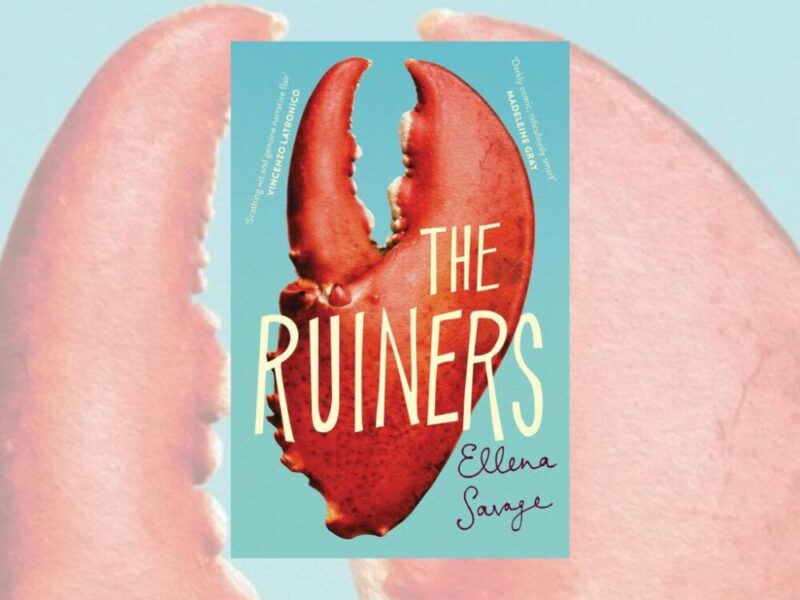
Ellena Savage’s debut novel, The Ruiners, is exactly the kind of novel that abounds in Australian writing at the moment. Predominately focussing on characters who are over-educated and under-employed, it is a smart, witty novel which zones in on characters at a particular moment in time, all whilst favouring philosophical and intellectual insights over plot – and yet, there is something exciting and different about this book that sets it apart.
The main character is Pip, a smart and cynical young woman who feels she is wasting her life working at a seafood restaurant where customers take bets on why she is still working in hospitality at her age, and her bosses have singled her out as management potential. Pip is good at her job, and yet she has internalised the idea that people are supposed to age out of waitressing and go on to do something more worthy.
The problem is that Pip never finished her university degree – her mother got sick and very quickly passed away from her disease – and Pip has found herself drifting. She doesn’t really know what it is she wants to do, but she knows that the idea of being a manager at ‘Claws’ is not it. Then, her father – absent for the majority of her life – dies and leaves her a large amount of money, and for the first time in her life, Pip has a choice in what to do next.
At a party, she meets Sasha, an attractive young academic whose debut work of literary fiction was a big success. The pair are attracted to one another, and quickly become a couple. While Pip has grand plans about becoming debt free and trying to find a sense of purpose in her life, in the bubble of new love, she allows herself to be seduced into the idea of living the bohemian life in a European city somewhere, and buying a small cottage where Sasha can write and Pip can… do whatever it is she decides she wants to do.
They eventually find a ramshackle, derelict property on the made-up island of Fokos, where a literal rubbish mountain is forming not that far away, unbeknownst to them. Then, Viv, Pip’s erstwhile best friend (who did not know how to be her friend in the wake of her mother’s passing) comes to stay, amidst the turmoil of the impending collapse of the socialist magazine he edits. His intention is to help Pip, assuage some of his guilt, and lie low; but when he arrives, and he sniffs out (perhaps literally) the garbage story, the trip becomes a lot more.
Told in three points of view, with a coda tacked onto the end, it’s hard to know exactly whose story this is, and who the ‘ruiners’ of the title are. Is it that Pip, Viv and Sasha are all the ruiners of their own futures, by their very nature doomed to accidentally behave in self-destructive ways by loving the wrong people, being irresponsible with their careers and finances, and contributing to the decay of the world around them? Or are the ruiners those who have contributed to the creation of the volcano of human refuse on Fokos? Who allow barges with rubbish from other countries to be dumped there, ruining the community for those who live on the island?
The novel makes a lot of compelling points for both arguments and more besides. In choosing three very erudite protagonists, and having their sections mirror a work from the literary canon – in Pip’s case, Great Expectations, Viv, Bartleby, the Scrivener and Sasha, The Book of Exodus – Savage allows herself to make a number of pithy and timely observations about both the enduring meaning of these books and the world we live in now. The downside to this approach is that all three narrators sometimes veer into the territory of exposition, or even lecturing. At times they seem to be showing off how smart and well-read they are in a way that starts to feel repetitive, even while it is interesting.
Splitting the point of view into three also seems to dilute the story, so if a plot-driven work is what you are looking for, this one won’t be for you. Each character’s point of view could probably have sustained a narrative on its own, if it were that kind of book. Instead, we are shown a glimpse of each character and what they are up against. In Pip, a story is set up about belonging and self-discovery, in which a young woman, freed from the necessity to work meaningless jobs, makes a few poor choices along the path to finding purpose for herself.
It was her perspective and her story that I connected to the most, even though it was only ‘her’ story exclusively for the first six characters. I loved her moxie, and the way she played with others around her, refusing to let anyone make her feel inferior – because she is perfectly capable of doing that herself. I could have stayed with her perspective, and her take on the inheritance plot line from Dickens, for the whole book. But the story jumps to Viv, and the narrative becomes about chasing the story of who is to blame for the environmental destruction in Greece, all the while the trio are being threatened by shady local figures.
When Sasha’s point of view is added to the mix, the message becomes harder to glean – his section is notable for its more explicit discussion of Pip and Sasha’s sex lives, and a peek behind the curtain of this ‘successful academic’. The inclusion of his section, while still giving the reader the ability to follow what happens next, slows down the pace, and despite his background, I found it hard to empathise with selfish Sasha.
The coda – in which more voices join the chorus, and some answers are given as to why things may have turned out the way they did – is a necessary addition for readers who need some degree of closure, something which is so often denied to them at the end of works of literary fiction.
The Ruiners is a compelling and intellectually stimulating book about the things we think are ruining our lives versus the things (and people) that actually are. It is a clever conversation with some of literature’s greats which does not require you to have actually read those novels to understand why they are significant, and how their significance has changed.
I particularly enjoyed going along for the ride as all three characters wrestled with reconciling who they actually are against the versions of themselves that they wished to project to the world.
Pick this one up if you enjoyed Bri Lee’s The Work or if Savage’s collection of essays, Blueberries, left you wanting more.


FOUR STARS (OUT OF FIVE)
The Ruiners by Ellena Savage is out now from Summit Books. Find a copy at your local bookstore HERE.
