

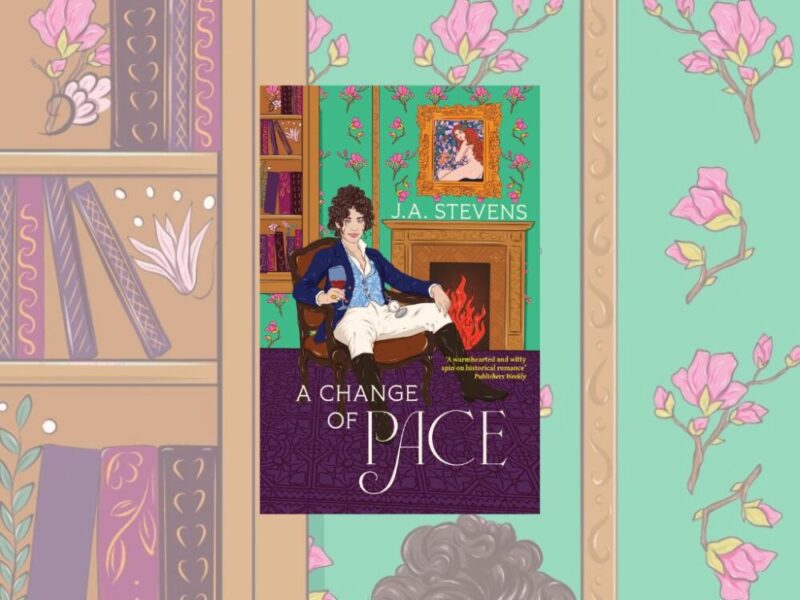
J A Stevens’ debut novel, A Change of Pace, gives every impression that it is the opening chapter of a long running Regency era mystery series. Its lead character, Georgina Pace, feels like a combination of Phryne Fisher and Lord Byron – hopping from bed to bed, flouting convention, and solving a few problems for her friends along the way. While the setting of the novel is ostensibly London, there are a few significant changes to note.
When Georgina – or George to her nearest and dearest – returns to London after a disastrous affair with a young debutante in Cornwall, she is content to avoid her problems in other women’s beds, and in the private rooms of her club. But as the kind of person who is notorious for getting others out of tricky situations, trouble still manages to find her.
Arthur Coombes, a young man of her acquaintance, has been swindled out of a ridiculous sum of money, and his honour, at a local gambling house. Arthur has a sweet and trusting nature and it is clear he has been taken advantage of. Spurred to act by how closely this situation mirrors that which took away her own dear brother, George begins to investigate. Her detective work brings her into the close orbit of Lady Elizabeth Mortimer, a countess whose usual adherence to strict morals mean that her association with a gambling parlour come as rather a surprise to George – but the opportunity to get closer to Elizabeth is not an unwelcome one.
Alongside this, George’s two closest friends, Colt (a notorious womaniser) and Sarah (a widowed woman with considerable societal influence) are dancing around their feelings for one another. Colt is willing to put aside his rakish ways and settle down with Sarah, but she is having a hard time believing that he can. All of this is complicated by the fact that Arthur’s sister, Emily Coombes, has heard of Colt’s reputation for introducing young women to the sensualities of the marital bed before they commit to a choice of husband, and wants to harness his skills for herself. The pair of them must try their best to assist George in her quest, despite these distractions.
Much in the way that television’s Bridgerton features a cast of actors from a number of different races, the London that George comes from is more accepting of different sexual and gender identities, as well as those who live with disabilities. In fact, there is a whole glossary of terms at the beginning of the book to describe characters’ various identities. The thought that has evidently gone into this glossary is admirable, and yet, I did find it a little distracting to occasionally have to flick back to this reference guide whenever a new term came up, and its meaning was not immediately clear from context.
Yet, also I recognise the need to think about the ways that language is tied to attempts to label people from different, marginalised identities and keep them boxed up – perhaps by interrupting the flow of reading and asking readers to think about characters in different ways rather than leaping to pre-judge, Stevens is providing an important disruption. Far from being the Regency England that may be familiar from other novels, Stevens’ London is lovingly peopled with those whose stories are hidden in the archives, and while their identities might be remarked upon in their initial introductions, neither gender identity not disability form crucial plot points. The characters are simply allowed to exist, and to take part in the plot rather than to be the plot.
For the most part, the story ticks along at an engaging pace, with a few occasional missteps when the word choice is allowed to veer too far into overdoing it- such as when Colt thinks about how much he wants to please ‘this gorgeous woman’ midway through an intimate scene. In general, the Colt and Sarah subplot does pull focus a little bit more than it should, and has a less developed story arc.
However, ultimately I really enjoyed this book, and found it interesting to see that it has been marketed predominantly as a Regency Romance. What stood out to me the most was the mystery of how George would help Arthur get his promissory notes back. The romance made for delightful extra detail – and for those who like to be prepared, it might be worth mentioning that there are numerous sex scenes in this one, of a slightly higher spice level than some readers may be used to – but to reduce this story simply to one of girl meets girl is to overlook all of the other aspects. I can see great potential for George to return in future instalments to help more of her friends.


FOUR STARS (OUT OF FIVE)
A Change of Pace by J.A. Stevens is out now from Echo Publishing. Find a copy at your local bookstore HERE.
