
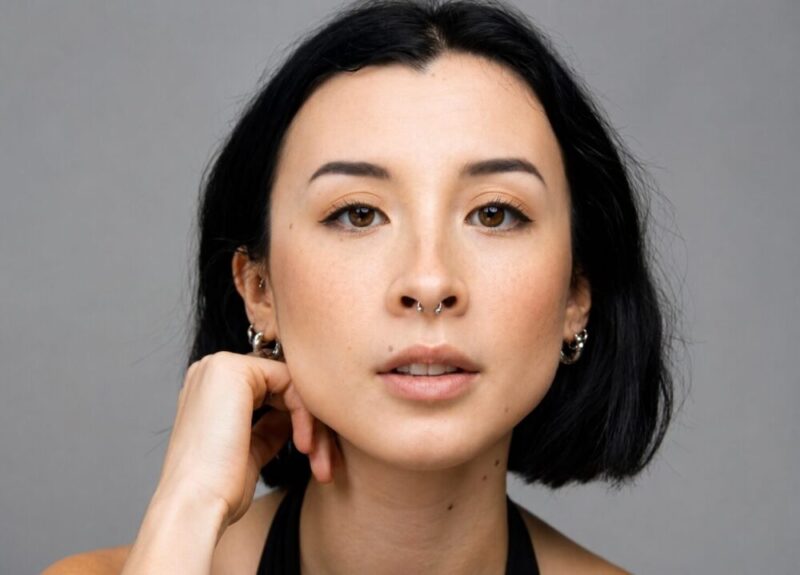
This is probably a question you’ve been countless times before, but I obviously have to know about your relationship with Beetlejuice the film. I’m curious as to whether it felt like chaos to you when you watched it, or were you already clocking the grief sitting underneath it?
I watched the film at a friend’s house when I was younger. I don’t know how old I would have been. I presume maybe 10, or something. I would always watch cool movies at this friend’s house. I feel like she introduced me to a lot of my faves. I remember it just being so cool, and I don’t know if it was my first Tim Burton film, but it was definitely one of the first ones I saw.
With the character of Lydia, she’s so often played as “the goth girl who loves death.” Underneath that is a kid dealing with something profoundly adult. Where did you locate her emotional truth? Was it the anger, the numbness, or something quieter for you?
I feel like I’m very aware from my own experience that just because is “goth” or “alternative,” I think people really assume they’re going to be this rare type of person that sees things in a twisted and crazy way. Regular people wear dark clothes. And if you ever are talking to a goth or punk, they’re always the nicest people ever. I knew that I didn’t have to lean into any trope of her. I just had to say the lines and mean them, and then map out her relationship with her mum and the world and all that stuff.
For me, it was more about leaning into her age, because she’s so young. I’m over a decade older than she is, and because I do have that distance from her age, I can think back to when you’re 15 and you think everyone is seeing the world the same way as you are. But no one is. Once you get older, you look back at any age and it’s really this little capsule of a world view. Being a teenager, you’re just operating with a completely different emotional landscape. I find it really exhausting to play teenagers on another level when it comes to the way they receive information and the way they experience emotions. I think with teenagers, they’re all so different. Like, a 14-year-old is so different than a 15-year-old, and that’s different to a 17-year-old. I just try to put myself in that place and what she would believe in, and then how that all gets rocked when her mum passes away.
It’s been a few decades since I’ve been a teenager, but I very much understand that feeling of how the world view at such a specific age is so singular. Looking at Winona Ryder’s performance, it has that stillness and dry wit to it. Did any of that seep into your version? Or did you deliberately push in a different direction?
I definitely did my re-watch and my deep dives in the preparation. I wanted to understand how important this character is to so many people and all that she represents. On top of that, in pop culture she’s a very important character. I wanted to know what is it about Winona’s performance that people loved so much, but not copy that. I wanted to get to the root of that, and then what does that look like for me? I’d honestly be a bit embarrassed if I was try to copy her. And it wouldn’t be fun for me, either.
The character of Lydia in the musical is quite different (too). In the film she’s a bit dreary and walks about, and in (the musical) she’s a lot more active. In this story she’s so driven to get her mum back and reckon with death. It was a recipe of getting my thoughts around Winona, understanding what the role of Lydia is in the musical, and then finding that perfect overlap.
Does that help you in staying grounded? I feel like Lydia is essentially the emotional anchor in a show that’s very deliberately unhinged. How did you find that center for you?
Yeah, that’s so true. I’ve said this to directors when we were in our very first rehearsal that I felt like I was sucking the energy out of scenes. It doesn’t feel great, because as an actor you’re used to keeping the ball up in the air, and when your character’s nature is that she’s depressed as hell…I think a lot of people associate (Lydia) with the Wednesday Addams thing. That’s been in the zeitgeist, but Lydia is not Wednesday at all. They are both teenage girls who wear dark clothes and are a bit dry at times, but someone has to be the straight man. It’s just hilarious in this world that the straight man in any other media would be this crazy, angsty teen. Here, she’s the flag pole that’s holding together the web of all the craziness.
The show does position Beetlejuice as the disrupter, but he’s also, strangely, kind of a healer. Do you think Lydia needs him? Or is he just the most chaotic manifestation of something already inside of her?
I think they both need each other. The tagline for the show is “A girl that wants to die and a demon that wants to live,” and it’s kind of a perfect storm. No human could talk to her and make her feel seen like a crusty, old demon (laughs). She knows he gets her, and she’s a human that can actually see him, so they’re in touch with each other’s worlds. They are weird twin flames, in a way.
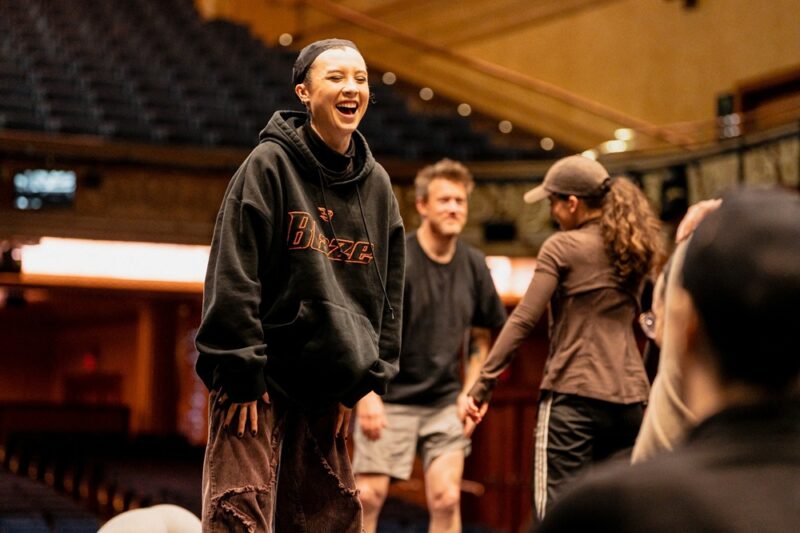
Lydia talks a lot about feeling invisible. In a medium as heightened and as theatrical as musical theatre, how do you play invisibility without disappearing?
Yeah, damn. It’s honestly so dependent on everyone else. If it’s just me hanging out safely, being “invisible,” you kind of go, “Okay, I guess you’ll just have to take my word for it.” But once other people are there, everything suddenly clicks into place. All the prep I’d done beforehand made sense the second we started actually moving around together on the floor.
Even during our very first photo shoot when the cast was announced – it was just the principal cast sitting around this dining table set – I’d never properly met Tom Wren, who plays my dad, and I think it might’ve been the first time I really met Eddie (Perfect, lyricist) too. But I remember sitting there with Eddie at one end of the table, my dad and step-mum nearby, and these two “normal” ghost people in between us. And I suddenly felt exactly what the invisibility thing was. Like, “Well, that’s my dad sitting two seats away from me, but there’s this crazy woman between us, and the only person who feels remotely on my side is all the way at the opposite end of the table.”
The dynamics just instantly clicked into place once everybody was there. And the direction was really great with that stuff too. Sometimes I’d suddenly become very aware that I was the only person standing on one side of the stage while everyone else was grouped together on the other side, and I’d think, “Where’s my person?” That kind of physical blocking and separation became really informative for me as an actor.
That’s one of the things that I really love about the film, is that it’s addressing serious subjects in the guise of something else. I feel like this show will also make grief funny without trivializing it. Have you looked at where that line is for you? The point where a joke stops being a release and starts undermining the emotion? Was that something you looked at?
These are all such great questions. I feel like I’m very aware that, because it is so absurd and literally bananas, with things happening all around me that go so far, I almost have to go just as far the other way and make it very serious, especially in act two. Otherwise, we’d all just be up in the air, and it would become a show that’s fully chaotic just for the sake of being wacky and crazy. It really needs that tether.
So when those more grounded moments come, it almost feels like a relief. And Lydia famously isn’t really laughing. I think she’s trying to, but no one else in her family is, which is why, when this fantastical world comes to life, she gets so pulled into it. She’s like, “Well, this guy is dead, and he’s willing to talk to me about all this stuff.” The only person who will actually talk to her about death is this guy, these crazy little goblin people, his clones, and all of that. So naturally, she’s going to want to go to the Netherworld and lean into all of it.
It feels very dramaturgically sound to me, so it never actually feels bizarre while I’m doing it.
On the mention of wanting that release, are there moments where you deliberately let Lydia break? Where the control slip? And, if so, how important are those cracks in a performance?
There’s a song in act two called “Creepy Old Guy” that comes right after a really huge emotional beat for Lydia. I won’t spoil anything, but I’ve usually just had this massive emotional release before going into it. And then suddenly we launch into this really silly song that also addresses the whole Beetlejuice-and-Lydia-getting-married aspect from the film.
By the time I get to “Creepy Old Guy,” I’m basically in giggle town. If anything goes wrong during that number, that’s absolutely the point where I’ll start laughing while I’m singing. It genuinely feels like that ‘laugh after a funeral’ kind of energy – you’re just so relieved after carrying all that emotion.
And at that point, we’ve only got about 15 minutes left of the show, so there’s this sense of release. I’m definitely not afraid to laugh, but unfortunately Lydia herself is not the most giggly girl.
Looking at the trajectory from Six to Fangirls, do you feel drawn to characters who are outsiders? Or is that something directors are seeing in you?
Yeah, it’s so funny. I literally just said this in the last interview I did. I feel like the types of characters I get seen for really change depending on the times. I’m sure every actor has their own version of this.
When I was going through uni and starting out, I was always going for roles where the character was being heavily bullied, deeply traumatised, or really struggling in some way. I don’t know whether I was naturally drawn to those roles or if I just thought that was the kind of casting lane I fit into.
Then post-2020 – with all the conversations around diversity and changing industry expectations – I suddenly started getting seen for completely different roles that I’d never really practised that skill set for before. Suddenly it was the “mean girl,” the “hot cool girlfriend,” the “hot girl next door.” It was a full status shift.
And now it feels like it’s settled into this space where I’m often playing outsiders, but in a kind of “cool” way – inverted commas on cool. I think people are really interested in the outsider archetype these days because, honestly, no matter who you are or what you look like, most people feel like an outsider in some way. That’s part of why audiences connect so much with this show too. Lydia is obviously the big outsider, but so is Delia, so are the Maitlands, so is Beetlejuice. People can recognise themselves in all these different flavours of isolation and otherness.
And honestly, that’s something I’m constantly navigating in my own life too – feeling outside of things for whatever reason. I think that’s probably why I can play it well. So I’m happy to keep living in that space for as long as people want me to
Looking at that connection, Lydia is so often the character people project themselves onto. Have you become more aware of the audience whilst playing it? Almost like you’re carrying their experiences as well as your own?
Yeah, I feel like I’ve met heaps of fans, and it’s such an interactive fanbase online as well. There’s this huge mix of people. Some were Beetlejuice fans long before I was even born, and talking to them is amazing because they’re just ride-or-die for it. They’re like, “We’ve always loved this show.”
Then there are 13-year-olds who discovered it on TikTok and feel really seen by it in completely different ways. I’ve also spoken to a lot of people who connect deeply to the “dead mum” side of the story and say, “This is my show.” It means something really personal to them.
So when I talk to fans, I really experience all the different ways people see themselves in the show – why they love it, what the characters mean to them, and what they connect to emotionally. And then there’s the representation side of it too. Anyone who looks like me or shares parts of my identity will often tell me how much that means to them.
Obviously, I don’t wake up every day thinking, “Who do I represent on a global scale?” I try not to carry that pressure constantly. But then you meet people and realise, “Oh, wow. Every half-Japanese lesbian out there might look at me and think, that’s someone like me up there.”
And moments like that remind me that it’s bigger than just me showing up and doing a job. I’m actually telling a story that people genuinely see themselves in, and that’s really special.
And just before I let you go, if Beetlejuice represents chaos and Lydia represents control. Where do you sit on that spectrum?
Well, I feel like I’m always moving up and down that sliding scale. At the moment, I’m probably leaning less toward the control side of things, but as we get closer to Brisbane, I can already feel myself dialling that back up again. Even with little things, I’m like, “Okay, I’ve got to pull my shit together.”
So it becomes: get back into lessons, get to the gym, start locking back into routines and all of that. I can definitely feel myself leaning back into that mindset now.
Beetlejuice the Musical will begin its Australian tour from June in Brisbane, before moving to Perth from August, Adelaide from October, and Sydney from November. Tickets are now available through the official site.
