

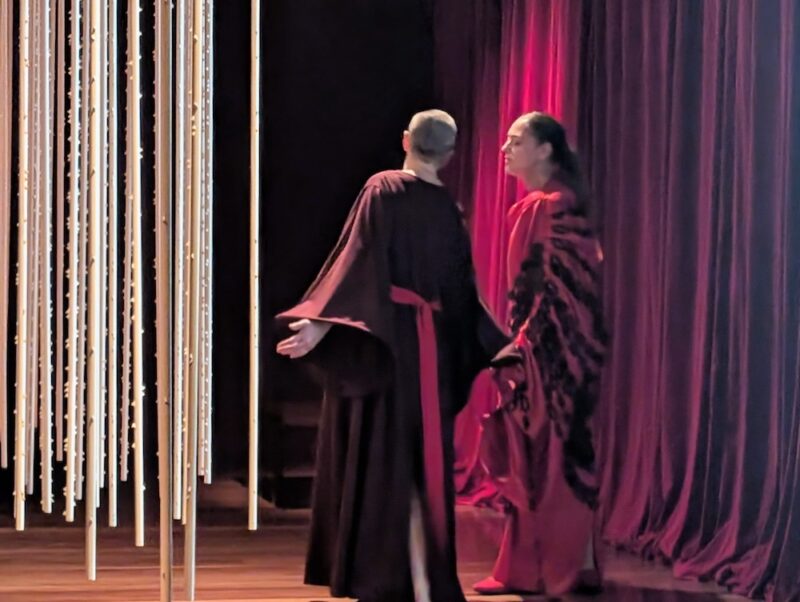
Patience and Penitentia is a powerful durational performance by South Australian artist Ida Sophia that explores silence, punishment, and power within relationships. Over forty days, the artist, weighted down by rose-petal chains, performs a ritual of penance and silence. Dark red walls and a haunting soundtrack evoke memories of cavernous churches. Strands of rose thorns remind us that small cuts and snags can build up over time. The interaction among the other performers is silent, with feelings of attraction mingled with longing and aversion. We spoke to the artist about her work, how it fits within her broader narrative, and the preparations leading up to the installation.
How excited are you for your performance?
It’s one of those little crossroads, you know sort of what will happen, but it’s 280 hours of performance; you can’t rehearse it. What happens in the performance is the performance, and you’ve just got to trust.
So, how do you prepare for something like that?
It is a pretty long process, actually, about a year, I start working on for something like this, because it’s so physical. It’s non-stop, seven hours a day, so I have a practice of a water and a food fast until the performance ends for the day. That’s the first part, just training my body to be okay with doing that throughout the day, so that I don’t need to use the bathroom. Also, I don’t sit down through that time, so I also prepare with long durational exercises that I was trained in in the Marina Abramovic Institute some years ago now. That was pretty extraordinary, long durational walking or doing things extremely slowly, but for long periods of time. It’s sort of a mental and physical capacity endurance building. Yeah, it’s a marathon, not a sprint.
Where did the idea come from for the performance Patience and Penitentia?
I was in Italy on an artist residency, and I was just journaling in a Basilica in Galatina, and I looked up and saw this image, an allegory of penitence that said “Penitentia.” She was wearing this chain dress, and I was so moved by this image because I was in the midst of experiencing the silent treatment in my family. I just thought my God, you’ve been up there for 500 years already. How long do I have to wait until this is over?
In my practice, I’m really interested at looking at our interpersonal relationships and how can we sit with what’s uncomfortable and discover a counter narrative. I wanted to make a work about the silent treatment and how corrosive it is and show, yes, we’re very capable of this cruelty, but we’re also really capable of maintenance, care and tending to our relationships, and that it doesn’t have to last forever. So, I wanted to weave the hope as well, and I did that by remaking that chain dress, but in the material of rose petals. These rose petals were donated by women in Adelaide from their own tended gardens, and that was the reason to I wanted to bring in that idea of care and long-term maintenance that we showed to our gardens, similarly to our family relationships. So, I’ve remade that chain dress, and that’s what I wear. It’s about eight kilos. There’s tens of thousands of rose petals contributed. It was extraordinary.
So, you’ve taken these rose petals and formed them into sort of a type of paper mache?
More like a clay. I went to another residency, and over eight weeks I experimented, and I ended up drying them, and then making them into a fine powder kind of texture, and then rehydrating them with water and archival glue, forming them again, re-dehydrating them into these chain links. So, it sits on top of a dress, and over the over the period of the performance, over the 40 days, a length of that chain will be taken off every day. We want to finish this image of the of the woman in the chain dress, we want to remove those chains, so that by the end of it, there is liberation. There was burden, but there was the slow reparation of that period of time, seemingly endless time, but it does have an end.
So, it’s sort of like the opposite of your 2021 “Regret” performance?
Yes, it’s a mirror, totally.
That looked fascinating, that you bear the weight of regret. We all bear that weight, but you’ve done it in an artistic way.
Art is so wonderful like that, we get to use these metaphors of weight, of action, of transformation, and it’s why I like to work in long durational performance, because there’s no rush. It really reflects life, things happen slowly. In Regret, the people that contributed a regret and were able to just anonymously give that over to me, share the burden, I would hold it, and then they all came back at the end. There were hundreds of people there spilling out into the street, just understanding we have this sort of temporary community. It brings us all together, and we get to see that you’re not alone in these in these really normal human situations.
What fascinates me about your artwork is that it’s so temporal, yet long lasting as well. There’s nothing left to show for it at the end, except the experience.
Yeah, I mean, that’s the essential quality of it. It gets to continue on in in memory. A lovely thing in this work, I’ve made these little sets of seven beads, which I give away as part of the gesture to people in the audience, and I love the idea of a souvenir that can be found maybe months, maybe years later. It can bring you back to the reason it was given to you, and perhaps that’s the right moment to start that healing process.
I think that as humans we love memories or souvenirs of moments past, or you know, whether it’s to heal a sad moment or to remember a happy moment. Even the ritualistic parts of our lives, like a funeral, for example, is a way of commemorating a person’s life, which is what you’re doing in your artwork.
We don’t have a lot of rituals in our sort of Western post capitalism time, and to go back to thinking, how can I work through this? How can I process this? I wasn’t given a guidebook, so maybe I can make a moment for it. And you know, the silent treatment is so disastrous, it can go for a lifetime, without us going towards it, and asking, beyond judging it, what drives it and we might resolve that, even if it doesn’t resolve with the other person.
It is very destructive. I don’t think anything good comes from it.
It doesn’t, and you know, it makes me wonder as well about how it affects us more broadly. It begins in our families, and then it can happen in community, and then it can happen politically. There are countries that don’t speak to each other, and that affects peace, capacity, innovation, connection, belonging, everything that makes it so extraordinary to be a human. We haven’t learned how to say this has happened, this is how I felt, and can we talk about it. I think if any conversations come from this work between people, that’s the success of it.
I noticed that the rose symbolism appears a lot in your artwork. I really liked one of the quotations from one of your earlier works, that the rose bloom distracts from the thorn in the same way that the party dress distracts from suffering. That really resonated with me, the opposites of roses, the thorns and the beauty, which is what your work really shows.
That’s what I hope for, that both of those things are present at once. It’s kind of like seduce and repel, you know? When you see this work, you walk in and it’s incredibly aesthetic. I want it to be seductive. The room is red. The installation has a huge scale, so to look up at it, you have to open your chest, widen your eye. There is the sound work, which is full and intense, and there’s a scent as well in the space. The scent of the domestic home smells like rose and floorboards and worn leather. Elements that can pull down someone’s defences, lure them in, seduce them in, just like that work for The Party. Once you’re in and you’re more able to sit with the uncomfortable thing, it’s the same tactic used in a church. You pre-look at the image of Christ, which is a violent image. It’s awful when you think about it, but when it’s in that framing. People can go there and use that discomfort to work through their own issues and agonies and pain.
The Church provides a framework for suffering and redemption at the same time.
Yes, it’s similar to those spaces, in that’s it’s really a secular space to come to. There’s seating, it’s open all day, people can come and go as they wish, they can come back as many times as they want, and where it will always be received, whoever needs it.
I watched your 2022 baptismal performance, “Witness”, and honestly, I couldn’t watch the whole thing. I was traumatised by the experience. How do you go through those experiences yourself?
That one was, is definitely the hardest one. I mean, that sound work as well. It was the same composer for Patience and Penitentia; that work was absolutely shattering. John, we did it once, one take. I did that for 30 minutes, and it was a 12-minute take that we got out of it. And honestly, I had to work against my body’s survival instinct. To fully trust my co-performer, who was just a divine artist.
There’s a really beautiful article, by Amelia Jones, and she’s talking about a Caravaggio painting. Caravaggio painted beads of pain with blood and everything, and she likens performance art to being the experience of watching something separate to you. Being able to have it mirror to you from a safe distance your own sort of deepest pain and agony. To be able to walk away from it unscathed, but in deep reflection, with the door open to that, and witness is certainly my most ferocious undertaking of that.
Where it is, The Pool of Siloam, is where I learned to swim, so it’s got all of that background for me. It’s also a salt lake, so the reason we learned to swim there is because it’s so buoyant. Water was really pushing me back up, it was like you don’t get to come here. I’m trying to reiterate my father’s action to try and experience what he experienced, to see what he saw, and it was just not possible. Hence the repetition, hence the growing intensity of it, and no resolution. The film ends without it ending, it just ends and just continues and goes and goes. I’m sort of interested in how vain hope plays out like this, we bash our head against the wall again and again and again, trying to make, trying to see that that would change something, even when we know that it won’t. I think that that’s a huge waste of energy in in our very short and precious lives.
Your father took up religion when you were quite young, and that really changed the dynamic of the family life. Your ability as an artist to capture that moment and express those feelings – is that a gift or a burden?
I think it’s purpose. I’m five years on from “Regret” now. That work was really personal, like I was very forward about my regret that I wasn’t there for my father for that month. “Regret” showed me that working from an autobiographical standpoint, I’m experiencing what everybody else is experiencing. It’s my purpose to make work about those experiences that I know intimately but allow others to take it and work through their own regret with such a beautiful teacher of what my practice was actually about and how it works in society. So, now with the silent treatment I’ve been much less explicit about the particular family situation of mine, and I’ve collaborated with all of the women who contributed roses from their gardens. This counter narrative of care and maintenance and resilience and seasonality. Also, in the sound work I interviewed women about their experiences, and wove it in there, in sound metaphors. Things like slammed doors, or screeching cars, or passive-aggressive dishes, or cutting of hair. All of those sounds are in the sound work, so it’s born from my experience, but it is our experience, and we’re not alone. Even though it feels individual and unique, it’s not in the end, and that can be a gift to share.
Can you describe how the exhibition finishes?
So, in the centre of the installation of the room is the Tyranny of Small Decisions, which I did in Berlin last year. This work is made from three-metre-long stems covered in thorns. Little decisions amount to us becoming entangled, and in places that we didn’t desire, or think that they would happen. We’re going to work through that installation right at the end. In order to get through it, you have to sacrifice something, so that is what we will do. That’ll happen between four and five on August the 22nd at Samstag, the final hour of the exhibition.
Event details
Ida Sophia: Patience and Penitentia
26 June to 18 September 2026 with the finale set for August 22nd from 4.00pm until 5.00pm
Samstag Museum of Art, Gallery 2, Hawke Building, Adelaide University, City West Campus
55 North Terrace, Tarntanya/Adelaide
samstag.adelaide.edu.au/exhibitions/2026/patience-and-penitentia/
Header photo: Ida Sophia – Penance and Penitentia – credit John Goodridge
