

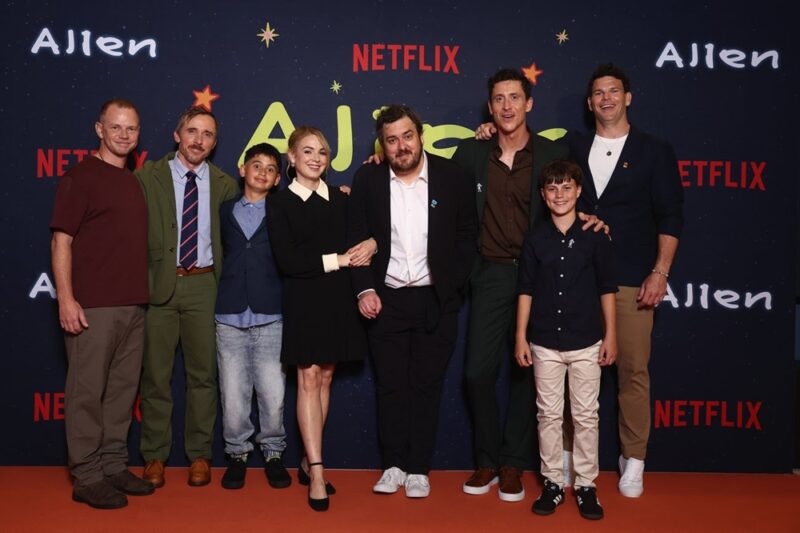
From childhood nostalgia and the friendships that shape us to alien invasions and the enduring magic of a Friday night at Blockbuster, the cast of Allen reflected on their new Netflix adventure at a special Brisbane premiere.
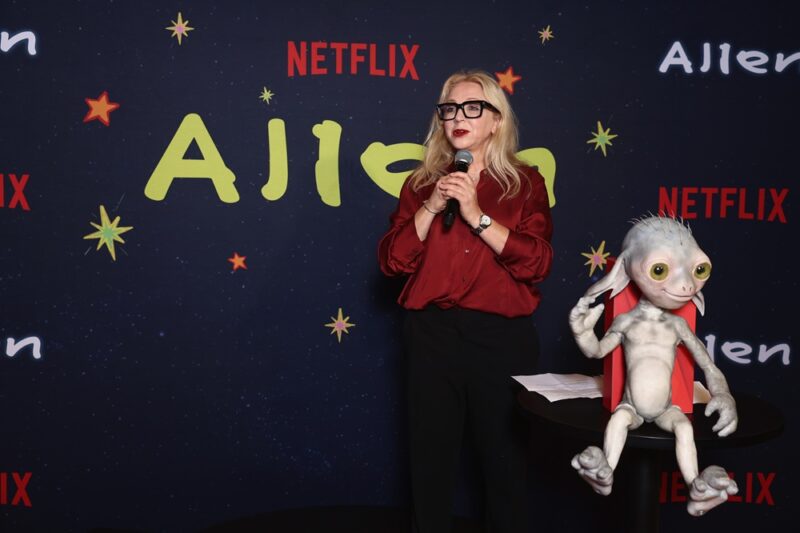
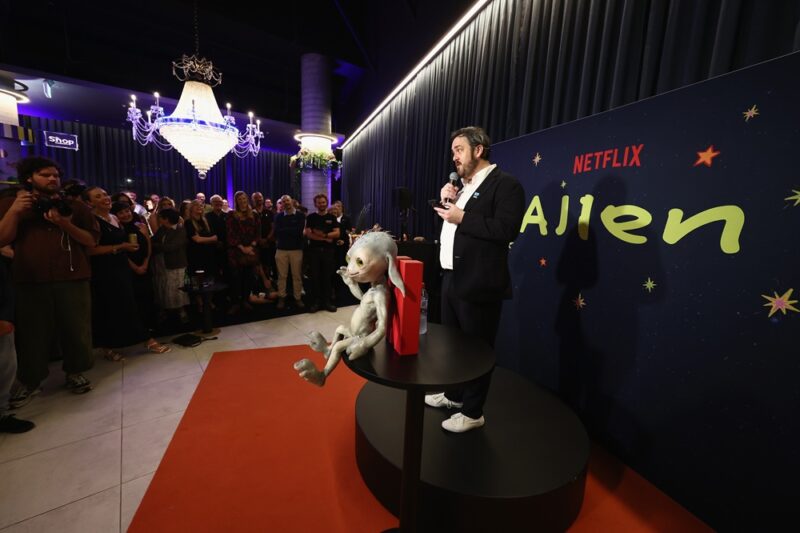
Queensland has long provided the backdrop for stories of adventure, but on Wednesday evening, November 11th, Brisbane played host to something a little more extraterrestrial as Netflix, Ludo Studio and Screen Queensland celebrated the premiere of Allen, a heartfelt Australian comedy that finds the extraordinary hiding within the familiar. Bringing together the film’s cast, creatives and crew at Angelika Cinemas, the special screening marked a homecoming of sorts for a production that wears its Queensland identity proudly, having filmed across Brisbane, the Sunshine Coast and Gold Coast.
For Ludo Studio, the Emmy and BAFTA-winning production company behind the global phenomenon Bluey and acclaimed series Thou Shalt Not Steal, Allen represents another significant creative milestone as its first live-action feature film. Co-directed by Daley Pearson and Jeffrey Walker, and written by Pearson alongside Sophie Miller, the film takes a distinctly Australian approach to a familiar science-fiction premise, grounding its extraterrestrial adventure in something altogether more recognisable: the friendships we form as children, the people we become as adults, and the parts of ourselves we sometimes leave behind along the way.
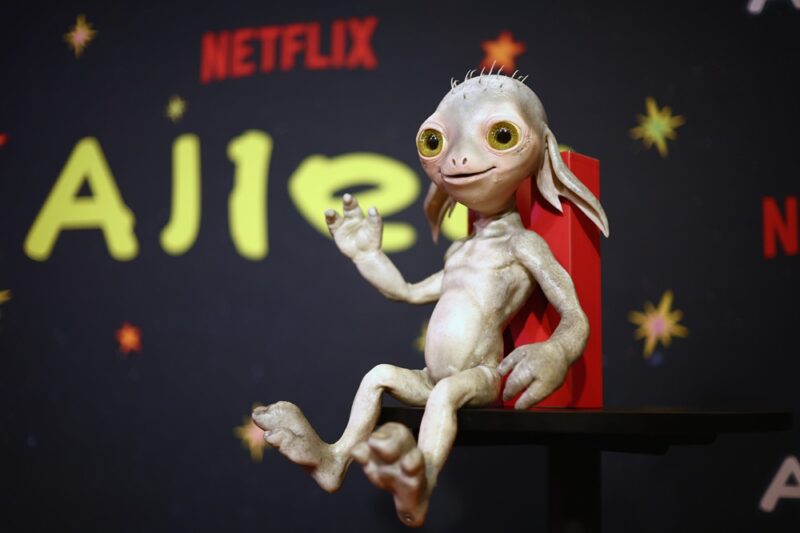
At the centre of the story is Petey (T.J Power), a man whose childhood friendship with a small alien named Allen has remained the defining experience of his life. Twenty years after losing the best friend he ever had, Petey is still struggling to move forward. When Allen unexpectedly returns, the reunion threatens to upend the carefully constructed adult lives of those around him, forcing old friends and family members to confront memories they may have preferred to leave in the past.
For Pearson, who grew up in Coolum on the Sunshine Coast, the story is rooted in the sun-drenched coastal landscapes and suburban experiences of his childhood. And while its premise promises plenty of fantastical adventure, the film’s emotional foundation is considerably more intimate, exploring the universal experience of a childhood loss that never entirely heals.
That tension between childhood wonder and adult responsibility was something the cast returned to repeatedly when speaking with our Peter Gray on the Brisbane premiere carpet.
Rediscovering the magic of childhood
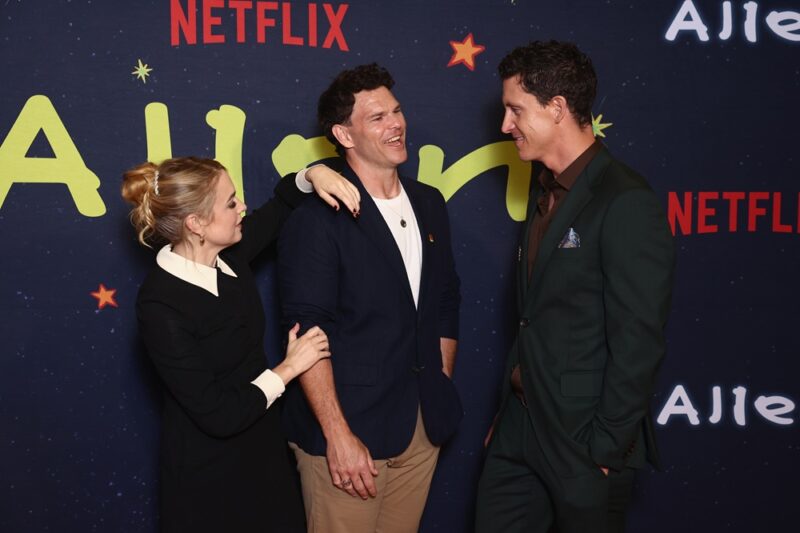
For Emily Barclay, who plays Sarah, one of the most compelling aspects of her character was the way she had seemingly moved beyond the experiences that continued to define Petey.
“I think something I thought about is she sort of left Petey behind, in a sense, and stepped into the grown-up world,” Barclay explained. “She has a grown-up job and a partner, but I think what she loves about Petey, and what she feels like maybe he helps her to remember, is that sense of being a kid.”
For Barclay, Sarah’s relationship with Petey becomes an opportunity to reconnect with something adulthood has gradually pushed aside.
“I think through him she’s able to reconnect to something that feels like the magic of childhood. And I don’t even know if that’s something that was necessarily written, or something that I thought about and felt when I was playing her.”
It’s an observation that speaks to the emotional heart of Allen, a film less concerned with the mechanics of extraterrestrial life than with the ways our earliest relationships continue to inform who we become.
For Power, whose character’s connection with Allen is defined by an almost unconditional affection, the emotional reference point proved unexpectedly personal.
Asked whether portraying such a friendship had encouraged him to reflect on his own relationships, the actor revealed that he drew inspiration from his relationship with his son.
“I think the closest thing that I had at points to express what it felt like, especially because I play the grown-up version of Petey, was my son,” Power said.
“It’s that kind of, ‘You’re small. How can I explain this to you? You don’t understand the world yet, but you’re still my best friend.’ I think I had a little bit of that going on.”
The comparison offers a particularly touching insight into Petey’s emotional attachment to Allen. While the film’s premise may be fantastical, the relationship at its centre is built around something immediately recognisable: the instinct to protect someone whose understanding of the world is different from your own, and the profound affection that can exist without the need for explanation.
The stories we tell ourselves to make growing up easier
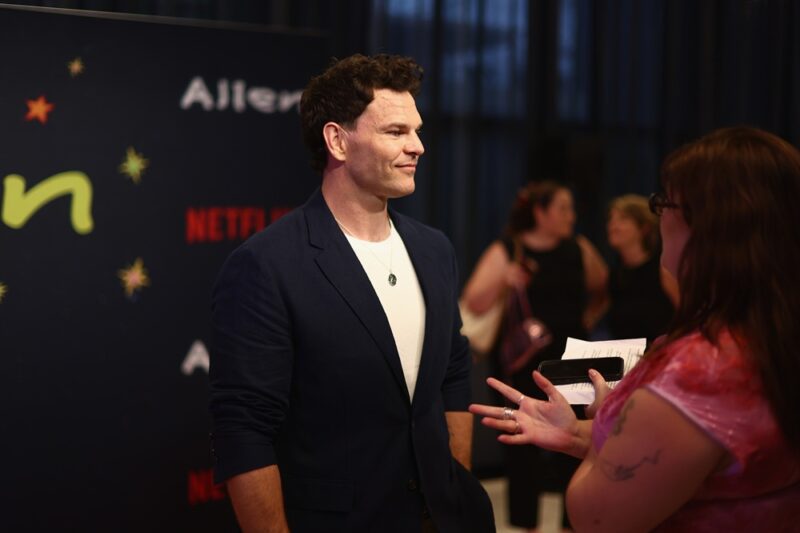
If Petey represents the part of us unwilling to surrender childhood wonder, his brother Jaden, played by Josh Helman, embodies the complicated realities of moving forward.
With a house to renovate, a child on the way and the responsibilities of adulthood increasingly demanding his attention, Jaden has little room for the kind of disruption Allen’s return promises.
But as Helman explained, his character’s resistance isn’t simply a matter of practicality. It’s rooted in the way people reshape their memories to accommodate the lives they’ve built.
“I think the crux of the emotional life of this movie is Petey, and all of us having this very formative experience when we were very young and then not knowing how to deal with it,” Helman explained.
“Petey obviously is the one who’s really staying in the past and wants to protect that connection to who he was at that age.”
For Jaden, however, that same childhood experience has taken on an entirely different meaning.
“I think there are certain things that we kind of bastardise in our memories over time, and we change the narrative of things over time with certain memories, and not deliberately so. They become coloured by what happened at the time, who we become as people after that, and the things that are important to us.”
According to Helman, Jaden has come to view Allen as the catalyst for losing the relationship he once shared with his brother, a perception that has allowed him to justify his emotional distance.
“He has really just coloured the whole idea of Allen as being a really terrible thing that took away his relationship with his brother.”
The actor suggested that much of Jaden’s journey involves confronting the possibility that his interpretation of the past has been shaped more by self-preservation than truth.
“He kind of has to face the fact that he’s been conveniently lying to himself, I think, to make himself feel better. And that’s hard for any of us, to have to reckon with those things that we tell ourselves that aren’t completely true, but we tell ourselves because it makes our lives a little bit easier.”
It’s a surprisingly philosophical consideration for a film about a returning alien, but one that reinforces the emotional complexity beneath its playful exterior.
When the fear of the unknown becomes a need for control
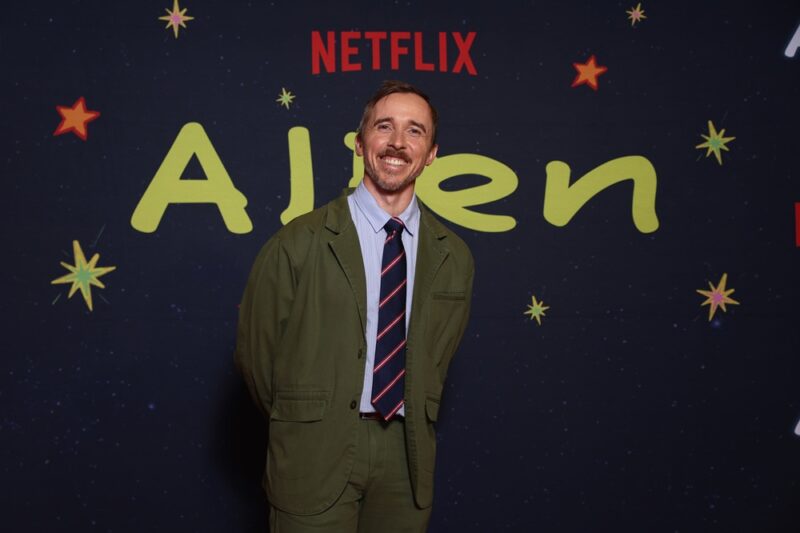
That relationship between uncertainty and control also informs Benedict Hardie‘s portrayal of Rory, a character whose attempts to maintain order place him in opposition to the unfolding adventure.
When asked whether Rory is more threatened by Allen himself or by his inability to control the increasingly ridiculous situation around him, Hardie suggested the distinction was largely irrelevant.
“I think those two things are the same,” he said. “I play the antagonist in the sense that the other characters are having an adventure, and I’m largely trying to pump the brakes on that, trying to stop the fun guys from having too much fun.”
For Hardie, Rory’s behaviour reflects a recognisable human response to circumstances that challenge our understanding of the world.
“I think that is a desire for control, or a fear of the unknown. I think those two things go hand in hand: the desire for control and the fear of the unknown. Conservatism, the fear of progress, whatever. Those things are two sides of the same coin.”
Yet the actor was careful not to reduce Rory to a conventional villain.
“I don’t think that makes Rory a bad guy. I think it probably makes him a guy with fear in his soul.”
After a moment’s consideration, Hardie offered a suitably wry summary of his character’s worldview.
“Fear makes us all sensible. Is that a quote?”
It might well be now.
Surviving an alien invasion, one cast member at a time
Of course, a film about an alien returning to Earth also invites a considerably less philosophical question: if an actual extraterrestrial invasion occurred, which member of the Allen cast would be the most useful person to have by your side?
For Barclay, assembling her hypothetical end-of-the-world team required a careful assessment of her co-stars’ practical abilities.
“Benedict, for sure, actually, because I feel like he’d be very practical and he’d keep his head and he’d come up with a really clever plan,” she reasoned.
Charlotte Nicdao, meanwhile, would apparently be a welcome presence, though Barclay was less certain about her survival credentials.
“Charlotte would be nice to have around, but I don’t know how much she’d bring to the table in terms of practical life skills.”
Helman’s imposing physical presence made him another potential candidate, although Barclay wasn’t entirely convinced appearances would translate into usefulness.
“Josh could be okay, but I think he just looks like he can lift really heavy things, and I don’t know if he could if it came down to it. We’d find out, but I don’t want to find out post-alien invasion.”
Power, she suggested, would fulfil an equally important role.
“I think T.J would keep everyone feeling really positive, which is important, I guess. They’d all bring something beautiful to it.”
Power himself had a rather more straightforward assessment of Helman’s suitability.
“I mean, look at that guy. Look at Joshy Helman!”
Hardie, however, was quick to point out that actors might not be the most reliable people to have around when civilisation collapses.
“The thing about most actors is they’re pretty useless people. They don’t have a lot of skills,” he joked.
Nevertheless, he agreed that Helman’s strength would likely prove invaluable.
“I think Josh is very strong and could carry me and run through a horde of alien laser guns. He’s picked us all up. Emily could probably pick me up as well. I think she’s actually secretly quite strong.”
Ultimately, Hardie believed the ensemble would fare better together than apart.
“They’re all very resilient people. So I think the best would be if we banded together. If we were a crew, an apocalypse crew, we would figure out what to do.”
Helman, on the other hand, wasn’t particularly confident in his own chances of survival, although his concerns had less to do with physical ability than his moral compass.
“I trust myself to a point, but I really think that I care a lot about being a decent person, and I think that would get me killed in some sort of apocalyptic situation.”
And not, he clarified, in any particularly heroic fashion.
“I think I would just be like, ‘I don’t want to kill this person,’ and then someone else would just kill me instantly because they’re not beholden to it with the same kind of fears that I am. They’re just like, ‘Let’s kill him and eat him. There’s a lot of meat on those bones.'”
Perhaps it’s fortunate that Allen offers a rather more affectionate interpretation of extraterrestrial contact.
Cheddar Rings, Happy Pants and the lost art of Blockbuster
With Allen drawing so heavily on childhood nostalgia, the conversation inevitably turned to the 1990s and what the cast would most like to resurrect from the decade.
For Barclay, the answer was immediate and wonderfully specific.
“Cheddar Rings!” she exclaimed. “I love Cheddar Rings, and I tried to find some for my kids, and I couldn’t. I was like, ‘Can Cheddar Rings come back?'”
Power opted for a fashion revival.
“Happy Pants, do you remember those? They’re just loud pants.”
Hardie, meanwhile, recalled a childhood birthday that revealed just how thoroughly one particular pop culture phenomenon had consumed his younger self.
“I remembered something that I’d forgotten recently, that I had a birthday once in the ’90s when every present that I got was Teenage Mutant Ninja Turtles. Just wall to wall.”
The actor admitted he hadn’t realised quite how obvious his obsession had been to everyone around him.
“I didn’t know I was putting that out into the world, but apparently it was obvious to everyone that that was the only thing I cared about at the time.”
His ideal nostalgic revival, unsurprisingly, would involve returning to the original incarnation of the heroes in a half shell.
“Not the rehash, not the remakes, but old-school Ninja Turtles. That would probably send me to a very happy place.”
For Helman, however, the object of his nostalgia wasn’t a particular film, television series or fashion trend, but the ritual of watching movies itself.
“The first thing I thought of instinctively was my VCR,” he admitted. “I had such a fucking relationship with that thing. Excuse my French!”
He went on to fondly recall his weekly pilgrimage to Blockbuster, a ritual that will likely resonate with anyone who remembers when choosing a film involved considerably more effort than scrolling through a streaming menu.
“I used to go to Blockbuster every Friday, and they would have seven weeklies for $11. I think it took me half an hour to walk there, and then I was probably in there for half an hour, and then I’d walk home. And then I’d just spend all weekend watching the seven movies that I got. Oh man, it was bliss.”
Asked whether there was one film he found himself repeatedly returning to, Helman didn’t hesitate for long.
“Probably at that time, if I was feeling like I needed a pick-me-up, it would be Back to the Future. That was just an evergreen film.”
It’s a love affair that has endured well beyond the demise of the video rental store.
“Still to this day, if ever that’s on, I’d easily just be like, ‘Great. This is a fantastic use of the next hour and a half of my life.'”
Other childhood favourites included The Goonies and Wallace and Gromit, titles that feel particularly appropriate given Allen‘s own combination of youthful adventure, eccentric humour and heartfelt storytelling.
A Queensland story with universal appeal
Beyond the playful exchanges and nostalgic recollections, the Brisbane screening served as a celebration of Queensland’s growing creative industry and the storytellers bringing distinctly local experiences to an international audience.
For Ludo Studio, Allen is an opportunity to extend its storytelling beyond the animated world of Bluey while retaining the emotional sincerity, distinctly Australian humour and affection for everyday life that have helped define its work.
The film’s coastal setting is more than an attractive backdrop. It is an essential part of its identity, reflecting Pearson’s own childhood on the Sunshine Coast and the particular atmosphere of suburban Australia in which the extraordinary can feel just around the corner.
And while Allen arrives with the promise of extraterrestrial encounters, its cast’s reflections suggest that the film’s most affecting moments may come from something far more grounded.
Whether it’s Barclay finding the magic of childhood through Sarah, Power drawing on the unconditional love he feels for his son, Helman examining the stories we construct to protect ourselves from difficult memories, or Hardie recognising the fear that often sits beneath our need for control, each actor approaches the material from a distinctly human perspective.
Perhaps that’s what makes Allen such an appealing proposition. Beneath the science-fiction premise is a story about the people we were, the people we’ve become, and whether growing up necessarily means letting go of everything that once made the world feel magical.
And for one evening in Brisbane, surrounded by the people who brought that story to life, it was a reminder that sometimes the most extraordinary adventures begin in our own backyard.
Allen premieres globally on Netflix on November 12th, 2026.
