

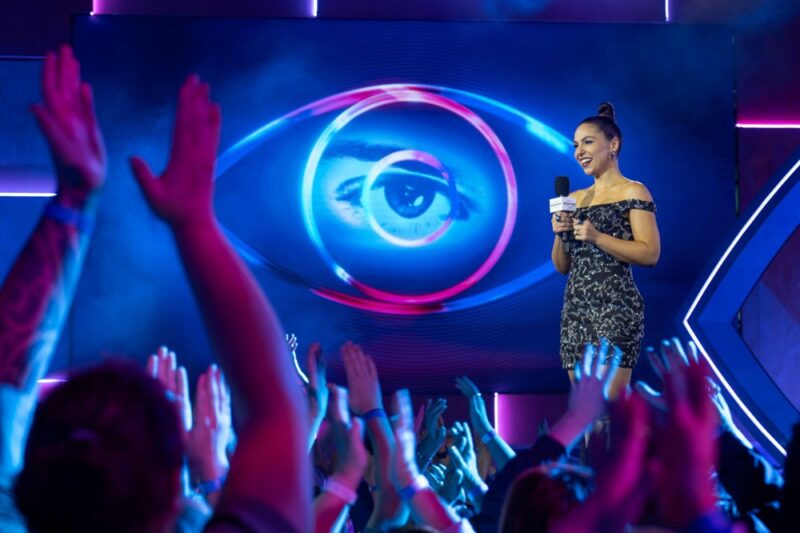
In an age where our lives are increasingly curated for social media and differing opinions can be silenced with the click of a button, the idea of throwing complete strangers into a house where there’s nowhere to hide feels more fascinating than ever. As Big Brother Australia returns to Network 10 with live nominations, live evictions, 24/7 streaming and an all-new Brisbane location, the iconic reality series is once again embracing the unpredictability that made it a cultural phenomenon. For returning host Mel Tracina, that unpredictability is precisely what makes the show’s enduring social experiment so compelling.
Speaking with our Peter Gray ahead of the show’s premiere, Tracina reflects on the challenges of remaining authentic in an era of cancel culture, why younger generations could benefit from being forced to confront differing opinions face-to-face, and how hosting live television has taught her to embrace the unexpected. From her surprising emotional investment in last season’s housemates to the anxieties that would make her a less-than-ideal contestant herself, Tracina discusses the importance of giving people room to evolve, the beauty of unfiltered human behaviour, and why, in a world obsessed with controlling its own narrative, sometimes the most revealing thing we can do is surrender that control.
Big Brother was designed to observe people being themselves. We’re now living in this world where everyone is so conscious of how they’re perceived through social media. Do you think it’s harder to be genuinely yourself in the Big Brother house today?
With social media and cancel culture, I think there’s a genuine concern, particularly among younger generations, about expressing an opinion that isn’t necessarily shared by your peers. Online, it’s easy to block someone, leave a comment or simply disengage without ever having a conversation. But in the Big Brother house, you’re living with these people 24 hours a day. You’re sharing the same space, which forces you to have difficult conversations, resolve disagreements and confront opinions you might otherwise avoid.
I think eventually your true self comes out, but it also gives you an opportunity to redeem yourself. So much can change in 24 hours in that house. You might say or do something that people disagree with, but then they’ll see another side of you and realise there’s more to who you are. Maybe they’ll begin to understand why you think a certain way because of your upbringing or experiences they hadn’t previously considered. It allows people to show their layers in a way social media rarely does.
That’s what excites me about this season and what I loved about last season. Particularly for younger housemates who’ve grown up with technology, there’s something valuable about being forced to have face-to-face conversations rather than simply ghosting someone when you disagree. In the house, you can’t hide. There are cameras everywhere, and you’re all living together. You have to work through things.
It makes us sound like we’re saying, ‘Kids today don’t understand,’ but there’s something to be said for recognising that differing opinions are okay. You can still be friends with someone who has different political views or a different outlook on life. I think about Bruce last season, who spoke about wanting a very traditional lifestyle, which some Australians found quite old-fashioned. But as the season progressed, he fell in love with a single mother, and suddenly his actions seemed to contradict what he’d initially said. You got to see someone evolve, or perhaps reveal a side of themselves that their words hadn’t properly conveyed.
I’m not saying everyone needs to change their opinions, but Big Brother gives people the space to show who they really are, rather than being defined by one statement or one moment. And I think that’s incredibly important.
You’ve spent so much of your career observing people through comedy and pop culture, but Big Brother gives you this opportunity to watch people when they’re stripped of their usual routines and comforts. Has hosting the show changed the way you understand human behaviour? Or has it made you more sympathetic to why people act the way they do?
That’s a really great question. The first thing that comes to mind is seeing the housemates during auditions. Some come across as incredibly confident and opinionated, but then you put them on a live stage and suddenly that confidence disappears. It’s a reminder that people behave differently depending on their environment. For me, being on stage is where I thrive because it’s my job and I’m comfortable there, but for them, it’s unfamiliar territory, and they can feel anxious or overwhelmed.
It’s interesting seeing how people respond in those situations, because sometimes what they give you isn’t necessarily what you anticipated. Their inner monologue is probably going into overdrive with the cameras, lights, audience and everything happening around them. It’s also a reminder that when someone seems a little short with you, it doesn’t necessarily mean they’re rude or don’t know what to say. They might simply be completely out of their depth. Sometimes you need to approach people with a little more kindness, give them space to settle in and allow them to become comfortable enough to show who they really are.
Well, going off that, I wanted to look at your relationship with live television. With Big Brother, you’re hosting a show where unpredictability is the entire point. Has it taught you to become more comfortable with losing control? Or is there still a part of you internally screaming when something goes off script?
(Laughs) You always want things to be within your control, right? Maybe that’s just my personality, but I like to be as prepared as possible and know what to expect. With live television, though, you can’t control everything. Things can go off the rails at any moment.
What I reminded myself last season is that the reason we were all craving the original Big Brother format was because everything these days feels so curated and edited. That live element brings a certain anxiety, not just for me as the host, but for the audience too. You’re watching and thinking, “Is this supposed to be happening? How are they going to handle this?” And that’s where the excitement and exhilaration come from.
I’ve shifted my perspective and realised we’re all on this ride together. I might be the one driving, and I don’t necessarily know where we’re going, but we’ll figure it out along the way. That’s what makes it exciting. It’s what we’ve all been wanting, so when something unexpected happens or we’re thrown a curveball, I’ve learned to embrace it rather than fear it.
That probably answers this next question, but after your first season, did you discover something about the type of host you wanted to be that perhaps you hadn’t anticipated when you first took the job?
I feel like with everything I do, I just try to be myself. I wanted to remain authentic, and for me that means having fun, sharing a laugh, bringing some heart when it’s needed, but also calling people out when necessary. Thankfully, I feel like last season gave me the opportunity to do a little bit of everything, and I felt really comfortable in that space. I was never pushed to do anything that felt outside my comfort zone or respond in a way that didn’t come naturally to me. I can just be myself, and that’s always been really important.
I imagine when you sign up to host something like Big Brother, you’re expecting chaos, you’re expecting drama, you’re expecting laughs…but did you underestimate how emotionally invested you’d become in the housemates? Was there a moment last season where you thought, “I’m not just presenting these stories; I genuinely care about how this is turning out?”
Yeah, I remember when Coco was announced as the winner in the finale, I actually got emotional. I could feel myself welling up and thought, “Oh my God, am I going to cry? Don’t cry, you’re on national television!” (Laughs). But it was such a beautiful moment, seeing her family and kids there, and knowing how much that money meant to her. That was when I realised just how invested I’d become.
I had so much respect for every housemate. Not everyone is going to love every contestant, but they gave us so much entertainment and, more importantly, they gave us themselves. I respected the hell out of them for that. So whenever someone would criticise a housemate, I’d find myself getting a little defensive, almost like they were talking badly about one of my friends.
One of the things I miss about early reality television is so often the contestants became famous accidentally. They weren’t trying to build a brand or launch a career. They were ordinary people thrown into these circumstances. How important is it to you that Big Brother still feels like a show about everyday Australians rather than people who are already thinking they’re going to become reality stars?
I think that was always the beauty of Big Brother. When it first started, nobody really knew what it was, and suddenly the housemates became household names. People were obsessed with them, and they became celebrities. That probably helped create this culture where people go on reality television hoping to launch a career.
But what’s interesting about Big Brother is that so many people who apply genuinely just want the experience. They’re not necessarily looking for fame or opportunities afterwards. They want to live in the house, be part of that social experiment and then return to their normal lives. So many former housemates would happily go back and do it all again, which says a lot about how unique the experience is. I think that’s what makes it so fascinating, both for the people participating and those watching at home.
Given how much you’ve observed from the outside, do you think you’d make a good Big Brother housemate? Or would living with a dozen strangers with no privacy and knowing Australia was watching every version of Mel Tracina be too much?
(Laughs) The first thing that gives me anxiety is the thought of 12 or 14 beds in a bedroom with no windows. I couldn’t do it! I always need to sleep near a window, so I already know I’d struggle with that. And I’d spend every night replaying every conversation I’d had with the other housemates, overanalysing what I said, what I didn’t say and how I might have embarrassed myself.
I’ll probably do that tonight about our conversation! I’ll be lying in bed thinking, “Why did I say that? Why didn’t I answer that differently?” Honestly, I reckon I’d do my own head in before any of the other housemates even got the chance.
I’m the same! I’ll have an argument and think on it for the next few days, thinking, “Oh, this is going to happen, or that’s going to happen,” and then days later the person in the argument actually has no idea why you argued in the first place. It’s like, “Yeah, cool, I don’t remember either. I’m fine!”
(Laughs) Yeah, it’s like, “What argument?”
And just before letting you go, this idea of being watched around the clock felt very confronting when the show first began. Now we voluntarily document so much of our lives online for complete strangers. Do you think Big Brother has become an even more interesting social experiment because the housemates are experiencing something we’re all doing to varying degrees, but they can’t control what the audience can see?
That’s an interesting point, because you look at platforms like Twitch, where people stream themselves just going about their daily lives. I think that proves how much we love watching other people live, although I’m not sure what it is about us that’s so fascinated by it.
What makes Big Brother more interesting is that the housemates never really know what the audience is seeing. Even with the live stream, you might be in a completely different room from where the cameras are focused, so you have no idea what’s being broadcast. And unlike people who choose to livestream their everyday lives, these housemates are voluntarily locking themselves in a house with complete strangers, where this ominous figure tells them what to do! That adds a whole other layer of excitement and craziness to the experience.
The latest season of Big Brother is now available to watch and stream free on Channel 10.
