

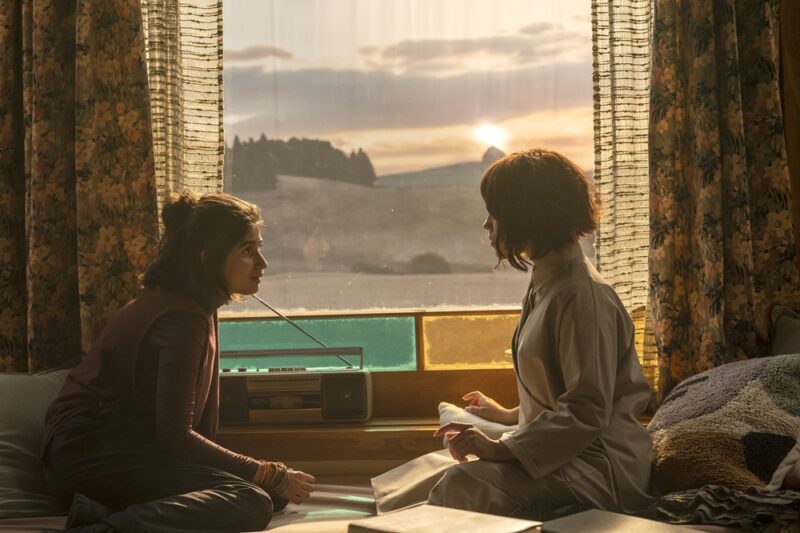
There’s something inherently heartbreaking about the idea of a machine understanding the value of human connection better than the people who created it. That contradiction sits at the centre of Klara and the Sun, Taika Waititi‘s adaptation of Kazuo Ishiguro‘s acclaimed 2021 novel, a science-fiction fable that explores artificial intelligence, faith, grief and the lengths we go to for those we love. It’s a story that should feel increasingly relevant in an age where technology is reshaping our understanding of companionship and emotional intimacy. And, in its most affecting moments, it does. But for all its philosophical ambition and undeniable visual beauty, Klara and the Sun is a frustratingly uneven experience, one that struggles to reconcile its whimsical sensibilities with the profoundly sad story it’s attempting to tell.
Set in an unspecified future where artificial companions have become an accepted part of everyday life, the film introduces us to Klara (Jenna Ortega), a solar-powered Artificial Friend whose outdated B1 programming has left her facing an uncertain future. Displayed in the window of a store managed by an encouraging but pragmatic shopkeeper (Natasha Lyonne), Klara spends her days observing human behaviour, attempting to understand the peculiarities of love and friendship, and quietly praying to the Sun that someone might finally choose her. It’s a beautifully simple introduction to a character whose understanding of the world is simultaneously limited and remarkably perceptive.
That wish is eventually granted when Josie (Mia Tharia), a lonely teenager suffering from a mysterious illness, convinces her reluctant mother, Chrissie (Amy Adams), to bring Klara home. Living in an isolated countryside property surrounded by seemingly endless golden fields, Josie has undergone a controversial procedure known as “lifting”, a form of genetic enhancement designed to improve a child’s intellectual capabilities but one that carries potentially devastating consequences. With the family already haunted by the death of Josie’s sister, Klara’s arrival introduces an unusual source of optimism into a household where grief has become almost as familiar as the furniture.
It’s here that Waititi’s film finds its most compelling ideas. Klara, despite being an artificial creation, approaches the world with a purity of feeling that the humans around her have seemingly forgotten. She doesn’t question whether love is logical or whether hope is justified. She simply believes. Her relationship with the Sun, which she regards as a benevolent force capable of healing those she cares about, becomes a quietly moving expression of faith, suggesting that the need to believe in something greater than ourselves may not be exclusively human after all.
And at the centre of it all is Ortega, who is unquestionably the film’s greatest asset.
In what is arguably one of her most endearing and accomplished performances, Ortega brings a remarkable physical and emotional specificity to Klara. There’s something wonderfully delicate about the way she moves, her tentative gestures, curious expressions and occasionally awkward movements suggesting a being still learning how to inhabit the world around her. Yet what makes the performance so effective isn’t simply its carefully considered physicality, but the genuine emotional warmth Ortega manages to communicate through a character who, technically speaking, shouldn’t possess emotions at all.
Her wide-eyed wonder never feels entirely manufactured, and even when the screenplay threatens to reduce Klara to little more than an adorable collection of artificial quirks, Ortega finds something recognisably human beneath the programming. It’s a truly shining performance, one that manages to be funny, innocent and, ultimately, tremendously sad. There are moments when the slightest shift in her expression communicates more than entire stretches of dialogue, and it’s largely through her commitment that the film retains any emotional credibility when its storytelling begins to falter.
Tharia provides a tender counterpoint as Josie, capturing both the youthful excitement of someone desperate to experience the world and the quiet vulnerability of someone increasingly aware that her time within it may be limited. Adams, meanwhile, brings an appropriately brittle quality to Chrissie, a mother whose protective instincts are inseparable from the trauma of having already lost one child. Her relationship with Klara is particularly interesting, shifting between suspicion, resentment and a desperate willingness to entertain possibilities she might otherwise consider unthinkable. There’s an entire film to be made about this woman’s grief, and Adams occasionally suggests the emotional complexity that a more focused screenplay might have explored.
Visually, too, Klara and the Sun is frequently stunning. Shot in New Zealand, the film makes extraordinary use of its expansive landscapes, with golden wheat fields, softly illuminated interiors and a deliberately heightened colour palette creating a world that feels suspended somewhere between a storybook fantasy and a melancholy vision of the future. Waititi’s use of light is especially effective, not merely as an aesthetic choice but as an extension of Klara’s understanding of existence. The Sun becomes both a literal source of energy and a symbol of something far more spiritual, while occasional pixelated imagery offers an intriguing glimpse into the way Klara processes her surroundings.
There’s a charming retro-futurism to the production design, too, one that avoids the sterile technological environments so often associated with stories about artificial intelligence. This is a world that feels strangely familiar despite its advancements, and that familiarity allows the film’s more fantastical elements to exist without requiring excessive explanation.
Unfortunately, the film’s greatest problem is its inability to establish a consistent tone, with Waititi’s instinct for offbeat humour repeatedly undermining the emotional gravity of Ishiguro’s material.
Waititi has previously demonstrated an extraordinary ability to locate humour within sadness, particularly in Hunt for the Wilderpeople and Jojo Rabbit, where moments of absurdity often made the surrounding tragedy feel more devastating. Here, however, that balancing act proves considerably less successful. The director appears torn between presenting Klara and the Sun as a whimsical family adventure and allowing it to exist as the deeply unsettling meditation on mortality, loneliness and human replaceability that its premise demands.
The result is a film that can feel almost juvenile in one moment and overwhelmingly bleak in the next, without the necessary emotional transitions to make those competing sensibilities feel complementary.
Nowhere is this more apparent than in a particularly unfortunate sequence involving a gathering of fellow “lifted” children that Josie is expected to attend. Until this point, the film has established a heightened, occasionally eccentric reality that, while not entirely convincing, possesses its own peculiar internal logic. This scene, however, feels as though it has wandered in from an entirely different production.
The children are presented as such an obnoxious collection of exaggerated personalities that the sequence becomes almost unbearable. Their behaviour is theatrical to the point of absurdity, the performances insufferably mannered, and the entire interaction so aggressively unpleasant that it completely disrupts the film’s carefully cultivated atmosphere. There’s presumably an intention to expose the social cruelty and emotional detachment fostered by a society obsessed with intellectual superiority, but the execution is so heavy-handed that any underlying commentary becomes lost beneath the noise.
It’s a genuinely baffling creative decision, one that feels too far removed even from the exaggerated reality Waititi has already established. More frustratingly, it’s the sort of sequence that doesn’t merely interrupt the film’s momentum; it fundamentally changes the way we engage with it. The delicate emotional connection that had been developing is abruptly severed, and the film never quite recovers its earlier sense of intimacy or sincerity.
That tonal instability becomes increasingly problematic as the narrative moves towards its darker revelations. Ishiguro’s original story is built upon ideas that are quietly devastating: the possibility that human beings might be replaceable, the uncomfortable relationship between love and possession, and the extent to which grief can distort our understanding of identity. These are fascinating concepts, particularly when viewed through the eyes of a character whose innocence prevents her from recognising the cruelty inherent in certain human decisions.
Yet Waititi’s adaptation often seems reluctant to sit with those uncomfortable implications for long enough. Rather than allowing the film’s more disturbing ideas to develop organically, the screenplay introduces them, briefly acknowledges their significance and then moves towards another moment of levity or narrative convenience. The result is a story that gestures towards profound emotional and philosophical territory without consistently engaging with its complexity.
The central friendship between Klara and Josie suffers as a consequence. While Ortega and Tharia share an appealing chemistry, the screenplay doesn’t always devote sufficient time to establishing the depth of their connection. We’re encouraged to believe in an extraordinary bond, and there are certainly moments when that affection feels genuine, but the relationship occasionally seems more important to the story’s thematic intentions than to its actual dramatic construction.
Interestingly, the interactions between Klara and Chrissie often carry greater emotional weight. Adams’ character is driven by a desperation that makes her behaviour increasingly difficult to justify, yet entirely understandable. In those moments, the film comes closest to confronting the uncomfortable truth that love, particularly when accompanied by the fear of loss, can become something deeply selfish.
And perhaps that’s what makes the overall experience so disappointing. Beneath its uneven execution lies a genuinely affecting story about the sacrifices we’re prepared to make for people who may never fully understand what we’ve given up for them. Klara’s unwavering devotion is beautiful, but it’s also tragic, particularly as the film gradually reveals how easily that devotion can be taken for granted.
There is an overwhelming sadness running through Klara and the Sun, one that becomes more pronounced as its central ideas begin to crystallise. For all the bright colours, eccentric humour and occasional moments of childlike wonder, this is ultimately a story about mortality and the inevitability of being left behind. It’s difficult not to be moved by the implications of Klara’s existence, or by Ortega’s ability to communicate a sense of longing that feels almost painfully human.
Which makes the film’s conclusion all the more frustrating.
Rather than allowing its emotional revelations the space they deserve, the final act feels strangely hurried, moving through significant developments and difficult decisions with an efficiency that borders on indifference. Questions that should linger are brushed aside, character arcs arrive at their conclusions without sufficient exploration, and the film seems determined to reach an uplifting emotional resolution without fully confronting the sadness that makes such a resolution complicated in the first place.
And yet, despite its considerable shortcomings, it’s difficult to dismiss Klara and the Sun entirely. There are images of undeniable beauty, moments of genuine tenderness and a central performance so committed and luminous that it frequently elevates material struggling to find its own identity. Waititi’s more playful instincts aren’t inherently incompatible with Ishiguro’s melancholy worldview, but the film never quite discovers how to make them coexist without one undermining the other.
Perhaps the greatest irony is that a story about an artificial being learning to understand human emotions should itself feel so uncertain about how to express them. The ingredients for something extraordinary are all here: a fascinating premise, an accomplished cast, exquisite production design and themes of enduring relevance. What remains elusive is the delicate emotional precision required to bring them together.
Ortega gives Klara and the Sun its heart, and it’s a heart that shines remarkably brightly. Unfortunately, the film surrounding her is too tonally confused, narratively uneven and emotionally rushed to fully honour either her performance or the extraordinary sadness of its source material. Beautiful to look at and occasionally deeply moving, it’s a film that understands the importance of human connection without ever quite making us feel it as profoundly as we should.


TWO AND A HALF STARS (OUT OF FIVE)
Klara and the Sun is now screening in Australian theatres.
