

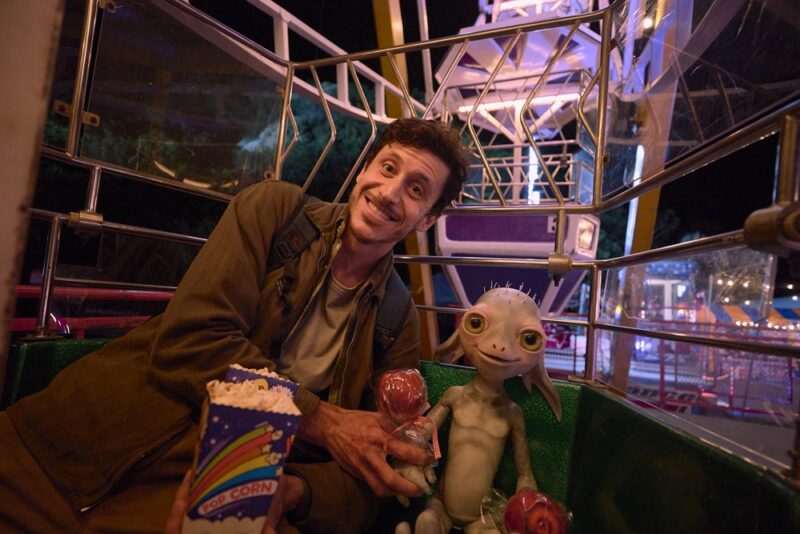
The creative minds behind one of Australia’s most beloved television exports are turning their attention to a different kind of family adventure, as Netflix unveils the official trailer for Allen, a heartwarming new Australian feature from Brisbane-based Ludo Studio.
Best known for bringing the Emmy and BAFTA Award-winning phenomenon Bluey to audiences around the world, Ludo Studio is making its first foray into live-action feature filmmaking with Allen, a nostalgic tale of friendship, family and the extraordinary connections that shape our lives.
Created by Australian filmmaker Daley Pearson (Talk to Me, The Strange Chores, Content), who co-directs alongside Jeffrey Walker (Apple Cider Vinegar, The Artful Dodger), the film takes audiences to a picturesque Queensland coastal town, where the past and present collide through the story of Petey, a man reflecting on the loss of his best friend, Allen, twenty years earlier.
Set against the sun-drenched backdrop of coastal Australia, Allen promises a distinctly local take on the kind of emotionally resonant, fantastical storytelling that defined family cinema throughout the 1980s and 1990s. There’s an undeniable spiritual connection to Steven Spielberg’s E.T. the Extra-Terrestrial, not simply through its extraordinary central character, but in its exploration of childhood innocence, unlikely friendship and the emotional weight of growing up.
It’s a sensibility that feels particularly fitting for the team behind Bluey, a series that has demonstrated an extraordinary ability to find universal truths in the seemingly ordinary moments of family life.
And while Allen may represent a significant creative departure for Ludo Studio, its commitment to storytelling that resonates across generations remains very much intact.
A nostalgic adventure with a distinctly Australian heart
One of the most intriguing elements of Allen is its relationship with time.
By contrasting the world of the 1990s with the present day, the film looks to capture the particular magic of childhood memories, when friendships felt limitless, adventures seemed possible around every corner, and the smallest moments could leave the most lasting impressions.
Rather than relying on nostalgia purely as an aesthetic, Allen appears interested in examining what those memories mean to us as adults, and how the people who shape our childhood continue to influence who we become.
For Pearson, the project is deeply personal, drawing inspiration from his own upbringing and the people and places that helped define it.
“Allen is really a story about love, family and all those big and small moments from childhood that end up shaping who we are when we grow up,” Pearson explained. “Getting the opportunity to make this story in this part of the world – in the town where I grew up in, inspired by the friends and family I grew up with – is a dream. We created Allen for families to watch together.”
That personal connection is evident in the film’s Queensland setting, which serves as considerably more than a picturesque backdrop. Filmed across Brisbane and the Gold Coast, with production also taking place in the coastal surrounds of Coolum, Allen embraces the particular textures of Australian coastal life, grounding its more fantastical elements in an environment that feels familiar and lived-in.
It’s an approach that recalls the enduring appeal of classic family adventures, where the extraordinary becomes all the more affecting because it exists within a recognisable world. For Australian audiences, there’s also something particularly appealing about seeing this style of cinematic adventure unfold against our own landscapes, rather than the American suburbs that have traditionally dominated the genre.
Behind the scenes: Bringing Allen to life
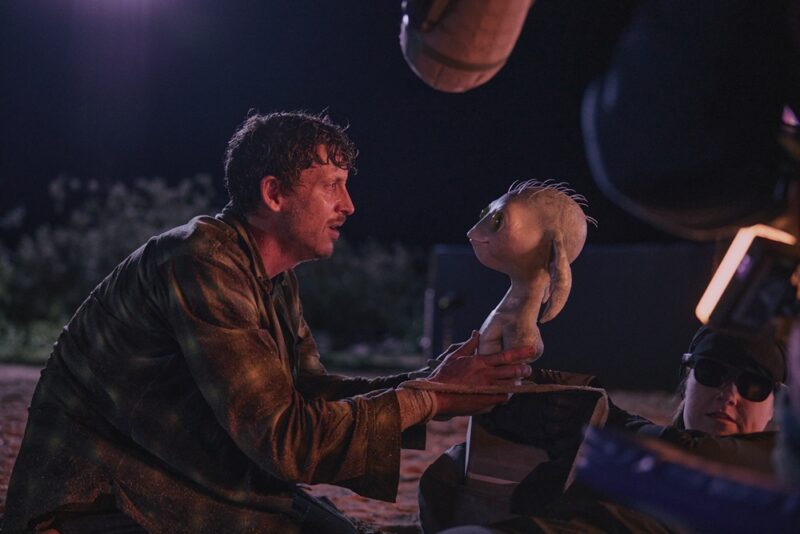
Last year, our Peter Gray was invited to visit the film’s Queensland production in Coolum, where he was given a behind-the-scenes look at the ambitious techniques being employed to bring its extraordinary central character to the screen.
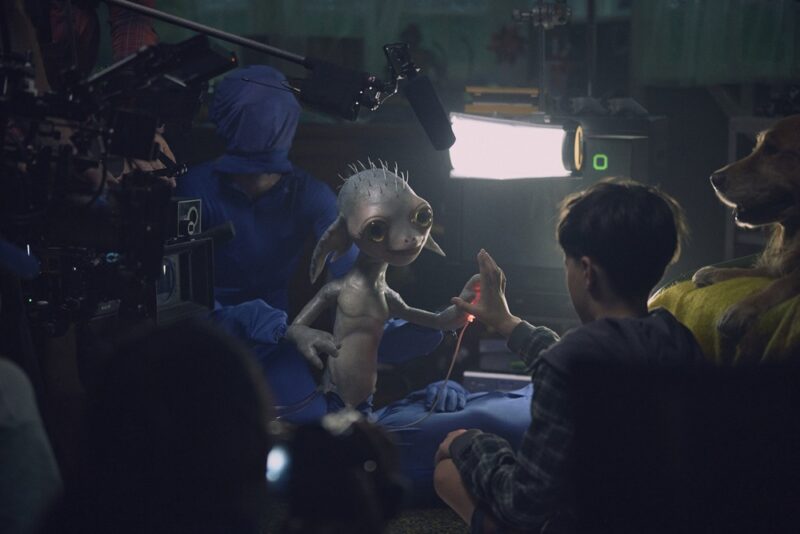
One of the most fascinating aspects of the production was the combination of physical puppetry, motion capture and advanced visual effects, with the filmmakers embracing both traditional and contemporary techniques to create a character capable of forming a genuine emotional connection with audiences.
Rather than relying exclusively on computer-generated imagery, the production incorporated a physical alien puppet, providing a tangible presence around which the performers and filmmakers could build their scenes. It’s a particularly interesting creative decision for a film so heavily informed by the emotional storytelling of earlier decades, when practical creature effects were central to making fantastical characters feel believable.
But Allen isn’t simply attempting to recreate the filmmaking techniques of the past.
The production also embraced new technology that allowed visual effects to be viewed and developed in real time, with the team able to livestream VFX elements during production and assess how the character would ultimately appear on screen.
This integration of practical performance and digital technology offered a fascinating glimpse into the evolving possibilities of modern filmmaking. Where productions have traditionally relied on visual effects being completed long after principal photography, this approach allowed the creative team to see, assess and refine elements of Allen’s appearance and performance while the filmmaking process was still underway.
The intention was not merely to create a technically convincing alien, but to preserve something far more important: the natural vulnerability and fragility of Allen himself. For a film built around an unlikely friendship, that emotional authenticity is crucial. The audience needs to believe not only that Allen exists within this world, but that he is capable of inspiring affection, empathy and genuine emotional investment.
It’s an ambition that makes the combination of puppetry and motion capture especially compelling. The physical elements provide an immediate point of connection, while the digital work allows the filmmakers to develop a broader range of expression and movement. Together, these techniques aim to create a character whose emotional presence is every bit as important as his fantastical appearance.
And having witnessed some of the work involved in bringing Allen to life, it’s clear that considerable thought has gone into ensuring the character feels like more than simply a visual-effects creation.
Finding the magic between old and new
The technological ambition behind Allen is particularly interesting when considered alongside its nostalgic influences.
At its heart, the film appears to be embracing a delicate balance: using the possibilities of contemporary filmmaking to recapture the emotional simplicity of the family adventures that defined an earlier generation.
Films such as E.T. the Extra-Terrestrial have endured not because of their spectacle alone, but because of the humanity audiences found within their fantastical characters. The relationship between Elliott and E.T. remains affecting because the film understands childhood loneliness, the need for connection and the pain of having to say goodbye.
Allen appears to be exploring similar emotional territory, albeit through a distinctly Australian lens and a narrative that also considers how those childhood experiences continue to resonate decades later. That contrast between the 1990s and the present day gives the film an intriguing additional dimension.
For older viewers, the period setting may evoke memories of their own childhoods, while younger audiences can discover the same sense of wonder without needing to have lived through the era themselves. It’s an approach that speaks to the multigenerational appeal Pearson and his collaborators are hoping to achieve.
And in an entertainment landscape where nostalgia is frequently employed as a shortcut to audience recognition, there’s something refreshing about a film that appears more interested in the emotions associated with the past than simply recreating its visual identity.
From Bluey to the big screen
For Ludo Studio, Allen marks another significant chapter in what has become one of Australia’s most impressive contemporary creative success stories.
Having achieved extraordinary international recognition with Bluey, the Brisbane-based production company has continued to demonstrate its versatility through projects such as the acclaimed Thou Shalt Not Steal. Its first locally made live-action feature represents an ambitious expansion of that creative identity, while maintaining the emphasis on family, humour and emotional honesty that has become synonymous with the studio’s work.
Pearson’s involvement is especially fitting. As one of the creative forces associated with Ludo’s success, and with credits including the Australian horror phenomenon Talk to Me, he brings an understanding of both genre filmmaking and emotionally grounded storytelling. Joining him behind the camera is Jeffrey Walker, whose recent work on Apple Cider Vinegar and The Artful Dodger further demonstrates the breadth of Australian filmmaking talent involved.
Pearson co-wrote the screenplay with Sophie Miller (Thou Shalt Not Steal), with Sam Moor producing for Ludo Studio alongside Ross Allsop. Lauren Brown serves as co-producer, while Pearson, Charlie Aspinwall and Miller are executive producers.
The ensemble cast includes T.J. Power as Petey, Edward A. O’Sullivan as Young Petey, Charlotte Nicdao as Carly, Caitlin Niemotko as Young Carly, Josh Helman as Jaden, Chaydon Jay as Roy, Benedict Hardie as Rory, Kaipo Heke as Nahuel, Danny Kim as Jim, Christopher Sommers as Deputy Officer Gary Foots, and Scarlett Crabtree.
Netflix Vice President of Content APAC (ex-India), Minyoung Kim, praised the studio’s approach to the project.
“The team at Ludo Studio are among Australia’s most exceptional storytellers, injecting this film with their characteristic relatability and wit. We are delighted to create a film that the entire family can enjoy, and the Queensland coast provides the perfect, heartwarming backdrop for this tale.”
The production has also received support from the Queensland Government through Screen Queensland’s Production Attraction Strategy and Post, Digital and Visual Effects Incentive, further reinforcing the state’s growing reputation as a destination for major screen productions.
Minister for the Arts John-Paul Langbroek described Ludo Studio as a Queensland entrepreneurial success story, highlighting the opportunity for the Netflix production to showcase the state’s landscapes and creative talent to an international audience.
A friendship worth remembering
What makes Allen such an intriguing prospect is the combination of its intimate emotional ambitions and the considerable filmmaking innovation taking place behind the scenes.
The new trailer offers audiences their introduction to a story that celebrates the enduring power of friendship, while the production itself represents an ambitious attempt to unite the tactile charm of practical creature effects with the expressive possibilities of contemporary visual technology.
It’s a film looking backwards and forwards at the same time, revisiting the sense of wonder associated with the family adventures of the 1990s while exploring how modern filmmaking can bring that same emotional authenticity to a new generation. And with the creative team behind Bluey at the helm, there’s good reason to be intrigued by a story that promises to find something extraordinary in the seemingly ordinary experience of growing up.
Because beyond its alien character, technological achievements and nostalgic appeal, Allen ultimately appears to be asking a very human question: what happens to the friendships that define us when childhood becomes a memory?
