

The video game-to-film adaptation has long been a notoriously difficult undertaking. Despite the Mortal Kombat films enjoying relative commercial success and this year’s Resident Evil proving a welcome exception to the rule, Hollywood has continually struggled to translate the appeal of interactive entertainment into something equally engaging on the big screen. Whether it’s the baffling creative decisions of the live-action Super Mario Bros., the forgettable brutality of Doom, the misplaced ambition of Assassin’s Creed, or whatever DOA: Dead or Alive was attempting, the results have often been less than encouraging.
And then there’s Street Fighter. One of gaming’s most recognisable and enduring franchises, its cinematic history has been similarly troubled, beginning with the gloriously camp 1994 Jean-Claude Van Damme vehicle. Uneven, cheesy and very much a product of its time, that film at least had a certain ridiculous charm, thanks in no small part to Raul Julia’s deliciously theatrical final screen performance as M. Bison and, because why not, Kylie Minogue kicking her way through proceedings. The less said about 2009’s Street Fighter: The Legend of Chun-Li, however, the better.
The announcement of a new adaptation initially inspired some cautious optimism, particularly when Talk to Me filmmakers Danny and Michael Philippou were attached to direct. Their eventual departure saw Kitao Sakurai take the reins, and whilst it’s tempting to imagine what the brothers might have brought to the material, the screenplay credited to T. J. Fixman and Sakurai suggests that even the most inventive filmmaker would have struggled to salvage this particular tournament.
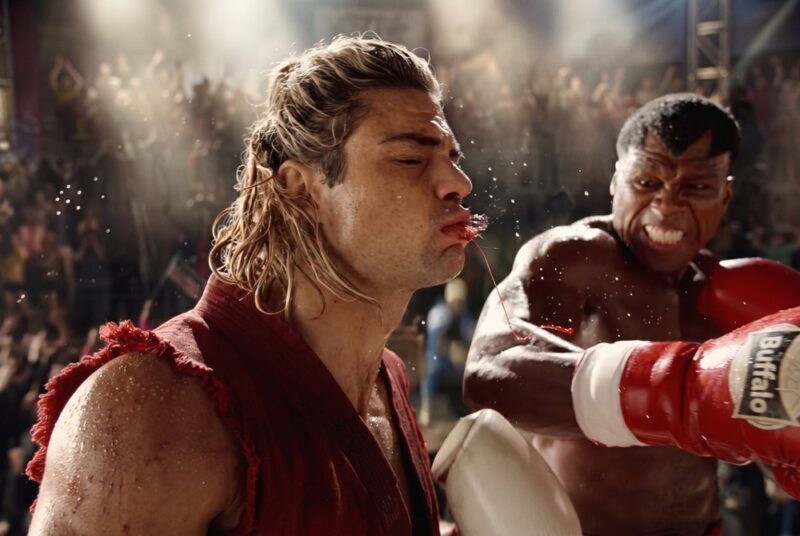
Set in 1993, six years after a devastating encounter with the mysterious Akuma (Joe “Roman Reigns” Anoa’i) fractured the brotherly bond between martial artists Ryu (Andrew Koji) and Ken Masters (Noah Centineo), Street Fighter centres on a new World Warrior tournament orchestrated by the villainous M. Bison (David Dastmalchian). With fighters from across the globe gathering to compete, Chun-Li (Callina Liang) hopes to expose Bison’s sinister intentions, whilst Ryu reluctantly finds himself drawn back into a world he’s spent years attempting to escape.
It’s a perfectly serviceable premise for a film based on a franchise whose primary appeal is watching larger-than-life personalities beat the living daylights out of one another. Unfortunately, Sakurai’s interpretation seems strangely uninterested in delivering that relatively straightforward pleasure.
For a film called Street Fighter, there’s a surprising lack of actual tournament fighting.
That’s not to suggest the film is entirely devoid of action, but the tournament itself feels frustratingly secondary to an increasingly convoluted narrative involving fractured friendships, personal vendettas, supernatural powers and Bison’s questionable ambitions. Some of the most anticipated confrontations are either rushed or relegated off-screen entirely, with a Guile-versus-Vega showdown proving a particularly baffling omission. When audiences are coming to see beloved characters square off against one another, denying them those encounters feels like a fundamental misunderstanding of the assignment.
Even more frustrating is that so much of Street Fighter appears promising in isolation. The casting, for one, is frequently inspired. Centineo makes for a surprisingly effective Ken, balancing the character’s cocky confidence with an appealing, slightly dim-witted charm that never renders him unlikeable. Koji, meanwhile, brings the necessary stoicism and physical credibility to Ryu, grounding the film whenever its increasingly cartoonish sensibilities threaten to overwhelm proceedings. Their contrasting personalities provide the closest thing the film has to an emotional centre, and both actors deserve credit for committing to material that rarely returns the favour.
Elsewhere, professional wrestler Cody Rhodes proves an unexpected comic highlight as Guile, whilst Dastmalchian possesses precisely the right eccentric energy for a villain as inherently theatrical as Bison. Liang certainly looks the part as Chun-Li and demonstrates impressive physical ability when finally afforded the opportunity, though she’s saddled with some particularly clunky dialogue concerning her father’s death and her determination to bring Bison down. It’s difficult to invest in her personal mission when the screenplay seems more interested in constantly redirecting its attention elsewhere.
The casting of Orville Peck as the masked, famously vain Vega is an amusingly inspired touch, whilst Anoa’i brings an imposing physical presence to Akuma, even if the character’s limited involvement diminishes what should be a genuinely intimidating threat. Jason Momoa, meanwhile, is predictably given permission to indulge his more unhinged tendencies as Blanka, though an unnecessary attempt to provide the character with a tragic backstory feels less like meaningful development and more like an excuse to justify additional screen time for one of the ensemble’s biggest stars.
And therein lies one of the film’s most persistent problems. With such an enormous roster of recognisable characters, Street Fighter seems determined to accommodate everyone without establishing why we should care about most of them. Curtis “50 Cent” Jackson‘s Balrog, Rhodes’ Guile and Peck’s Vega are all afforded precious little opportunity to make an impression beyond their appearances, whilst several other fighters barely register at all. The result is a film that somehow feels overcrowded and underdeveloped at the same time.
There are flashes of visual imagination, particularly during the animated sequences depicting the characters’ histories. Presented in striking 2D anime, these moments possess an energy and stylistic confidence that makes you wonder whether an entirely animated feature might have been the more rewarding approach. The costumes and character designs similarly demonstrate an admirable affection for the source material, even when the film surrounding them struggles to find a consistent identity.
Unfortunately, whatever goodwill these individual elements generate is repeatedly undermined by a screenplay that mistakes juvenile humour for personality. The abundance of obvious innuendo, childish punchlines and awkward comedic exchanges suggests a film pitched squarely at adolescent sensibilities, yet the tone never quite settles into something knowingly ridiculous enough to embrace its own absurdity. It wants to be irreverent, occasionally emotional and intermittently epic, but rarely manages to balance those ambitions convincingly.
At approximately two hours, the film also has a peculiar relationship with pacing. Considerable time is devoted to establishing motivations that ultimately amount to very little, whilst the tournament’s more exciting possibilities are frustratingly abbreviated. By the time the story begins approaching something resembling a satisfying culmination, Sakurai makes the particularly misguided decision to prioritise potential future instalments over delivering a complete experience. Without revealing specifics, the ending is remarkably abrupt, arriving at a moment that feels less like a natural conclusion and more like the beginning of a final act that never materialises.
It’s a particularly frustrating choice for a franchise attempting to re-establish itself cinematically, especially when the prospect of further adventures is far from guaranteed.
Perhaps the greatest disappointment is how uncomplicated a successful Street Fighter adaptation could have been. Assemble an eccentric collection of fighters, allow their personalities and rivalries to collide, build towards increasingly spectacular confrontations, and ultimately unite them against a common enemy. The source material practically provides the blueprint. Instead, Sakurai and his writers complicate matters with an excess of narrative threads that distract from the very thing audiences have come to see.
For all its missteps, Street Fighter isn’t entirely without entertainment value. Centineo and Koji emerge with their dignity intact, several supporting players make the most of their limited opportunities, and the occasional burst of stylised action hints at the considerably more enjoyable film buried beneath the clutter. But those fleeting pleasures can’t compensate for a production that consistently mistakes quantity for substance.
With its appealing ensemble, colourful visual sensibilities and decades of beloved gaming history to draw upon, Street Fighter had the ingredients for a gloriously entertaining piece of action escapism. Instead, it’s an overstuffed, tonally confused and surprisingly underwhelming adaptation that spends so much time setting up its fighters that it forgets to let them fight.


TWO STARS (OUT OF FIVE)
Street Fighter is now screening in Australian theatres.
