
Yeon Sang-ho has never needed monsters to expose the uglier parts of humanity. Even when working within horror, science fiction or apocalyptic spectacle, the filmmaker behind Train to Busan and Hellbound has remained fascinated by what people become when circumstances push them somewhere uncomfortable. Following Colony and The Ugly, Paradise Lost continues that fascination on a considerably more intimate scale, using artificial intelligence not as its villain, but as the doorway into a mother’s grief.
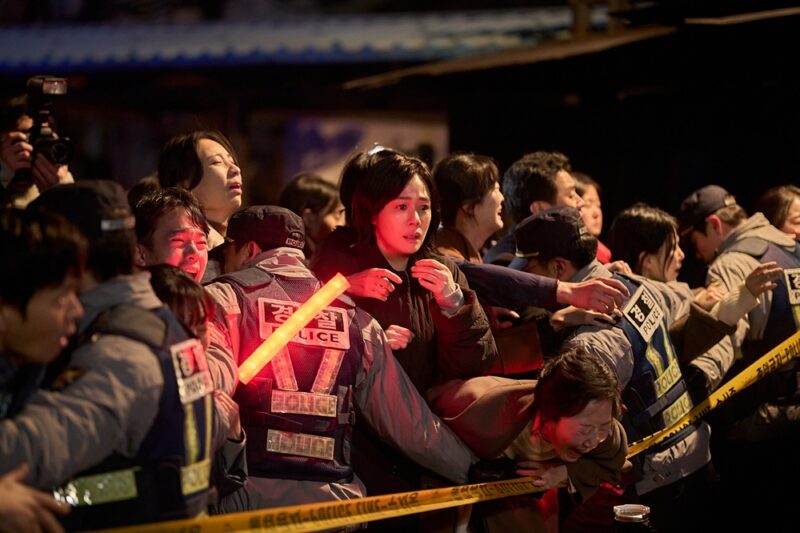
The film begins with an unimaginable tragedy. A bus carrying children to camp disappears, with only a handful of bodies recovered before the investigation eventually goes cold. Ryu So-young (Kim Hyun-joo) is left without answers regarding her 10-year-old son, Sun-woo, and finds an unusual means of surviving his absence through “Children of Paradise,” an AI program accessed through AR glasses that recreates the boy she lost.
For nine years, this virtual Sun-woo remains exactly as So-young remembers him. He speaks to her, needs her and allows her to continue being his mother, effectively freezing their relationship at the moment before everything went wrong. Then the impossible happens: Sun-woo (Bae Hyeon-seong) comes home.
Now an adult, the flesh-and-blood Sun-woo bears little resemblance to the child So-young has spent almost a decade preserving in her memory. He’s distant, difficult to read and carries the scars of nine missing years she knows nothing about. Rather than ending her grief, his return forces So-young to confront something potentially more painful: the child she desperately wanted back no longer exists.
It’s here that Paradise Lost becomes far more interesting than a cautionary tale about artificial intelligence. Yeon asks what happens when technology doesn’t merely imitate someone we love, but gives us the version of them we would rather have. The virtual Sun-woo is artificial, but So-young’s feelings towards him aren’t. He represents memory without complication, love without change and motherhood without the painful requirement of accepting that a child will eventually become someone independent of their parent.
The real Sun-woo, meanwhile, represents everything the simulation protects her from.
Yeon has described Paradise Lost as something of a companion piece to The Ugly, and the connection makes sense. Where that film examined a father and son, this is centred on a mother and child, with both stories interested in what happens when supposedly unconditional familial love encounters truths it would rather not acknowledge. Yeon even reshaped the story from its earlier conception, reducing its investigative elements to concentrate more directly on this fractured relationship.
That intimacy serves Kim Hyun-joo particularly well. So-young could easily have become either a helpless victim of technology or an increasingly irrational mother, but Kim keeps her suspended somewhere painfully between the two. Her behaviour becomes harder to justify as the film progresses, yet the emotional logic behind it remains understandable. She has spent nine years constructing a relationship around absence; asking her to suddenly abandon that because reality has returned is considerably more complicated than simply taking off the glasses.
Bae Hyun-sung is equally effective precisely because he gives so little away. Sun-woo has an unnerving stillness that makes both So-young and the audience question him, but Yeon wisely avoids turning that inscrutability into obvious menace. Behind the production, Bae specifically approached the character through restraint rather than overtly trying to frighten, while he and Kim deliberately maintained a degree of distance during filming to preserve the awkward unfamiliarity between mother and son.
That disconnect extends beautifully into the film’s construction. The virtual world is deliberately warm and colourful, albeit interrupted by tiny visual glitches, while reality becomes increasingly cold and unstable. Cinematographer Song Hyun-suk gradually abandons the comparatively composed imagery of the film’s opening for more restless movement as So-young’s emotional state deteriorates, while the sparse soundscape contrasts the warmth of her artificial sanctuary with the uncomfortable quiet of the world outside it.
It creates an intriguing contradiction: the world we know is fake frequently feels more comforting than the one we know is real.
And perhaps that is Paradise Lost’s most unsettling idea. So-young’s dependence on her virtual son is obviously extreme, but the emotional impulse behind it isn’t particularly futuristic. People already curate memories, revisit old messages and photographs, and preserve versions of people and relationships that no longer exist. AI merely allows So-young to make that memory responsive. Her son can answer back. He can tell her he loves her. Most dangerously, he never has to become someone she doesn’t recognise.
The film’s eventual resolution isn’t quite as satisfying as the psychological puzzle Yeon constructs around it, with its answers proving less provocative than the questions that precede them. But perhaps neat closure would be dishonest for a story so consumed by our inability to achieve it.
Paradise Lost ultimately isn’t asking whether artificial intelligence can become human. Its more disturbing question is whether humans might willingly choose an artificial relationship when reality becomes too painful to accept. In So-young’s desperate attempt to preserve the son she remembers, Yeon finds something sadder than technological dependence: the possibility that loving our memory of someone can sometimes be easier than loving the person standing in front of us.


THREE AND A HALF STARS (OUT OF FIVE)
Paradise Lost screened as part of this year’s Toronto International Film Festival, which ran between September 10th and 20th, 2026. For more information, head to the official site here.
