

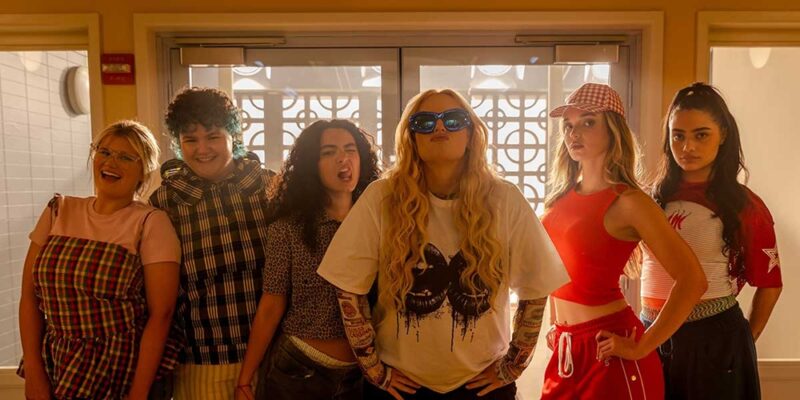
Rebel Wilson clearly has an enormous amount of affection for the girl groups that soundtracked her formative years. Spice Girls, All Saints, Destiny’s Child and The Pussycat Dolls all hover over Girl Group, a bright, loud and relentlessly enthusiastic musical comedy that wants to bottle the particular euphoria of watching a group of women harmonise, dance in formation and preach the virtues of friendship and female empowerment.
Unfortunately, affection isn’t enough to sustain a movie.
Written, directed by and starring Wilson, Girl Group feels particularly disappointing following The Deb, her 2024 directorial debut that, whatever its eventual behind-the-scenes troubles, demonstrated a genuine knack for staging musical numbers and navigating a broad ensemble. Here, Wilson attempts to recapture something of the anarchic energy of Pitch Perfect – arguably still the film that best understood how to deploy her particular comic persona – but the result plays more like an imitation assembled from its most recognisable ingredients.
The comparison is one Girl Group practically invites, even dropping a joke about how funny Pitch Perfect is. Unfortunately, reminding audiences of a better comedy whilst they’re watching yours is dangerous business.
Wilson plays Tassie Young, who rose to fame in the late 1990s as part of Gurlfriends, a British girl group formed alongside her school friends at the height of Spice Girls mania. Success comes almost instantaneously before Tassie inevitably decides she’s destined for solo greatness. That career implodes, and two decades later she’s a washed-up former pop star whose drinking and increasingly disastrous behaviour have left her both professionally irrelevant and estranged from the women with whom she first found fame.
When Gurlfriends announce a nostalgia-fuelled reunion tour, Tassie naturally assumes she’ll be welcomed back. Instead, her former bandmates have replaced her with an unnamed pop diva (played by Pussycat Dolls frontwoman Nicole Scherzinger), and another drunken incident soon lands Tassie with community service at a Los Angeles youth centre.
Enter the requisite collection of teenage misfits.
Tassie is assigned to mentor a group of musically inclined young women, initially treating the responsibility with the contempt expected of someone still convinced the universe owes her another fifteen minutes of fame. When a nationwide competition searching for the next great girl group is announced, she recognises an opportunity to transform the girls into stars and, inevitably, learns a few lessons herself along the way.
It’s such a familiar framework that predictability isn’t really the problem. Movies like this live and die by how much personality they inject between the expected beats. We know Tassie will eventually care about the girls. We know their rival group will appear impossibly polished. We know someone’s parent will object to their dreams. We know friendships will fracture before being repaired in time for the climactic performance.
Comfort-food filmmaking can be enormously satisfying when the ingredients are right.
The trouble is Wilson’s screenplay rarely finds enough character or comedy to make those ingredients taste particularly fresh.
Girl Group is crowded with characters and subplots, yet surprisingly few people emerge with identities beyond whatever function they perform in the story. The young cast are appealing and talented, and their camaraderie provides some of the film’s more natural moments, but the screenplay keeps introducing conflicts only to skim across their surfaces. Ideas about parental expectations, body image, generational attitudes towards female sexuality, competition between women, friendship and what empowerment actually means in 2026 are raised without being meaningfully explored.
One potentially interesting thread has the younger women challenging Tassie’s generation’s understanding of “girl power,” particularly the contradiction between preaching female empowerment whilst marketing young female performers through hypersexualised imagery. That could have provided Girl Group with a genuinely funny and thoughtful generational clash. Instead, the idea is acknowledged, lightly discussed and essentially moved aside for the next gag or musical number.
The comedy is an even greater problem.
Wilson has built a career around an intentionally awkward rhythm – the dry delivery, inappropriate remark, prolonged silence and absolute refusal to recognise how strange whatever she has just said might be. Used as seasoning, it can be hilarious. Bridesmaids and Pitch Perfect understood that exceptionally well. Asked to carry almost an entire film, however, that shtick becomes exhausting.
Too many jokes feel constructed around everyone waiting for Tassie to say or do something outrageous, and the broadness frequently prevents the character from developing the vulnerability her redemption arc requires. We understand that Tassie is lonely, frightened of irrelevance and desperately clinging to the identity she possessed when the world adored her, but the film rarely trusts Wilson to simply sit inside those emotions without reaching for another punchline.
Even more frustrating is how many gifted comic performers are standing nearby with comparatively little to do.
Jennifer Coolidge appears as Tassie’s manager Gabriella, yet the prospect of Wilson and Coolidge bouncing off each other proves considerably funnier than much of the material they’re actually given. Sally Hawkins barely has time to register. Randall Park lends some welcome sincerity as community centre manager Ken, whilst Jamie-Lee O’Donnell enthusiastically attacks the role of rival coach Miss Candy, even if the rivalry itself feels like another screenplay requirement rather than an organically developed conflict.
The film’s greatest comic weapon, somewhat unexpectedly, is Scherzinger.
Playing an outrageously narcissistic version of the pop diva archetype, Scherzinger commits to every absurdity with such shameless enthusiasm that she briefly reveals the movie Girl Group might have been. A funeral sequence in which her character seemingly cannot resist turning grief into another opportunity to demonstrate her vocal prowess is genuinely funny, precisely because the joke keeps escalating rather than merely announcing itself and moving on.
It’s a wonderfully ridiculous performance. The film desperately needed more of that energy.
Wilson’s affection for girl-group history is further demonstrated through appearances from Melanie C (Spice Girls), Shaznay Lewis (All Saints) and Ashley Roberts (Pussycat Dolls), but these pieces of casting function largely as nostalgic decoration. Considering the collective pop history assembled here, it feels like an enormous missed opportunity not to do something more inventive with them.
Musically, Girl Group fares somewhat better.
Wilson still knows how to stage a performance, and the young cast have enough energy to occasionally give the movie the burst of life its screenplay is missing. Covers of familiar hits from Spice Girls, Destiny’s Child, Little Mix, Fifth Harmony and the Pussycat Dolls provide easy audience recognition, whilst the climactic original number demonstrates the infectiousness the movie has spent much of its runtime chasing.
But even the musical sequences become part of the problem.
They frequently run for so long that they begin to resemble padding, with entire songs allowed to play out when a tighter edit could have preserved their energy. Rather than advancing character or narrative through music, Girl Group too often simply stops so everybody can perform. The difference between a musical number and watching a talented cover band becomes increasingly difficult to distinguish.
That’s particularly surprising after The Deb, where Wilson showed enough directorial promise to suggest musical storytelling might be an arena in which she could genuinely flourish. Whatever one thought of that film, its numbers demonstrated stronger visual personality and a clearer understanding of how performance could propel story and character simultaneously.
Girl Group instead feels strangely unfinished. The plotting is haphazard, dramatic developments arrive with little breathing room, and the sheer number of characters leaves the narrative fighting for space. Even visually, the film often lacks the polish its pop fantasy setting demands.
None of this would matter quite as much if it were consistently funny.
A gloriously silly comedy about a disgraced former pop star mentoring the next generation doesn’t require narrative innovation or profound psychological insight. It needs appealing characters, memorable music and jokes that land. Girl Group occasionally manages the first two and frustratingly struggles with the third.
The disappointment comes from how clearly Wilson loves this world. You can feel her affection for girl groups, the camaraderie they represent and the unapologetic joy of singing an enormous pop chorus with your friends. There’s a sweeter and considerably funnier movie somewhere inside Girl Group about one generation of women discovering that empowerment looks different to the generation following them.
Every so often – when the young cast are allowed to relax together, when Scherzinger is gleefully stealing the movie, or when Wilson lets the music take over – you can almost see it.
Then another strained gag arrives.
For a film about rediscovering your voice, Girl Group ultimately struggles to establish one of its own. Wilson wanted to recapture the infectious pop-comedy pleasures that helped make Pitch Perfect such a success, but assembling girl-group anthems, eccentric characters and a singing competition doesn’t automatically recreate that magic.
The girls can certainly carry a tune. It’s the movie surrounding them that remains painfully off-key.


TWO STARS (OUT OF FIVE)
Girl Group is screening as part of this year’s Toronto International Film Festival, running between September 10th and 20th, 2026. For more information, head to the official site here.
