

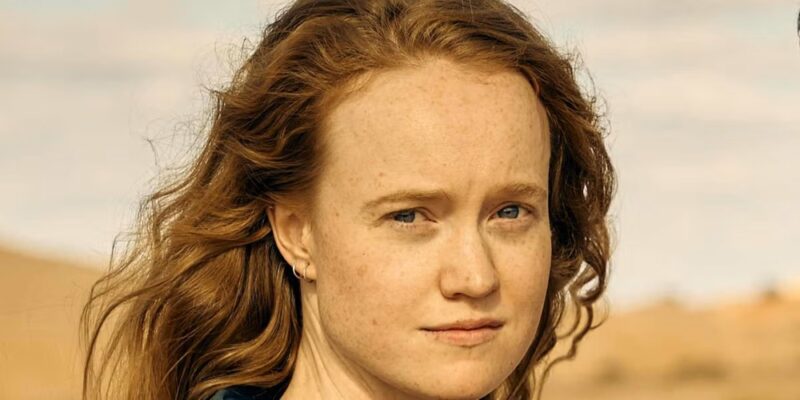
For Liv Hewson, a good detective story isn’t really about the crime. It’s about the people trying to make sense of what has been left behind.
That philosophy sits at the heart of Treasure & Dirt, a distinctly Australian murder mystery set in the scorched, dust-choked opal mining town of Nullah, where the brutal beheading of a local miner draws big-city detective Ivan Lucic (Michael Dorman) into a community governed by its own rules. Assigned to the case is ambitious rookie detective Nell Buchanan (Hewson), whose history with Nullah gives her an understanding of its people, secrets and lawless underbelly that her more experienced partner simply doesn’t possess.
For Hewson, though, Nell’s greatest strength may also be her greatest vulnerability. She is deeply curious about other people and acutely aware of everything happening around her, yet has little interest in allowing herself to be understood in return. As Hewson puts it, “She sees a lot, but she’s not interested in being seen.” It’s that contradiction that makes Nell such a compelling guide through a story concerned as much with isolation, alienation and human connection as it is with uncovering a killer.
Speaking with Peter Gray in celebration of the show’s release, Hewson discussed why they believe “all detective stories are love stories,” the importance of letting the Australian landscape become part of the storytelling, finding Nell through improvisation and collaboration, and why returning to work at home remains so important to them.
One of the things I found fascinating about the show is Nullah almost behaves like another character. Did you find yourself building Nell’s understanding of the town first and the murder second? Because it often feels like Nell’s investigating a place as much as a crime.
Yeah, I think that’s a really good point. Her contextual understanding of the place informs her understanding of the crime and how best to go about solving it. Even when Ivan first arrives in town, she knows how important it is that he understands how this place works, because if you don’t understand how Nullah works, you’re not going to solve the crime.
You need to understand where you are, how people behave and how things work around here in order to navigate solving the crime safely and effectively. She knows that better than anybody. I mean, she was literally run out of Nullah and had to come back, so there’s a wariness and an understanding that she brings into the story with her, for sure.
Nell is technically the rookie detective, but she often feels like the audience’s emotional compass. When you’re playing someone who’s constantly observing, how do you make silence feel as revealing as dialogue does?
It’s so fun for me to get to do that, to be honest. To get to have these two tracks happening: what you’re saying in a scene, or what’s written down as happening in the scene, and then what that scene is actually about underneath. Getting to build those two things was one of the most creatively cool parts of crafting this performance.
So often, like you say, Nell operates as an emotional centre, an observer, or the person in the room who sees exactly everything that’s going on. It was really fun getting to do that because you get to use your brain in the same way that she would, I guess. It’s like, “Wait, what is happening? What is happening in this room? What is happening in this scene?” It’s just brain food.
Crime dramas often revolve around finding the truth, and Treasure & Dirt seems more interested in how every person has their own version of the truth. As an actor, are you ever less interested in solving the mystery more than understanding why every character protects their own narrative?
That’s exactly right. I think I am a character-first creative, and also a character-first audience member. This is something that we talked about a lot in developing the show, actually. When you think about really effective murder mysteries or crime stories, the things you remember as an audience member are how they made you feel, what the characters were like, or what the relationships were like.
The actual minute-by-minute details of how the crime unfolded and how it was solved are all very important and very central. It all has to scan and make sense and be legible and thematically relevant. But I almost feel that plot takes care of itself once you have those fundamentals established and you know where the story is going. That is a meter that will just run in the background. The things you really have to build and take care of are the characters, how they feel and how they relate to one another, because that’s at the heart of the story, and that is ultimately what the story is about.
This is perhaps my hottest take on the genre, but I think that all detective stories are love stories. Not necessarily romantic ones, but they are stories about love and human connection because they’re about people working together to take care of harm that was done, to resolve that harm and bring attention to damage that was caused. I think solving a crime is a loving gesture, fictionally, when it’s done right. Whenever a story is about people working together to do that, that dynamic is going to be at the heart of the story no matter what.
So, with Nell and Ivan (Michael Dorman’s character), the dynamic we wanted to build was one of mutual recognition. These people don’t know it when they meet, but they’re the same. The more similar we can make them, and the more complementary we can make them, the stronger the story is going to be because that dynamic is at the heart of it.
Looking at these stories, the Australian landscape has produced so many stories where isolation distorts reality. What do you think it is about the outback that allows filmmakers to explore psychology in a way that cities can’t?
Well, isolation is a big part of it. This is a story about isolation and alienation in many ways. Not only the geographical isolation of the town itself, but also the isolation that Nell and Ivan each have in their own lives and their own experiences. There’s the isolation you can have even within a community or a wider structure, and the ways in which people are othered and alienated from a place, a profession or any sort of wider institution. A remote place can thematically be an extension of that.
A setting is a character when it thematically informs the story, right? When it’s a part of what is going on. And Nullah thematically informs the story because solving a crime is about something being hidden, and when you’re talking about a mining town, there is an element of the town that is literally, physically beneath the surface. It is literally hidden, right?
You’re also talking about people who are in competition with one another for resources, the ways in which the land is being extracted from, or people who are in great need of help or assistance and are underserviced. With somewhere remote, there’s this feeling of Nullah being unsupervised. I mean, Richter (Sarah Peirse’s character) even says it herself: “We do this thing here called self-policing.” There’s this sense that people who aren’t from there don’t understand it, and it’s away from everybody else. It’s away from any kind of larger scrutiny.
So those aspects of the town inform the story and then become part of the story.
Nell isn’t trying to dominate every room. There’s this very quiet confidence there. Do you find restraint more difficult to perform than intensity?
I think it’s often more fun, actually. I think it’s really fun to play with levels in that way. For me, it was a lot of fun to play somebody who is underestimated. Nell is somebody who, up to the point where the story starts, has walked through the world not only underestimated, but not respected by anyone.
This is somebody who is smarter than anyone thinks she is, has more skill and experience than anyone thinks she does, and deserves to be taken more seriously than anybody takes her. Her experience with those things also means that she’s incredibly hard on herself and doesn’t have a good relationship with herself.
So there’s a lot going on, but a lot of it is quiet and internal. To be honest, I loved doing that. It was so fun. There are a lot of layers to Nell. She’s a tough cookie.
There’s almost that mentality of, “Oh, you think I can’t do this? Well, I’ll show you!”
Totally. And then on the underside of that, there’s this feeling of, “Nobody thinks I can do this, but I can.” Underneath that is the wound, right, of being told for so long that you can’t do this and not being taken seriously, and then carrying that around with you. It’s like walking through the world not expecting to hear a kind word from anyone. What is it like when you walk into a room and don’t expect anyone to take you seriously or respect you?
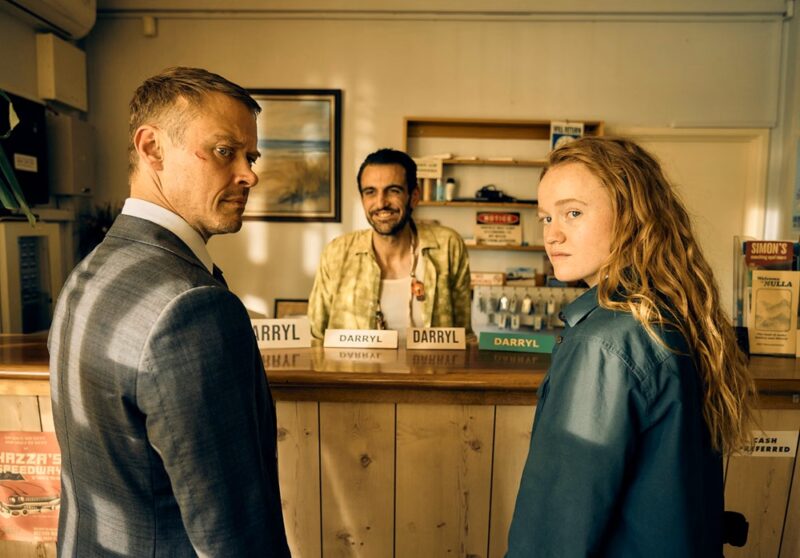
Going off that, detectives are often written as people who carry emotional baggage. Nell feels different, because there’s genuine curiosity about people. Do you think of that curiosity as her greatest investigative tool?
I think so, yes. Nell certainly does carry emotional baggage. It comes more to the fore later in the season, but she is somebody who really doggedly tries to keep that out of anyone’s view, to her own detriment, to be honest.
I think with really good detective characters, there’s often this sort of double bind going on where their greatest strengths are also their greatest weaknesses. Nell is incredibly curious about others, really attuned to others, and quite neglectful of herself. She sees a lot, but she’s not interested in being seen. That is, I think, often a really recognisable emotional pattern, you know?
And you’ve worked extensively in American productions, but Treasure & Dirt feels unapologetically Australian in its rhythm and humour. Did returning home as an actor reconnect you with parts of your own voice that perhaps you don’t get exercised overseas?
It was a real delight. Big picture, it’s very important to me to be able to balance working overseas with working back home. I really want to use what I’m able to accomplish overseas to help leverage being part of developing Australian work and bringing it to the fore.
That kind of specificity of tone and voice is something I look for regardless of where a project is from or where it takes place. But you’re exactly right that this particular story could not take place anywhere else in the world, and that is such a part of its appeal for me and, hopefully, for an audience.
As an actor and a playwright, those disciplines ask completely different questions. When you’re acting, does the writer in you ever quietly analyze why a scene works? Or have you learnt to silence that voice?
I actually think all actors do that. In my experience, actors do it all the time, and we’ll swap notes with each other. But whether or not you can actually do anything about that depends on the project and the people you’re working with.
On Treasure and Dirt, we were incredibly lucky that it was such a creatively generous and welcoming environment. Myself, Michael and Mads (director Madeleine Gottlieb) contributed a lot of character detail and really built out the voices of these characters together as we were working. We would improvise a lot, and there were things that we devised that ended up in the show. That’s not always a guarantee, you know. We were working in a way that felt like working in devised theatre again, to be honest, and I just had the absolute time of my life.
You’ve moved comfortably between comedy and genre, and now grounded crime drama. Is genre something you consciously seek out? Do you think you’re really chasing interesting people, regardless of the world they inhabit?
It’s kind of both. I mean, I am very character-first, but I’m also interested in the disruption of archetype or the deliberate use of genre as a storytelling technique to achieve a specific result. I’m really interested in specificity of tone and specificity of execution.
I like things that are a mix, or a deliberate subversion of a bunch of different things. I like funny dramas and sad comedies. Whenever a story takes a culturally understood image or idea and does something different with it to a specific aim, I’m always there for that, both as a creative myself and as an audience member.
Looking at longevity, is there something your younger self at the Canberra Youth Theatre believed about acting that has been completely disproven?
I don’t know that I could tell that version of myself anything. I don’t know that I could tell them anything about what my life is like now or what I’ve done since. But it’s interesting that the things I’m excited about have always remained the same, and the ways I’m interested in working have always remained the same.
So I guess if I was going to tell that version of myself anything, it would just be, “Follow that. Follow those things, because that’s where the most interesting stuff is, and it’ll lead you to some very cool places.”
You’ve spoken before about growing up consuming American television, yet you’re here telling a very distinctly Australian story that will now travel internationally. Has your idea of what makes a story feel Australian change now that you’re contributing to that identity yourself?
I don’t know that it’s changed. I mean, I was lucky enough to grow up on quite a steady diet of Australian media as well. I’ve just always thought that there is absolutely no reason for that cultural media exchange relationship not to go both ways. There is so much talent in Australia and so much skill. We have all the ingredients we need to consistently make really interesting work, and there is absolutely no reason for that not to be happening consistently and being shared with the rest of the world. We have so much to offer.
I don’t want to go too much into Yellowjackets, and I know you can’t say too much, but I do want to ask about playing Van. Having become one of television’s most resilient survivors, what has spending years with one character taught you about playing someone whose identity keeps evolving without feeling inconsistent?
I am very proud of what I feel I was able to accomplish in playing Van, and I’m proud of her in the way that you’re proud of a real person. I have so much love for her, and I’m so grateful to have been able to play that character and to see her through a journey that I could not have imagined taking her on when we were filming the pilot of that show seven years ago.
It has been absolutely life-changing. Characters like her do not come along all that often, and I’m just so lucky to have met her and to have spent the time with her that I did. I’m very grateful.
I’m very grateful too. I binged the shit out of that show. And just before letting you go, if Nell could investigate one mystery from another project you’ve worked on – either Santa Clarita Diet or Yellowjackets – which case do you think Nell would want to solve the most?
Oh, man! You know, I feel like Nell could have rumbled the older Yellowjackets sooner than they got away with (laughs). At a certain point, you guys were leaving a trail of very suspicious bodies, and she’s quite a good detective. But it’s funny hearing you say that and being like, “Wow, I guess I’ve worked on a bunch of shows where horrible, mysterious crimes happen. That’s my thing.”
Well, when I was reached out to to chat with you, it was an absolute “Yes.” I’ve loved your work and everything I’ve seen you in. It’s so comforting as someone who loves film and TV to continually see shows that aim for something different. It’s proof that there’s still originality in this industry. This is one of those shows. And I also feel that everything you’ve attached yourself to, there’s a reason for it. There’s a distinct voice, and a lot of that comes out of your performance. Thank you so much for taking the time out today.
Thank you so much. That really means the world. It’s so lovely to hear you say that. I really appreciate it.
All episodes of Treasure & Dirt are now available to stream on ABC iview.
