

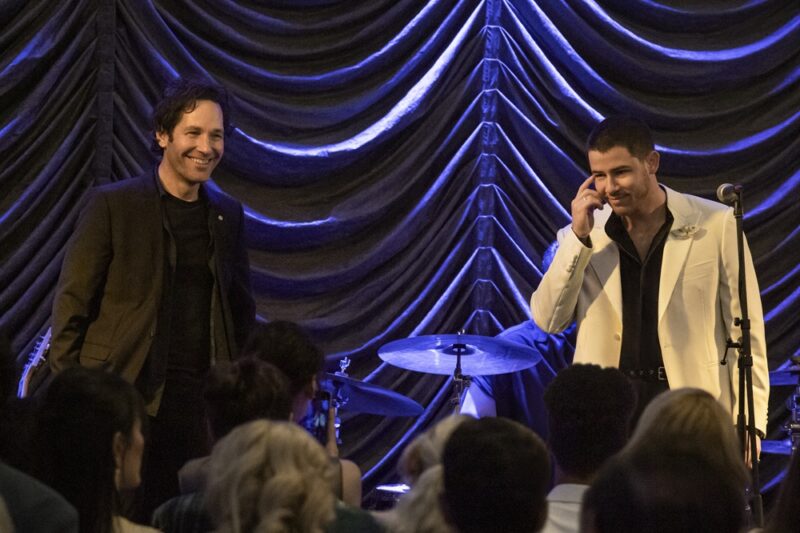
John Carney has spent much of his career proving that music in film works best when it feels lived-in rather than manufactured. From Once to Sing Street and Begin Again, his stories understand how songs can become emotional lifelines, time capsules, or the language people use when words fail them. With Power Ballad, Carney once again builds a film around music’s transformative pull – and, remarkably, creates a fictional hit song that genuinely feels destined to become one.
That song is “How to Write a Song (Without You),” an irresistibly soaring anthem that pulses through the entire film. Equal parts heartbreak confession and stadium-ready singalong, it has the kind of huge emotional hook that burrows into your brain almost immediately. By the time the credits roll, it’s easy to believe this fictional track could dominate real-world playlists, karaoke bars, and late-night car rides alike. The song doesn’t simply support the narrative – it becomes its beating heart.
The setup is deceptively simple. Rick Power (Paul Rudd) is an American expat living in Dublin, fronting a wedding cover band called The Bride and Groove. Once upon a time, Rick came close to music stardom, but adulthood, marriage, and fatherhood redirected his life elsewhere. He’s still charming, still talented, still capable of commanding a room, but years of playing other people’s songs at wedding receptions have left him haunted by the quiet ache of unrealised ambition.
At one such wedding, Rick crosses paths with Danny Wilson (Nick Jonas), a former boy band sensation desperately trying to reinvent himself as a legitimate solo artist. The two instantly connect over music, nostalgia, and shared artistic frustration, leading to an alcohol-fuelled all-night jam session where Rick plays Danny an unfinished song he has carried around for years.
Months later, Rick hears that same melody echoing through a shopping centre speaker system. Danny has released the track as his own, and it has exploded into a global phenomenon.
What follows could have easily drifted into broad comedy or simplistic morality play territory, but Carney is far more interested in emotional messiness than easy villains. Power Ballad isn’t really about whether Danny stole a song – though he absolutely did – as much as it is about the longing that both men project onto it. For Rick, the song represents the version of his life that never materialised. For Danny, it becomes validation that he can exist beyond the prefab identity of former teen idol. Both are desperate to be seen, heard, and taken seriously.
Rudd is superb here, weaponising the same everyman warmth that has made him so enduringly lovable for decades. Rick is funny, impulsive, selfish, wounded, hopeful, and occasionally infuriating, often within the same scene. But because Rudd carries such natural humanity, the film never loses sight of Rick’s vulnerability underneath the bitterness. He becomes the embodiment of every abandoned dream sitting quietly in the back of someone’s mind – the career not pursued, the creative ambition left dormant, the “what if?” that lingers long after life moved on.
There’s a melancholy undercurrent running through the film about learning how to live alongside regret without allowing it to consume you. Carney handles those ideas with an easygoing touch, never letting the introspection overwhelm the film’s humour or buoyancy. Even as Rick spirals deeper into obsession over the song and the recognition he feels robbed of, Power Ballad remains consistently funny and deeply humane.
Jonas proves equally strong casting. The role smartly leans into the public perception surrounding former boy band stars trying to transition into adulthood, allowing Jonas to bring genuine authenticity to Danny’s anxieties and insecurities. Danny exists in a strange limbo where fame has made him hyper-visible while simultaneously leaving him unsure who he actually is outside of celebrity expectations. Jonas captures that conflict beautifully, balancing arrogance, desperation, and vulnerability in ways that keep Danny sympathetic even when his actions aren’t.
The chemistry between Jonas and Rudd is ultimately what powers the film. Their dynamic evolves into something unexpectedly tender – part rivalry, part mentorship, part projection of each other’s lost selves. Carney wisely frames their relationship less as a traditional feud and more as two men clinging to music as proof that their lives still matter creatively.
And, naturally, the music sequences soar. Carney stages performances with the same intimacy and sincerity that have defined his best work, allowing songs to unfold organically rather than feeling like polished interruptions. Whether it’s a packed wedding reception in Dublin or a massive stadium performance, the film understands the euphoric communal feeling that music can create.
While the story follows a fairly familiar trajectory, Power Ballad succeeds because of how emotionally truthful it feels beneath the crowd-pleasing structure. The film recognises that artistic ambition doesn’t disappear simply because life changes course, and that sometimes the hardest thing isn’t failing to achieve your dream – it’s realising you may have already overlooked the life that mattered most.
Warm, funny, wistful, and powered by a genuinely terrific soundtrack, Power Ballad lands exactly where a great power ballad should: somewhere between heartbreak and exhilaration.


THREE AND A HALF STARS (OUT OF FIVE)
Power Ballad is now screening in Australian theatres. It will open nationally in the UK and in select theatres in the United States on May 29th, 2026, before expanding wide in the US on June 5th.
