
David Lowery’s Mother Mary wants to be an exorcism of pop stardom. Sometimes it feels like a fever dream stitched together from celebrity mythology, couture spectacle, psychological collapse, and gothic horror imagery. Other times, it feels like a film so entranced by its own symbolism that it forgets to give its characters enough humanity to sustain the emotional weight it keeps insisting they carry.
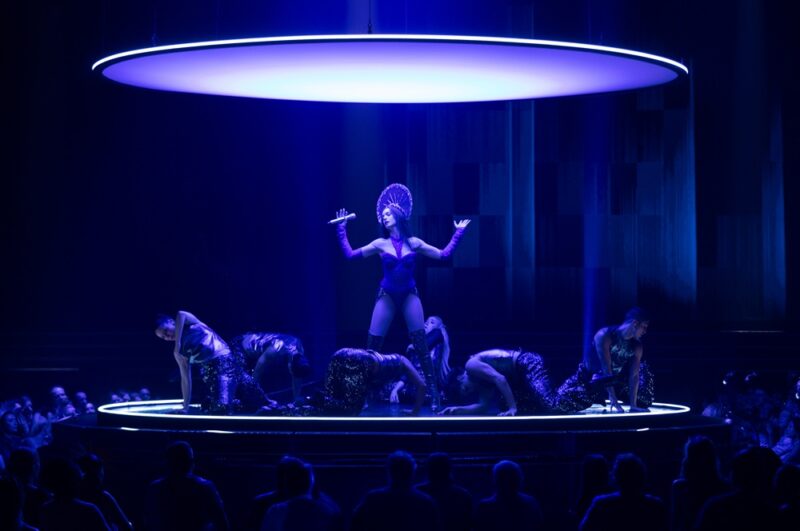
At its centre is Anne Hathaway as the elusive titular superstar, a performer caught somewhere between divinity and disintegration. Draped in halos, suffocated by iconography, and haunted by the demands of reinvention, Mother Mary is introduced as a woman performing control while quietly imploding underneath it. Hathaway commits completely. This is not a restrained performance; it is grand, wounded, theatrical, and often fascinating. She sings with conviction, moves with the exhaustion of someone permanently observed, and gives Mary a desperate fragility that the screenplay itself struggles to articulate.
Across from her, Michaela Coel delivers the film’s most magnetic work as Sam, the fashion designer and former creative partner whose influence helped construct Mary’s public identity. Coel plays Sam with an intoxicating mixture of resentment, longing, cruelty, and lingering affection. The relationship between the two women is easily the strongest aspect of the film. Their conversations crackle with unresolved intimacy and mutual bitterness, hinting at a deeper emotional history the film frustratingly circles without ever fully confronting.
Lowery frames their reunion like a haunted romance unfolding inside a luxury fashion campaign. Barn studios glow under noir-tinted lighting. Billowing fabrics move like spirits. Faces disappear into shadow and emerge haloed in gold. Visually, the film is often stunning. It carries echoes of A Ghost Story and The Green Knight in the way Lowery transforms physical spaces into emotional landscapes. One dreamlike sequence involving a floating red apparition is genuinely eerie and hypnotic.
The soundtrack is another undeniable triumph. With an electro-pop pulse that feels somewhere between Lady Gaga and Taylor Swift, the music gives the film an emotional immediacy that the narrative frequently lacks. The songs throb with longing, ego, heartbreak, and self-mythologising grandeur. Hathaway’s vocals sell the illusion of global superstardom far more effectively than the screenplay does.
That screenplay is where Mother Mary begins to unravel.
The film keeps gesturing toward fascinating ideas about fame as possession, celebrity as self-erasure, and artistry as emotional vampirism, but it rarely develops them beyond abstract imagery and loaded dialogue. It is somehow allegorical and painfully literal at the same time, never fully committing to either mode. One moment it plays like a psychological chamber piece about identity collapse; the next it veers into supernatural ghost story territory with such abruptness that it feels as though an entirely different film has wandered in midway through production.
The biggest issue is that Mary herself remains frustratingly opaque. Hathaway gives the character dimension through sheer force of performance, but the writing never clarifies who Mother Mary actually is beneath the iconography. The film becomes obsessed with the idea of her rather than the woman herself. Sam suffers similarly. Coel imbues her with intelligence and emotional history, yet the film repeatedly reduces her to a sounding board for Mary’s torment rather than allowing her equal narrative agency.
As a result, the emotional confrontations never land with the devastating force the film clearly believes they do. Long stretches become dramatically inert, circling the same themes of guilt, performance, and artistic dependency without building momentum. The imagery grows more elaborate while the storytelling becomes increasingly hollow. After the fifth slow-motion shot of fabric drifting through shadows, the visual splendour starts to feel like camouflage for a script that simply does not have enough substance underneath it.
Still, completely dismissing Mother Mary feels impossible. Even when it stumbles, the film remains strangely compelling because of the sheer conviction behind its performances and aesthetic ambition. Hathaway and Coel work far better than the material surrounding them, finding bruised emotional textures the screenplay only hints at. Lowery may not fully succeed in merging diva melodrama, psychological horror, and surreal art-house introspection into a cohesive whole, but the attempt itself is undeniably audacious.
Mother Mary ultimately plays like a gorgeous nervous breakdown: ambitious, self-indulgent, frustrating, occasionally intoxicating, and far more interesting to think about afterwards than it is to actually sit through.


TWO AND A HALF STARS (OUT OF FIVE)
Mother Mary is screening in Australian theatres from May 14th, 2026.
