

Few filmmakers working in Australia today understand the land the way Warwick Thornton does. With Wolfram, he once again turns the Central Australian desert into something more than a backdrop – it becomes a living, breathing force that shapes every character, every decision, and every moment of survival.
Wolfram unfolds as a loose companion to Sweet Country, not in a conventional sequel sense, but as part of a shared emotional and historical terrain. Set in 1932 and divided into four chapters, it’s a story built from fragments – escape routes, intersecting lives, and the quiet persistence of those trying to endure an unforgiving system. Thornton, working again with co-writers David Tranter and Steven McGregor, draws heavily from oral histories, giving the film a sense of generational memory that lingers even when the narrative itself begins to sprawl.
At its core is Pansy, played with remarkable restraint by Deborah Mailman. Her search for her stolen children becomes the film’s emotional spine, even as the story splinters outward into multiple threads. Mailman’s performance is defined by stillness – her grief and determination carried through glances and gestures rather than dialogue. It’s a quietly devastating turn, one that stands in for countless real histories without ever feeling reductive.
Around her, Thornton constructs a broader tapestry of survival. Young siblings Max and Kid (Hazel May Jackson and Eli Hart) endure brutal conditions as child labourers in a wolfram mine, while Pedrea Jackson’s Philomac – returning from Sweet Country – offers one of the film’s most compelling perspectives: observant, conflicted, and simmering with a need to reclaim autonomy. Jackson, in particular, emerges as a standout, giving Philomac a depth that anchors many of the film’s shifting dynamics.
The antagonists, led by Erroll Shand’s chilling Casey, embody a familiar but no less confronting brutality. Thornton doesn’t shy away from depicting the violence and racism of the era, and at times the film risks leaning too heavily into this suffering – lingering on cruelty in ways that can feel repetitive before the narrative finds its broader footing. That imbalance is most apparent in the first half, which can feel structurally diffuse as it moves between characters and tones without always establishing a clear throughline.
Yet once Wolfram pivots into a pursuit-driven back half, the film sharpens considerably. The threads begin to converge, and the focus shifts toward resilience rather than oppression. Moments of connection – particularly between the children and a pair of Chinese miners – introduce a welcome sense of solidarity, expanding the film’s themes beyond a single cultural lens to something more universal about survival under systemic injustice.
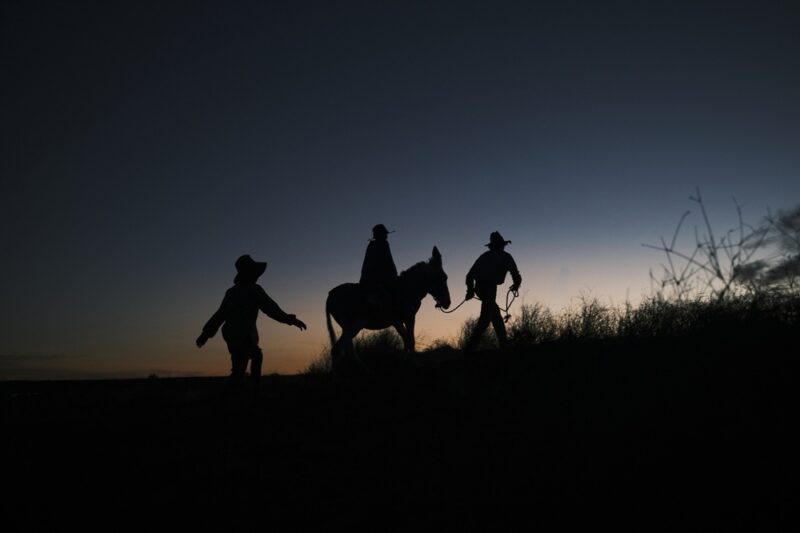
Visually, the film is extraordinary. Thornton, serving as his own cinematographer, captures the desert in a palette of scorched reds, golds and deep shadows, framing his characters against vast, indifferent landscapes. The compositions feel both epic and intimate, reinforcing the idea that these lives, however small they may seem within history, carry immense weight. The absence of a traditional score – replaced by the eerie, tactile sound of Charlie Barker’s saw – only deepens the atmosphere, giving the film an almost ghostly resonance.
Where Wolfram falters slightly is in its narrative cohesion. With so many characters and storylines, the film occasionally struggles to maintain momentum, and certain arcs feel underdeveloped as a result. A late revelation adds intrigue, but the resolution that follows arguably ties things together a little too neatly given the harsh realities the film otherwise presents.
Even so, the emotional impact remains undeniable. Thornton’s ability to balance brutality with moments of dignity ensures the film never becomes purely punishing. Instead, it builds toward something quietly defiant – a reclaiming of strength, identity, and connection in the face of erasure.
It may not reach the stark, poetic heights of Samson and Delilah, but Wolfram stands as a powerful and visually arresting addition to Thornton’s body of work. Imperfect yet deeply felt, it’s a film that lingers not because of its violence, but because of the resilience it ultimately honours.


THREE STARS (OUT OF FIVE)
Wolfram is screening in Australian theatres from April 30th, 2026.
