

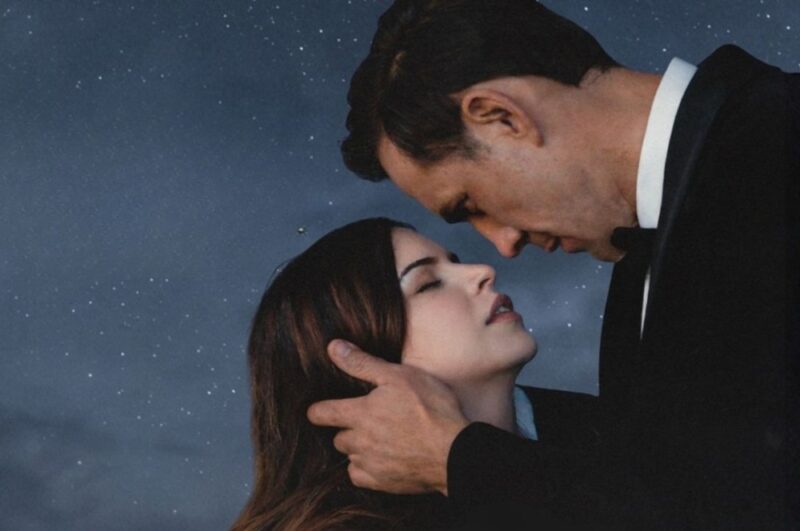
Love in the Moonlight is a romantic ghost story that drifts between modern-day Australia and the golden glow of 1950s Hollywood, drawing inspiration from classic cinema such as The Ghost and Mrs. Muir. In the newly released 3-minute proof-of-concept, the film introduces Samantha, a driven event manager who inherits a long-abandoned estate – only to discover Jack Stirling, a charismatic Hollywood star who died on set in 1952 and has lingered there ever since. Their first encounter is sharp, unexpected, and quietly electric.
With the feature currently in development, writer/star Cassidy Krygger and her on-screen ghost, Matty Wilson, are building a world that blends screwball romance, old Hollywood nostalgia, and a deeply personal exploration of love, grief, and connection. In conversation with our Peter Gray, they reflect on cinematic influences, creative exposure, and the emotional undercurrents shaping the project’s larger vision.
Cassidy, this is such a huge undertaking. Congratulations. This looks like such a lovely letter to old Hollywood. For both you and Matty, when you watch Love in the Moonlight now, what feels most you about it, rather than the inspiration behind it?
Cassidy Krygger: Oh, that’s such a good question. I think I see myself in my character, Samantha. For me, when I watch old Hollywood films, I can escape in them so easily, because it’s such a dream world. When I watched Moonlight… I could feel myself in this character. I guess I could feel a modern woman can sit there and watch this and feel like, “If this could happen to them…”
I guess that’s what I wanted this (film) to feel like, that we all can escape into these dream world that take us away from reality. I wanted a modern woman or man to watch this and see themselves in it. Walk into this world and have an old Hollywood movie star romance me.
Matty Wilson: (Cassidy’s) coming from it from a particular angle, where she’s built this incredible community, and you can see and feel (it). She can see the feedback of how much people are yearning for this kind of stuff. People watch movies for many, many different reasons, but one of the big things that people seem to want is for a story to be bold and be brave. People want to be brave in their own personal lives, but then they’re not quite brave enough they can watch a film and see someone else do it. Whether it works or not, you’re there for the ride and can live vicariously through that.
For myself, I was introduced to old Hollywood through the films of the 50s and 60s. Stuff with Paul Newman and Steve McQueen. I went down this vortex of imagining what this world would have been like. It’s a completely different version of what today is, or was it actually the same? You try and put yourself into those shoes. It was a little confusing at times, you’re dealing with these contemporary things around you (laughs). Like a film crew all wearing Nikes and Vans, and stuff like that, but then you’re trying to sink yourself into this world where the rules are different and the societal norms are completely different. For me, it was like jumping into a time capsule.
There appears to be a very specific rhythm to the banter in this. Almost that screwball feeling. Did that come naturally between you both? Or did you find that tone together?
Cassidy Krygger: For me, I really leaned into Cary Grant and Katharine Hepburn, especially in The Philadelphia Story – that kind of natural ease and effortless chemistry they have on screen. But the real joy of working with Matty – and I haven’t even told him this before – is how easy he is to work with. There’s an almost automatic chemistry, and I think that comes from him having worked with so many different actors so quickly. He’s incredibly adaptable, and that just comes across straight away.
So that was really the goal – trying to capture that feeling and hopefully bring it into the larger features as well. Leaning into that screwball energy, that Hepburn/Grant dynamic – those are my favourite films of all time. I especially love Cary Grant’s performance in that, so drawing from that era was very much the idea behind it.
Well, on the mention of The Philadelphia Story, is there a favourite film for both of you? Or the film that served as the gateway as to why you wanted to get into the business in the first place? The one that made you want to write? To direct? To act?
Cassidy Krygger: Oh, yes. Wuthering Heights from 1939, and Moulin Rouge. They are the two loves of my life. When I need to come back to myself as an actor, as a writer, as an artist, I just watch those films and I’m back in it.
Matty Wilson: Yeah, it’s like your ticket into the zone, isn’t it? Into yourself. If we’re talking about older films, I was completely mesmerised by Butch Cassidy and the Sundance Kid. I don’t know – it just felt like they were having so much fun. They’re buddies, and that dynamic comes through so naturally on screen. It might not be the most technical acting in the world, but it feels real – you believe it.
There’s this moment with Paul Newman – when the bull in the pen looks at him and he just pouts at it. It’s such a small, playful beat, but it says everything. The whole film feels like a world of fun, like people just playing make-believe – like when you’re a kid. And I think that’s what really stuck with me. I mean, you can take inspiration from so many different films, but that one just feels like pure joy.
With only three minutes, what did you deliberately leave out that you’re most excited to explore in the feature vision?
Cassidy Krygger: There’s so much more to it, because I’ve already mapped out and written the full feature version, and at its core, the relationship is really beautiful. It’s built on Samantha’s understanding of both grief and love. So while it has that romantic comedy foundation, there are much deeper layers running through it.
As humans, if we’re lucky enough to experience deep love, it inevitably comes with deep grief. That’s really what the feature explores. It was actually a very personal process writing it. I recently lost my dog quite suddenly, and a lot of that grief found its way into the script. It all just poured out onto the page. So in many ways, it’s a story about understanding yourself, understanding love, and understanding grief – and, ultimately, about coming to terms with death, which is something all of us will face at some point.
That’s one of the things I love about film, that it is this escape, this catharsis. It’s a way to process feelings. It’s able to tell a really deep story in the guise of something else. You might be selling something on the tin, but there’s a lot more under the surface.
Matty Wilson: Yeah, you notice it when people try to describe a movie and struggle to explain the plot – they’ll say, “Oh, it’s about this girl who goes to the big city…” and kind of trail off. But that’s because it’s not really about the plot. It’s about the experience – the feeling you get from it. That’s what hooks you. It’s the way it moves you, the way it connects with something deeper that you can’t quite put your finger on. And I think that’s the mark of a truly good piece of art.
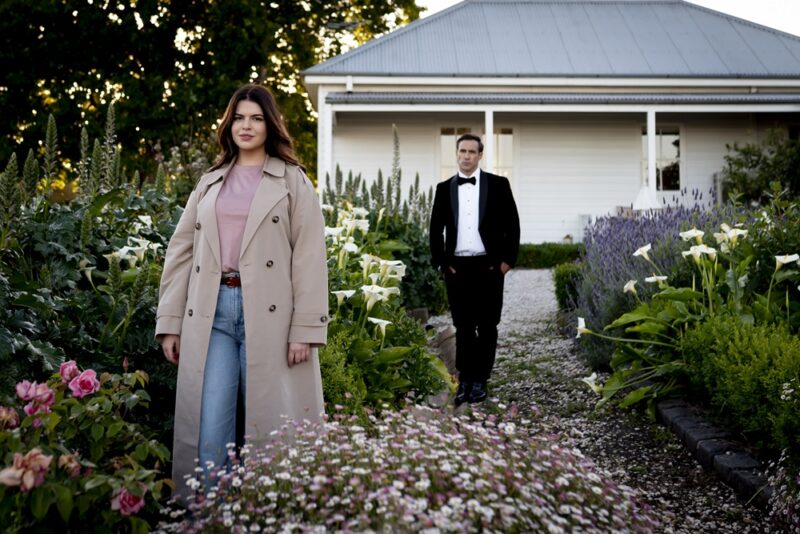
Looking at an identifying shift for you, Matt, you played Aaron on Neighbours for so long. What was the biggest mental shift for you in stepping into something that’s so stylized and romantic? Not that you didn’t have romance in Neighbours…
Matty Wilson: Yeah, I think I’m still trying to figure that out. I mean, when you’ve been on a show for so long with an ensemble cast, you don’t really have traditional lead characters – other than Karl and Susan, there’s no real central focus. So stepping into a lead role is a completely different way of working, and it’s something I’m still learning.
But at the same time, it’s not entirely different from how you approach anything as an actor, because it always comes back to the scene and the subtext. That’s what you’re really trying to understand – what’s underneath it, and how to play that truthfully. Everything else happening around it is what ultimately defines whether you feel like the lead or part of an ensemble, or somewhere in between.
I think when you play the same character for a long time, you naturally find a groove. But breaking out of that groove takes real effort. You have to constantly check yourself and go, “No, I’m only doing that because that’s the character’s reflex,” and then consciously step away from it. So in a way, you do have to start again. And yeah, it was very, very difficult.
This could be a more philosophical question for both of you, but I’m imagining the film lives in a certain tension. Do you think people fall in love with a person? Or they fall in love with the idea of a person?
Matty Wilson: I think they are both very different scenarios that can exist. I don’t think it’s either one or the other.
Cassidy Krygger: That’s a really good question. I think my brain goes to the idea of a person. I think because my favourite films are tales about the idea of a person as opposed to the actual person and who they are underneath.
As you have cited The Ghost and Mrs. Muir as a major inspiration. Cassidy, what did you understand about that film as a kid that you completely misread? And what do you understand now that you couldn’t back then?
Cassidy Krygger: Yeah, when I watched it younger, I only really saw it on the surface level – he’s a ghost, they fall in love, and then he leaves. But when I watched it again last year, and started developing it with my co-writer Jonathan Zsofi, I realised it’s so much deeper than that. In The Ghost and Mrs. Muir, the Captain – played by Rex Harrison – loves her so deeply that he’s willing to give up his own story for her. He chooses to step aside so she can go and live her life. I found that incredibly moving and such a selfless expression of love. That’s when I really understood just how profound that relationship is. I just love that film so much – I’m really passionate about it.
When I was younger, I saw it as a sweet little romance: he leaves, she eventually dies, and there’s this simple, beautiful ending. But watching it again, I saw something else entirely – the depth of his sacrifice, and how unconditional his love really is. It feels like another layer of beauty that I hadn’t noticed before, and that’s what makes it so special.
On the mention of the ghost, Matt, playing a ghost could allow you to go big or go subtle. What was your instinct in grounding Jack?
Matty Wilson: Yeah, right, right, right. I mean, just walking around with your hair done like that, in a tux, among people wearing Volleys and Nikes – it already does a lot (laughs). But I think there’s also something about the fact that he’s a ghost. He has nothing to fear, nothing really matters to him, so he’s quite aloof. Nothing really affects him because, well, he can’t be harmed.
I think later in the story – and I’m yet to read what Cassidy has written – that changes. That’s when he starts to care. But in this earlier snapshot, it feels like he’s in this space of, “What does it matter? This could have happened three or four times before.”
There’s this sense that nothing matters because he’s already dead – you can’t really change anything anymore. And then I think later on it shifts into the opposite: nothing else matters because of what he comes to care about. But that’ll be news to me when I read it.
On the mention of you writing, Cassidy, you’re also producing and acting in this. Where do you feel most in control? And where do you feel most exposed?
Cassidy Krygger: I definitely feel most exposed when I’m acting – I always have. It’s the rawest you can possibly be in front of a camera. The camera picks up everything.
When you’re writing, you can step back, edit, refine, show it to people, and ask for feedback – “What do you think? What are your ideas?” But when you’re acting, it’s immediate. It’s vulnerable. You have to be present, connected to someone else, and constantly responsive to what they’re giving you in the moment.
That said, writing this particular script has probably been the most personal experience I’ve had in the past couple of months, especially because of its themes of grief and loss. I enjoy every part of filmmaking. I started out as an actor, but over the past five years I’ve moved into screenwriting and producing, and into creating my own work. I genuinely enjoy all of it, and I think, as an actor, having some control over your own material and your own career is pivotal these days.
But I still feel most exposed and most raw when I’m on set, trying to connect to a character – even when you’ve written them yourself. That connection is still hard work. It’s still a job you have to do properly, every time.
For more information on Love in the Moonlight, investor options and collaborations, head to the official Love in the Moonlight page here.
