

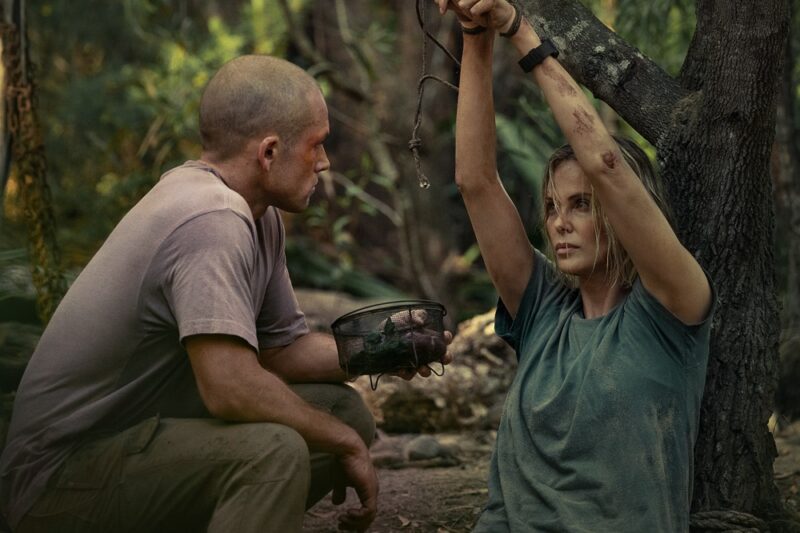
Grief sits at the centre of Apex, but it’s not the kind that asks for quiet reflection. It’s restless, disorienting, and constantly pushing forward – much like the film itself. What begins as a solitary escape into the wilderness gradually tightens into something far more dangerous, until it snaps into a lean, nerve-rattling game of survival.
Set against the imposing beauty of the Blue Mountains, the film makes a compelling case for landscape as character. The terrain isn’t just backdrop – it’s an active, often unforgiving presence that shapes every decision and every misstep. Director Baltasar Kormákur, who previously explored similar elemental tension in Beast, brings that same tactile sense of danger here, favouring practical movement and immersive camerawork over empty spectacle. A standout is his use of fluid, one-shot tracking sequences that place you right alongside the characters as they scramble, fall, and fight against both nature and each other.
At first the film carries echoes of The River Wild, a woman, Charlize Theron‘s Sasha, navigates grief while contending with the unpredictability of the wild. But Apex isn’t content to stay in familiar waters. About halfway through, it pivots sharply, peeling back the layers of its central threat – the initially unassuming Ben (Taron Egerton) – and briefly dips into something far more sinister and unsettling. That tonal shift gives the film an extra jolt, expanding it beyond a straightforward survival thriller into something with a darker, more unnerving edge.
Theron anchors the film with a steady, physical performance. She knows exactly how to operate within this space – resilient without feeling invincible, emotional without ever losing momentum. Opposite her, Egerton is clearly relishing the chance to break type. His Australian accent holds up impressively, but it’s the sense of unpredictability he brings that really lands. There’s a looseness to his performance, a willingness to lean into menace, that makes him a genuinely compelling foil.
What’s refreshing is how Apex looks. For a Netflix-backed production, it sidesteps the overly polished sheen that often flattens this kind of film. Instead, it feels cinematic in a grounded, textural way – the kind where you can almost feel the dirt, the water, the strain in every movement. The visual effects are seamless, but they never overshadow the physicality of what’s happening on screen.
It doesn’t reinvent the survival thriller, but it doesn’t need to. At a tight 100 minutes, Apex understands exactly what it is: a sharp, well-crafted ride that leans into performance, place, and momentum. And sometimes, that’s more than enough.


THREE AND A HALF STARS (OUT OF FIVE)
Apex is available to stream on Netflix from April 24th, 2026.
