
I really appreciated that it was this really beautiful story, and Callie is such a complicated character. What I really like is that she doesn’t just feel lonely – she actively rejects connection unless it fits her very specific worldview. How did you approach making a protagonist who isn’t immediately likable, but still deeply compelling? Was it difficult to thread that needle?
It’s so funny – I love and admire that quality in her so much. It’s not always the easiest quality, for sure, but I also think there’s a way in which she knows her own mind and has the courage to be persistent in exploring what she loves. She takes her lumps, but she also learns and grows and evolves.
I think we’re so often given this view of children as simple-minded, blank slates who just soak in the world around them, without strong feelings or opinions. And I love the way Callie goes through the world with this slightly sardonic, definitely skeptical eye.
She’s a tough character. But to me, that’s the joy of film – to take characters we think we know and let us explore them in ways we might not otherwise.
As a gay man, I was like – we would welcome her with open arms. She just says exactly what’s on her mind. I loved it. She can be one of us, right?
Totally. My husband definitely borrows lines from Callie in our relationship, and I’m just like, “Okay… that cuts a little close to home.”
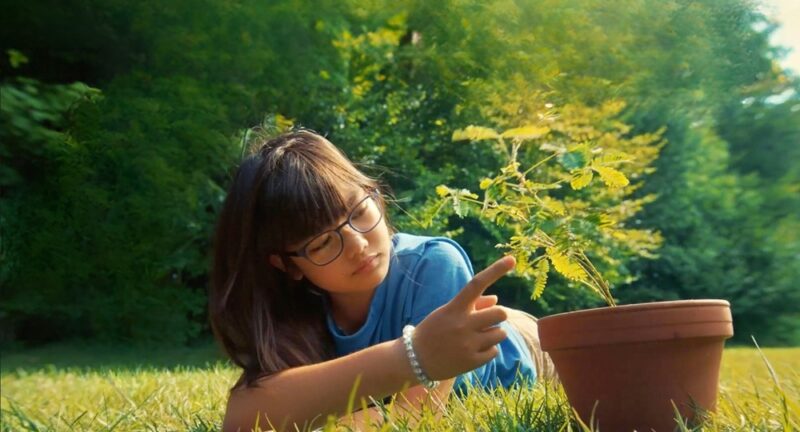
There’s something quite radical about centering a story around a young girl whose emotional anchor is a plant. What did Mabel allow you to explore that a human best friend couldn’t?
I think Callie sees something that others don’t – that this living thing has a totally miraculous way of existing in the world, and everyone else just isn’t clocking it.
There’s also safety in something that can’t run away from you. Human best friends can do that – especially if you’re prickly and a little bit saucy. So Mabel becomes this perfect balance: a space where Callie feels safe, where she feels like an expert.
But of course, the question becomes – you can’t live there forever. What do you do next? And that mirrors relationships in life. You think you know what you need, and then you realise maybe you don’t. That applies to friendships just as much as romance.
I wanted it to be a relationship that resonates across generations – where we can all see a little bit of Callie, and a little bit of Agnes, in ourselves.
The film almost treats adolescence like a biological process – growth is awkward, invisible, sometimes resistant. Were you consciously drawing parallels between botany and emotional development, or did that happen organically?
The idea that Callie’s best friend is a plant was there from the very beginning. But as the story developed, those parallels emerged naturally.
There is something about how plants find their way in the world – quietly, but effectively – that just felt right. And I was so grateful that botany opened up all these metaphors.
Miss G is actually a nod to Monica Gagliano, an Australian plant biologist whose work I really admire. She was willing to be countercultural in a field that wasn’t interested in the idea of plants having emotion or awareness. But the more we learn, the more we realise – just because plants don’t work like us doesn’t mean they aren’t doing something equally complex.
I have to say – Judy Greer forever! The fact that you got her in this film is amazing. Miss G feels almost mythic to Callie – less a teacher and more like a gateway. Was she designed as a kind of intellectual crush or philosophical awakening?
That’s exactly right. It’s that age where you’re not really dating, but you’re trying on the idea of it. “Crush” is the perfect word.
There’s a rom-com element to it – like Bridget Jones’s Diary, where you think, “This is the person, we’re going to ride off into the sunset.” For Callie, it’s, “Finally, someone who loves plants like I do.”
But that’s not what makes a relationship work. The fantasy is that someone just like us is perfect – but actually, it’s in discovering how people aren’t like us that relationships deepen. We used to joke about it being like a rom-com, just set in early adolescence.
I loved that when she answers a question in class, you expect a Matilda-style moment – and then Miss G is just like, “I don’t care.” It completely subverts expectations.
Totally. Callie might be prickly, but Miss G is just… she makes no bones about it.
Agnes feels like an emotional counterweight – she’s open where Callie is closed, expansive where Callie is precise. Were you thinking of them as opposites, or as different versions of curiosity?
I think I was more curious about what friendship might mean for Callie. What could it look like? Maybe the word is “complementary.” Agnes doesn’t push back when Callie pushes – she absorbs it. And there’s something very beguiling about someone who isn’t fussed by your complications.
First friendships are often unexpected, and quite beautiful. That was something we spent a lot of time thinking about.
The parent-child dynamic is really understated but affecting. What conversations were you most interested in not showing between Callie and her mother?
That’s a lovely question. There’s this idea that conversation is what fixes everything – but so much of parenting is watching and worrying and not being able to get through. Kids don’t grow as fast as you want them to. And you’re in this in-between stage where you can’t just organise their lives anymore, but they’re not fully independent either.
I grew up watching films like The Sound of Music and Mary Poppins, and when you revisit them, you realise how complex the adult dynamics actually are. I love that this film can work on both levels – about making friends, but also about the agony of parenting. Because the truth is – we’re all still figuring things out.
If Callie revisited this “experiment” as an adult, what do you think she’d realise she was actually trying to grow?
That we can withstand hurt and bounce back.
When you’re young, things feel cataclysmic – like the end of the world. And that fear can stop you from discovering anything new. But discovery is always awkward and painful, no matter your age. I hope she’d look back with gratitude – for the people in her life, even the difficult ones – and realise she’s both stronger and more vulnerable than she thought.
That’s a beautiful way of becoming a grown-up.
I feel like we can’t top that answer. But honestly, it was such a beautiful surprise of a film. It reminded me of the kinds of stories I wanted growing up – ones that feel specific but still let everyone see themselves in them.
Thank you so much. That means a lot.
Mabel is available on DirecTV in the United States from April 21st, 2026, before arriving on Digital and On Demand.
