

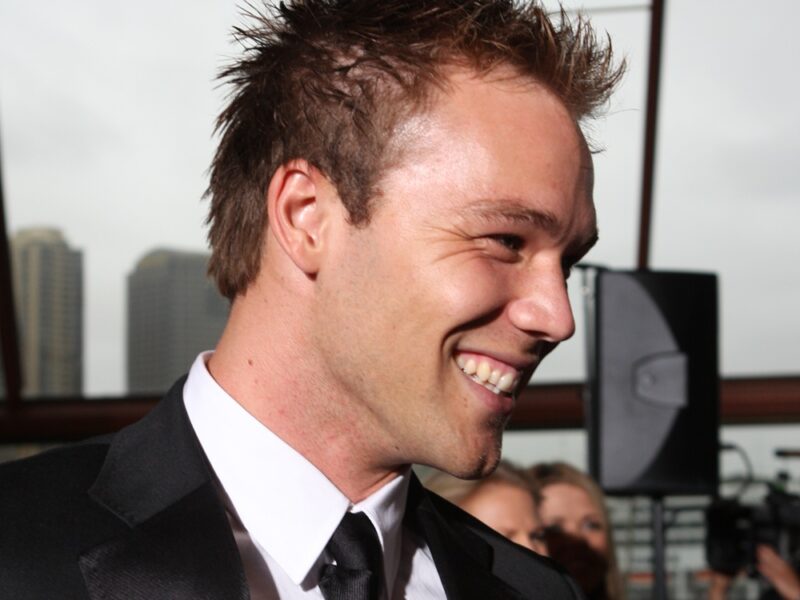
For more than a decade, Lincoln Lewis has been a familiar presence on Australian screens, but his journey from eager newcomer to seasoned performer has been anything but static. Starting out at just thirteen with early roles in The Sleepover Club, Mortified and H2O: Just Add Water, Lewis quickly built a foundation that would lead to his breakout moment on Home and Away in 2007. As Geoff Campbell, he became a household name – earning a Silver Logie and appearing in more than 500 episodes – before successfully making the leap into film.
From the beloved Australian adaptation of Tomorrow, When the War Began to a diverse slate of television roles across Neighbours, Underbelly: Razor and Gallipoli, Lewis has steadily expanded his range. His film work has been equally varied, spanning everything from shark horror (Bait) and rom-com (Spin Out) to international productions like After Earth and acclaimed dramas such as 33 Postcards, the latter earning him a “Male Star of Tomorrow” award.
In recent years, that versatility has only deepened. Whether sharing the screen with Travis Fimmel in Danger Close: The Battle of Long Tan, stepping into genre territory with The Possessed alongside John Jarratt, or appearing in high-octane action films like Black Site and Land of Bad with Russell Crowe, Lewis has consistently sought out projects that challenge expectations.
And yet, as he reflects in conversation with our Peter Gray ahead of his appearances at the Supanova Comic Con & Gaming, the biggest shift hasn’t just been in the roles he chooses – but in how he approaches them. Where once he focused on hitting every beat, Lewis now prioritises presence, instinct, and connection – less about “putting on a show,” and more about living truthfully within it. It’s a philosophy shaped by years on set, by watching veterans at work, and by an ongoing desire to evolve.
With recent projects like the psychological drama Hagar’s Hut, the action-horror Primitive War, and the upcoming romantic comedy Love, Wine & Valentine, Lewis is continuing to carve out a career defined not by a single lane, but by range. As he puts it, the goal isn’t to be remembered for just one thing – but to be seen as a chameleon, capable of slipping seamlessly between worlds.
Lincoln, you’ve been on our screens for over a decade now. When you look back at the version of yourself who first walked onto the set of Home and Away, what do you think that younger Lincoln misunderstood most about the industry?”
I love that question. That’s such a good question. I think, as time goes on and the more you spend on set, the more you learn to trust your instincts – and to get out of your own head. Instead of thinking, ‘I’m on set acting,’ it becomes about just being as present as you can, rather than trying to put on a show.
When I got Home and Away at 19, I was like, ‘Okay, every line has to hit.’ You want to make sure everything lands. But I’ve learned that just because a line is in the scene doesn’t mean you need to make a meal of it. It’s about being present, listening, and just being part of the moment. You’re so excited to be there that you don’t want to miss a beat – but sometimes that means you risk not actually being present.
I remember walking onto set even when I wasn’t in a scene, just to watch people like Ray Meagher and Lynne McGranger. In my first year, Kate Ritchie was still there, so you’d have scenes with Alf, Sally, Irene, Colleen – the OGs. I’d sit off to the side watching them, then watch the monitor, then watch them before they stepped into frame. It all looked so effortless.
At the time, I was like, ‘How do I do that? I need to get in there more, push harder.’ But the more you watch – and the more you do it – you realise it’s about just being present. Listening, responding, not trying to perform the moment. And even now, I still have to remind myself of that.
Like, even last night – I was doing a scene with Natalie Bassingthwaighte (on the romantic comedy Love, Wine & Valentine). After the first take we were stoked, and after the second, we just looked at each other, elated. We were bouncing off each other, the energy was building and then simmering. We’d done our runs, but we said, ‘Let’s leave it there. Let’s not overwork it.’ And when we did it again, it just felt so natural. That’s when you go, that’s the art. That’s why it feels so good.”
Going off that – if someone watched your career chronologically, from Tomorrow, When the War Began through to now – what do you think they’d notice about how you’ve changed as a performer?
Wow, man, I love these questions. That’s such a cool one. Honestly, I’d love to know the answer myself.
Not that long ago, I watched my very first scene on Home and Away – my entry scene with Charlotte Best and Jodi Gordon. It was Martha waking up in the barn. Watching it back, you can’t help but critique yourself – but you also have to give yourself some grace, because it’s the start of your career.
If you look at things chronologically, I think the biggest thing is learning to take your time and be present. There are scenes I’ve watched back where I’m like, ‘Mate, slow down. Just look at the other actor. Sit in it. Talk – don’t try to spoon-feed the audience.’
I’ve even watched scenes with other actors and gone, ‘Wow.’ Like, I’ll watch someone like Todd Lasance and think, ‘That’s an incredible performance – I couldn’t match that in that moment.’ And that’s a good thing. You learn from that.
That idea of being present is something I’ve really leaned into. Early on, it was more instinctive – learn the lines, hit the beats, move through it. Now it’s about feeling it, letting the moment breathe.
That’s why I love watching someone like Tom Hardy. He’s so stoic, but you can hear everything he’s thinking just through his eyes. It’s a masterclass without him even speaking.
And I imagine working with different actors teaches you a lot – but what about directors? Has there been a piece of advice that really changed your approach?
Yeah – honestly, it might sound like a cliché, but it’s something I’ve heard a lot: trust yourself.
I know I’m guilty of this – I’ll go into a scene already thinking about how it’s going to look once it’s cut together. Instead of just letting the character tell the story, I’m trying to jump ahead to the finish line. But the director and editor will take care of that. My job is to be in the moment.
There was also a moment with a director that really stuck with me. We were setting up a big explosion – like, a one-take situation, car blowing up, everything. It took about an hour to set up, and everyone else was chatting, but I just stepped away. I had music in, was visualising the scene, thinking about what had happened before that moment – building that internal backstory.
After a while, the director came and stood next to me. He said, ‘I love your work ethic. You know when to have fun, but when it’s time to work, you lock in.’ And that stuck with me.
Because at the end of the day, you’re living your dream – but you still have to centre yourself. I’ve always got a lot of energy, so I need to calm that down and really be present.
I totally get that – it’s the same on my side. You have those moments where you’re like, ‘Oh my God, I’m here, I’m doing this,’ but you’ve got to ground yourself and focus.
Exactly. And honestly, I’ve seen that in you too. When we bumped into each other, there was that moment of excitement, but then you switched straight into work mode. That balance – between personal connection and professionalism – you handle that really well. And I always love our interactions because of that.
When audiences look back on your career years from now, what kind of storyteller do you hope they see?
That’s such a good question – and a hard one. I think about actors I admire, like Heath Ledger and Tom Hardy, or even Matthew McConaughey. McConaughey was the rom-com king, and then he completely shifted into something else and won an Oscar. So what do you define him as?
For me, I don’t want it to be just one thing. I don’t want it to be, ‘Oh yeah, he was the guy from Home and Away,’ or ‘the guy from Tomorrow, When the War Began.’ I’d rather people say, ‘I loved him in that – and I loved him in that – and they’re completely different.’
My goal is to be a chameleon. To be able to step into completely different roles – whether that’s a rom-com, something dark and gritty, or something in between – and make people believe it. Because that’s the biggest compliment: when people look at your work and go, ‘He disappeared into that.’
Lincoln Lewis will be appearing as a guest at this year’s Supanova Comic Con & Gaming convention on the Gold Coast (April 11th and 12th, 2025), in Melbourne (April 18th and 19th, 2026), Sydney (June 19th – 21st, 2026) and Perth (June 27th and 28th, 2026). For more information on each event, head to the official Supanova website.
