

There’s a moment early in The Super Mario Galaxy Movie where a glowing Luma drifts into frame, wide-eyed and urgent, setting off a galaxy-spanning rescue mission. It’s the kind of whimsical, high-concept storytelling the Mario universe thrives on – colorful, strange, and full of possibility.
Unfortunately, that promise quickly gets swallowed by a film that never quite figures out what it wants to be.
Directed by Aaron Horvath and Michael Jelenic, this follow-up to The Super Mario Bros. Movie falls into a classic sequel trap: bigger, busier, and far less focused. What unfolds is less a cohesive story and more a frantic shuffle between subplots – a sugar rush of chases, battles, and character introductions that rarely have time to land.
At the center of the chaos is the kidnapping of Princess Rosalina (voiced by Brie Larson), which should serve as the emotional and narrative anchor. Instead, it’s just one thread in a tangle of competing ideas. Bowser Jr. (an enthusiastic Benny Safdie) wants his father freed. Princess Peach (Anya Taylor-Joy) is grappling with her identity. Mario (Chris Pratt) and Luigi (Charlie Day) are… kind of just along for the ride.
And that’s the problem. For a film built on such iconic characters, very few of them feel like they’re actually driving the story.
Instead, The Super Mario Galaxy Movie zips from one set-piece to another with the attention span of a hyperactive bee, introducing new characters, new locations, and new stakes before it’s properly dealt with the last. The result is a film that feels constantly in motion but rarely meaningful – like it’s trying to cover every corner of the Nintendo universe in one go, rather than telling a story worth caring about.
That “more is more” approach extends to the film’s expanding roster. Characters like Yoshi (Donald Glover) and Fox McCloud (Glen Powell) are fun additions in theory, but in practice they’re underdeveloped, often feeling like placeholders for future spin-offs rather than fully realised players in this one.
Powell, to his credit, makes the strongest impression. His cocky, Han Solo-esque Fox McCloud injects a burst of charisma the film sorely needs – and a brief 2D-animated backstory sequence hints at a far more compelling film hiding somewhere in the franchise’s future. It’s a glimpse of what could be: focused, stylistically bold, and emotionally grounded.
But here, it’s just another detour.
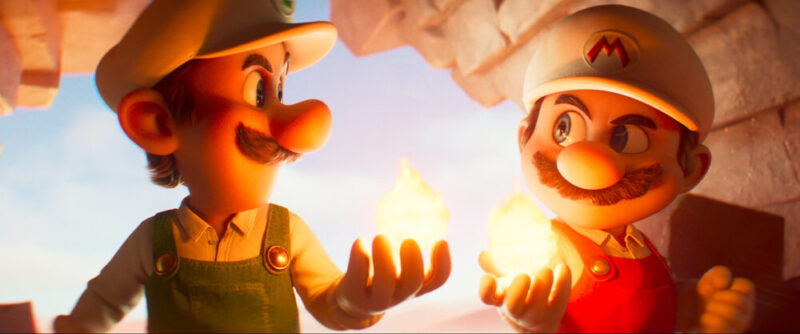
Visually, the film delivers. The cosmic settings are vibrant, the animation slick, and there’s no shortage of eye-catching moments. But even those come with a caveat. The screen is so packed with movement, references, and Easter eggs that it often feels less like world-building and more like distraction – a constant stream of “look at this!” moments that ultimately blur together.
That reliance on references speaks to a larger issue: the film assumes you’re already invested. Whether it’s the underexplained connections between characters or the rapid-fire introduction of new ones, The Super Mario Galaxy Movie rarely pauses to bring newcomers along. It’s fan service first, storytelling second.
Even returning highlights feel diminished. Bowser (Jack Black), who had such a larger-than-life presence in the original, is sidelined for much of the runtime – literally shrunk down, both physically and narratively. Without his presence (and musical flair), the film loses one of its most entertaining elements.
There are attempts to add emotional stakes – a vague love triangle between Mario, Peach, and Bowser, Peach’s search for identity – but they’re half-formed at best. Like so much else in the film, they’re introduced, skimmed over, and left without satisfying payoff.
To its credit, the film does bring Mario and Luigi together more consistently, correcting one of the previous film’s criticisms. But even their brotherly dynamic feels muted, lacking the spark and charm that defines them in the games.
Ultimately, The Super Mario Galaxy Movie isn’t without its pleasures. It’s colorful, fast-paced, and occasionally fun in the moment. But it’s also emblematic of a franchise more interested in expansion than refinement – laying groundwork for future installments rather than delivering a satisfying story now.
For younger audiences, the constant motion might be enough. For everyone else, it’s hard to shake the feeling that this is a film made up of pieces – some promising, some entertaining – that never quite come together.
In trying to do everything, The Super Mario Galaxy Movie ends up saying very little at all.


TWO STARS (OUT OF FIVE)
The Super Mario Galaxy Movie is now screening in Australian theatres.
