


A murder mystery usually begins with a body. In Kill Me, it begins with a question: what if the detective and the victim were the same person? Blending a darkly comic whodunit with an unexpectedly candid exploration of depression, the film follows Jimmy (Charlie Day), who begins investigating his own attempted murder, unsure whether he’s being stalked by a killer or unraveling inside his own mind. As Jimmy and his ally, 911 operator Margot (Allison Williams), piece together clues, the mystery spirals into something far more unsettling: the possibility that the most dangerous threat may be the one living in his head.
Inspired by director Peter Warren’s own experiences navigating mental illness within his family, Kill Me uses the mechanics of genre – clues, suspects, and red herrings – as a Trojan horse for a deeply personal story about survival, doubt, and the complicated work of wanting to stay alive. Our Peter Gray spoke with the director ahead of the film’s SXSW premiere about turning depression into a whodunit, finding humour in darkness, and crafting an ending that leaves audiences arguing long after the credits roll.
Congratulations on the film. Without spoiling anything, I have to say that ending… I loved it. It’s such a great way to land the story. I wanted to start with the creative origins and the personal connection behind the film, because I know you’ve spoken about writing it as a way of exploring the “serial killer” of depression in your own life. When did you realise that a murder mystery was the right metaphor for that experience?
I’ve always loved genre stories, so I never wanted to make a version of this that was just a sedate portrait of depression. I wanted it to be a kind of genre Trojan horse – a movie I’d actually want to go see in theatres, one that’s entertaining on the surface but hopefully deeper and smarter than you initially expect. A murder mystery is about investigating a killer, and in a way mental health treatment is also about investigating a killer. It’s trying to figure out what’s harming you, how to stop it, and how you got there in the first place. How did I end up on the bathroom floor? So the two ideas actually marry really well.
The first real spark came from wanting to do a whodunit in a way I hadn’t seen before. I started breaking down the genre: you’ve got a body, a detective, a killer, and clues. Then I thought, “What if the body was the detective?” That led to the idea of someone investigating their own murder. Obviously they didn’t die, so it’s an attempted murder, but everyone believes they’re responsible. That’s how Kill Me started to take shape.
It’s such a great way to frame a story. We’ve seen the whodunit genre get popular again – the Knives Out movies have definitely helped with that – and growing up for me Clue was the ultimate example. Even the Scream films are technically whodunits. But what’s so interesting here is that he’s solving his own murder. I spent the whole movie thinking, “I genuinely have no idea where this is going.” With the unreliable narrator and the emotional turns, it feels like the story could go in any direction. It’s heartbreaking, funny, and thrilling all at once. Pulling off a mystery like that is really impressive.
Thank you, I really appreciate that. The movie walks a real tonal tightrope, which is exactly what excited me about it. I’m a big believer that movies benefit from a diversity of tones. Think of it like movements in a symphony – you don’t want to stay in one emotional note the entire time. Roller coasters have ups and downs for a reason. Unless you’re making something like a Mission: Impossible movie (Peter seeing the film’s poster behind me) where the goal is pure action – and those movies are amazing at that – I think audiences can handle laughing, crying, and being scared in the same story. When you can balance those tones, it creates a much richer experience.
You’ve said before that parts of the story come from different perspectives – Jimmy, Margot, and the family. Which perspective was the hardest to write?
Jimmy, easily. His perspective comes from the most intimate relationship with mental illness – the one inside my own brain. His monologue in the interrogation scene, where Margot questions him about his complicated relationship with being alive, that was very tough to write.
There were earlier versions that were even longer. Sometimes I’d have to step away from the script for a while, which I normally never do. But it’s important work. If you want to make something that makes people feel seen, you have to lead by example and be honest about those experiences. That said, after a day of writing scenes like that, you definitely go home and watch a lot of reality TV to decompress. Lots of Shark Tank.
That interrogation scene is incredible. It’s the moment where you really understand what Jimmy has been carrying. The audience suddenly becomes the family – we’re seeing him through their perspective, and we just want to help him.
Exactly. That scene is really powered by Charlie Day’s performance. The whole movie runs on Jimmy’s conviction that he didn’t do this, and we follow him because we trust him. When that certainty starts to crack – when he begins to doubt himself – it’s almost like the audience realises we might have enabled him. We’ve been rooting for him to keep going, and suddenly we wonder if what he actually needs is help and safety. There’s a beautiful moment from Allison Williams in that scene where Margot almost starts reassuring him that he didn’t do it. She senses that his confidence is breaking, and she holds space for that doubt in a really compassionate way. Then… it leads to them making out.
It’s great casting too. Alison Williams obviously terrified audiences in Get Out, so it’s really nice seeing her play someone who becomes such a source of comfort. And then you’ve got Jessica Harper – that’s genre royalty.
Absolutely. She’s up there on the horror Mount Rushmore alongside Barbara Crampton. She’s incredible – such a warm, generous person, but she carries this emotional depth that feels like a whole hurricane is happening underneath the surface.
And then Aya Cash… I mean, come on. She could read the phone book and I’d watch it. I was incredibly lucky as a first-time filmmaker. My whole strategy was basically: hide behind the best cast possible and just make sure the camera stays in focus.
The tone is such a delicate balance. You’ve got very dark subject matter, but also some genuinely funny moments. Was there ever a joke where someone read the script and said, “You can’t do that”?
Oh, absolutely – probably a hundred times. My goal was to push both extremes as far as possible: make it as funny and as dark as I could without the tone collapsing. Some of our dumbest jokes ended up on the cutting room floor, and some of our most graphic imagery did too. For example, we shot a moment where you actually see Margot’s sister hanging from the ceiling fan in a wide shot. It was pretty brutal – like something from an Ari Aster movie. Personally it didn’t bother me, but it ultimately didn’t fit the tone of the film.
On the other side, the opening scene has comedy in it even though it’s about a suicide attempt. I fought hard for that moment – especially the Siri joke – and it took very precise editing and music to make it work.
For me the humour worked because it felt so human. The moment where he’s worried about whether the blood will stain the bath – that’s exactly the kind of thing someone might actually think in that situation.
Exactly. Depression is incredibly serious and frightening, but it’s also weirdly mundane and frustrating. It’s like, “Great, my own brain is trying to kill me – what a stupid problem to have.”
Real life is a mixture of emotions. You laugh, you get scared, you get bored. Movies should reflect that. Sometimes humour is a counterpunch that makes the darker moments hit even harder.
As both writer and director, what surprised you the most when the film moved from the page to the set?
Actors. I always think actors are the experts on their characters. As the writer and director, I’m thinking about the entire story, but they’re focusing completely on one person’s experience. They’ll sometimes point out emotional connections I never considered. That collaboration is one of the best parts of filmmaking.
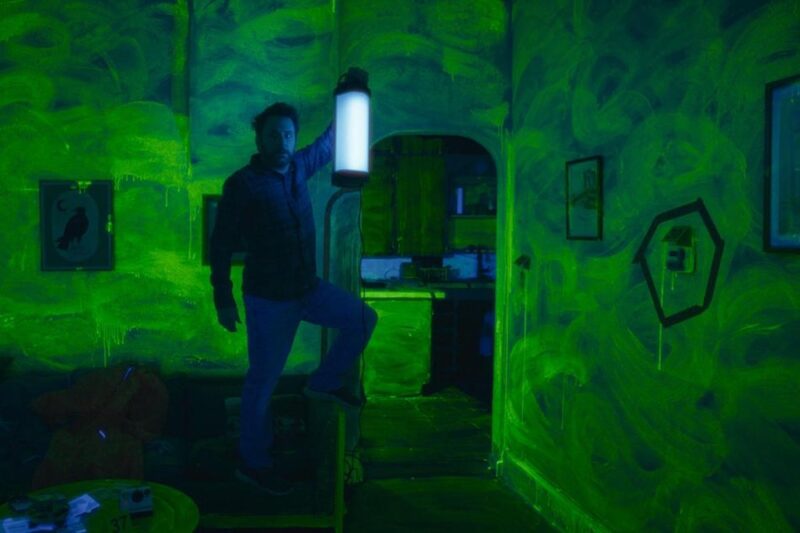
Visually, it was also amazing to see things come to life – especially the blacklight sequence. That was all practical effects. Our production designer Ashley Cook and her team did weeks of testing with fluorescent paints to figure out exactly how they’d behave under the lights. Seeing that appear on the monitor for the first time was pure movie magic.
Before we wrap up, if audiences leave the theatre debating whether Jimmy is right or completely delusional, have they understood the film?
Both. That’s exactly what I want. The ending is meant to reflect the complicated reality of mental illness – there isn’t a simple Scooby-Doo unmasking where everything is neatly solved. But I also want people arguing about the mystery. The best outcome is when the lights come up and everyone says, “We need another drink so we can debate this.” That’s the fun of it.
It feels like a perfect film for SXSW too. There’s something about that festival where bold, human stories really connect with audiences. Personally, I went through a pretty intense period with my own mental health a few years ago, and watching this film – seeing a character wrestling with those thoughts while surrounded by people trying to help him – really resonated. It’s powerful when a film that’s entertaining can also speak honestly about something people are struggling with.
That means a lot to hear. That’s really the whole reason I wanted to make the film. It’s also why genre storytelling works so well for this kind of subject. If someone is depressed, they probably don’t want to watch a depressing movie about depression. But they might want to watch a wild mystery starring Charlie Day – and along the way we can talk about the real stuff too.
I want the movie to feel like a hug. And if we can do that while giving audiences a fun mystery ride, then that’s the goal.
Kill Me is screening as part of this year’s SXSW Film & TV Festival & Conference , running between March 12th and 18th, 2026. For more information on the festival program, head to the official site here.
