

Grace Lisa Vandenburg (Teresa Palmer) counts everything. Numbers are the quiet architecture holding her world together, until a chance encounter with Seamus (Joe Dempsie) begins to loosen the careful order she’s built around herself. Directed by Marcelle Lunam and adapted from Toni Jordan’s bestselling novel, Addition is a story about self-acceptance and recognising what truly counts.
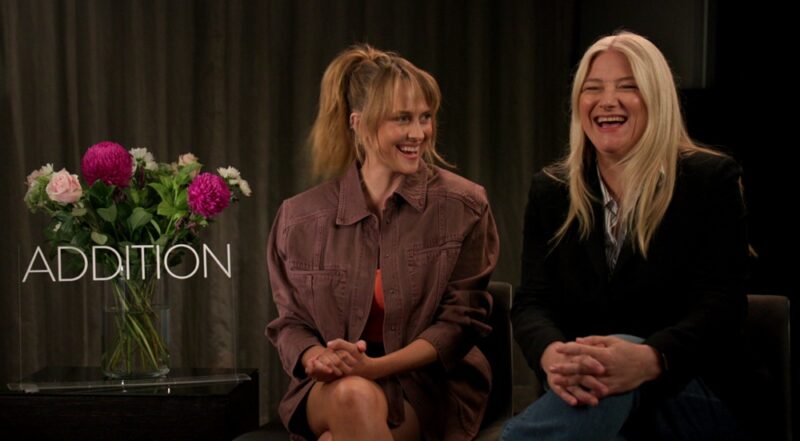
At the film’s Australia premiere screening, our Peter Gray spoke in conversation with lead actress Palmer and producer Bruna Papandrea, where it quickly became clear that bringing Grace to life came with a set of creative non-negotiables: resisting simplification, honouring the character’s inner logic, and ensuring the casting allowed for nuance rather than explanation. For both Palmer and Papandrea, the film’s power lies in its restraint – trusting the audience to meet Grace where she is, rather than asking her to change to be understood.
I spoke to you (Teresa) in 2024 at TIFF…
Teresa Palmer: I know!
I came up to you and was like, “I love you so much.”
Teresa Palmer: Oh, my God, you’re the sweetest. Thank you. I love you.
That’s where the interview can end. But it is awesome that this film is now finding its way here, so I wanted to say congratulations.
Teresa Palmer: Thank you.
When it came to the film, was there a non-negotiable for the both of you in terms of making sure that it got something right? Either within the story or the characters?
Bruna Papandrea: Yeah, everything. I always say everything, right? I think when you’re dealing with a subject about anyone who’s dealing with anything around mental health, I think it’s really important that you get the details right. My non-negotiable was casting the right Grace. So, mission accomplished. I’ve had the option on this book for a very long time. The longest option I’ve ever held on a book. So it’s a big deal for me. We really wanted to honour Toni’s (Jordan) book and the specifics around a woman who had this counting disorder. My non-negotiable was getting all the details right for me, but also making something that was really optimistic at the end.
Teresa Palmer: Yeah, I was going to say something like that too, My non-negotiable was not shining it in a negative light. The idea that she, Grace, is a highly-functional person living out in the world, and she’s sexy and funny and cool, and people are drawn to her. There’s a potency about her, which is so beautiful and loveable. And she also deals with anxiety, and I think the way it’s represented in the film is so unique and different and special, in that it’s not doom and gloom. We watch her as she fumbles her way though this romantic relationship, whilst also dealing with her wounds and the things that she has to deal with in order to put one foot in front of the other. In the hands of Marcelle, our beautiful director, she was able to weave all of those things into it beautifully.
One of the things that I really appreciated with Grace is that so much of this character is internalized. As an actress, how do you make sure that what’s going on with her doesn’t give way to over-performing? The nuances of what she’s thinking and making sure you’re not “projecting” as much…
Teresa Palmer: Yeah, it’s all in the art of subtlety. For me, I looked at it as if there was a lid on this thing, and it was about to explode out of her. Sometimes it’s incredibly subtle. The little mannerisms or the little things she does with her face or her hands are moving a lot, and I just found these little…like a throughline. With Marcelle, together we discussed the subtle ways we can show that (Grace) is holding on, even if it’s just a little rub of the thumb or twitch of the foot, because she’s in this romantic relationship, but she’s trying so hard to keep everything contained. It manifests in these little ways, until, ultimately, there’s a full breakdown. The breakdown to breakthrough.
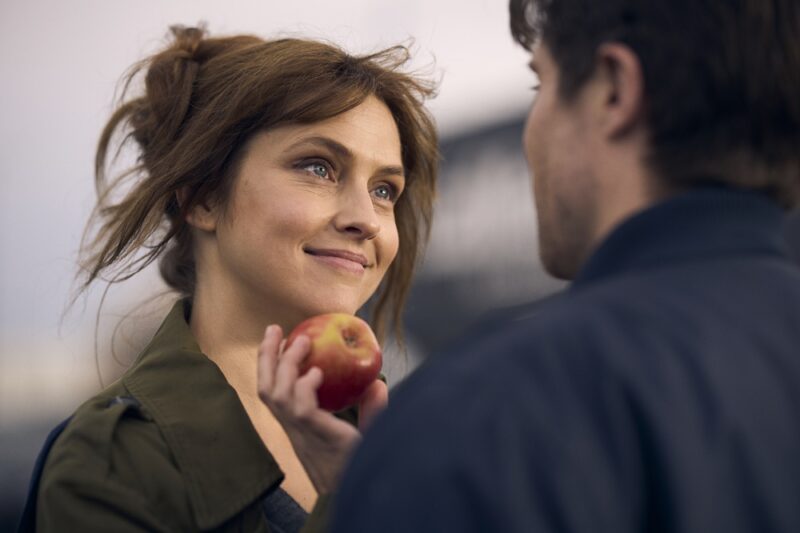
I was saying to Marcelle that the film is a romantic comedy, it’s a drama, it’s psychological, it’s funny, it’s sad…but it made me think of romantic comedy as a genre, and the fact that (Addition) is dealing with numbers and logic. Obviously we watch romantic comedies, and the couple gets together at the end, but I wanted to ask the both of you when looking at “perfection” and if people are compatible, is there a romantic comedy couple that you think are actually still together?
Teresa Palmer: (Laughs) Well, my favourite romantic comedy, and it’s not even really a comedy, but it’s one of my favourite movies, and I never really admit this out loud, because people are like, “Really, that’s one of your favourites?,” is The Notebook. I used to do a test with boyfriends, I’d watch them watching The Notebook to see how emotionally invested is this person in (this movie)? I would judge them from how much they would cry at the end or not, or if they thought the movie was bad. I had one who was like, “Oh, this isn’t very interesting.” And then another who thought it was amazing. So that is my favourite romance of all time.
Bruna Papandrea: Yeah, that’s up there with mine. Anything with Hugh Grant (for me). All mine are the Richard Curtis romantic comedies. I like to think that those people would definitely still be together, because I’ve been rooting for them. I’m definitely rooting for Grace and Seamus, because it’s very grounded. I love a movie where the end is the beginning.
I feel like if they can survive her stealing his banana…
Teresa Palmer: (Laughs) That is the best meet-cute ever, by the way.
And so many female characters, whether it’s subtle or overt, I feel like they’re always told to be “less than.” Less intense, less complicated…what did it mean for both of you to make a film where Grace’s intensity is part of her brilliance?
Bruna Papandrea: I mean, have you seen my work? (Laughs) No, I’m kidding. But that is literally why I do what I do, because the more complicated a female character is, the more I’m drawn to it. You asked a great question before about how Teresa got that performance, and I would say my biggest job is casting. Casting the person who can do that is not always as obvious as it seems. One of the beauties of what Teresa brings to (Grace), which so many people couldn’t, is that she has a natural vulnerability. You have to be prepared to be vulnerable, but also strong, right?
She’s so strong-willed. And because Teresa is such a high-functioning person, but she also allowed herself to be vulnerable. I think without that capacity as a human, Grace wouldn’t be who she is. For me, that’s where the work gets elevated. That’s the main goal, to show women with many shades.
Addition is now screening in Australian theatres.
