
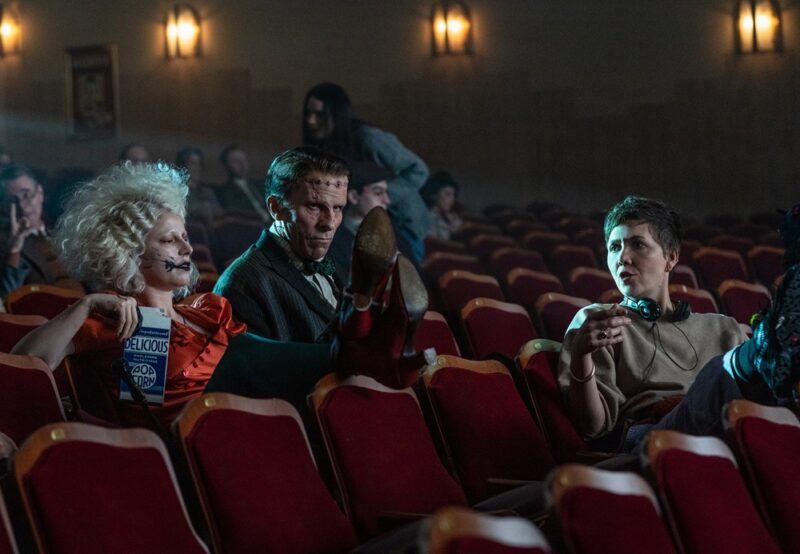
Maggie Gyllenhaal isn’t interested in playing it safe. At the global trailer launch for The Bride!, the writer-director-producer spoke with infectious passion about her radical reimagining of one of cinema’s most iconic monsters, revealing a film that’s punk, romantic, mythic, deeply personal, and unapologetically loud. Here’s everything we learned about The Bride! and the bold vision behind it.
From Quiet Intimacy to “Big and Hot” Truth-Telling
After the restrained, intimate emotional excavation of The Lost Daughter, Gyllenhaal was hungry for something louder. She explained that her first film came naturally – its tone, its emotional truth, its taboo subject matter – and she felt its impact when audiences responded strongly to its honesty. That response sparked a bigger question: what would happen if she tried to tell a different kind of truth, but in a bold, pop-forward way?
The Bride! emerged from that curiosity. Rather than examining maternal ambivalence, Gyllenhaal turned her gaze toward the “monstrous aspects inside every single one of us.” The result is a film that doesn’t shy away from ugliness or desire, but revels in them, telling emotional truths at maximal volume. In her words, it’s about being truthful “in a way that was hot… big and hot.”
The Tattoo That Sparked the Movie
The genesis of The Bride! didn’t come from a studio pitch or an IP brainstorm – it came from a tattoo. While at a party, Gyllenhaal noticed a man with a full forearm tattoo of the Bride of Frankenstein. The image hooked her instantly. Though she knew the iconography, she realised she hadn’t actually seen the film.
When she revisited Bride of Frankenstein, she was struck by a contradiction: a movie named after a character who barely appears, never speaks, yet leaves an indelible impression. Elsa Lanchester’s Bride appears for mere minutes, but she wakes up and says “no.” That refusal, that defiance, that power fascinated Gyllenhaal.
From there, the cracks in the mythology opened up. Frankenstein’s desire for a mate may be understandable, but what about the woman brought back from the dead to fulfil that need? What if she had her own agenda? Her own fears? Her own desires? That question sits at the molten core of The Bride!.
Reclaiming the Bride as the True Protagonist
One of the most quietly radical things about The Bride! is also one of its simplest: it is unapologetically about her. Gyllenhaal noted that people still refer to the film as “Frankenstein,” despite her repeated corrections. Even that misunderstanding, she suggested, reflects how deeply ingrained it is to centre the monster rather than the woman created for him.
In this film, The Bride is no decorative companion. She is the narrative engine. She has wants, needs, terrors, and agency. That re-centering of a woman historically treated as an afterthought is, in itself, a punk act.
A Heroine Who Comes Back With Something to Say
Gyllenhaal described The Bride as someone who, in her first life, was never able to fully express herself. Her voice was silenced. Her mouth was metaphorically shut. Death, paradoxically, becomes the condition of her freedom.
When she returns, she returns with a backlog, with rage, curiosity, hunger, and questions. Crucially, she also returns without knowing who she is. Unlike Frankenstein, who has long dominated stories about existential identity, The Bride must ask the same questions from scratch: Who am I now?
That search for self, untethered from memory, expectation, or male projection, is a central motor of the film.
Jessie Buckley: Chaos, Wisdom, and Total Humanity
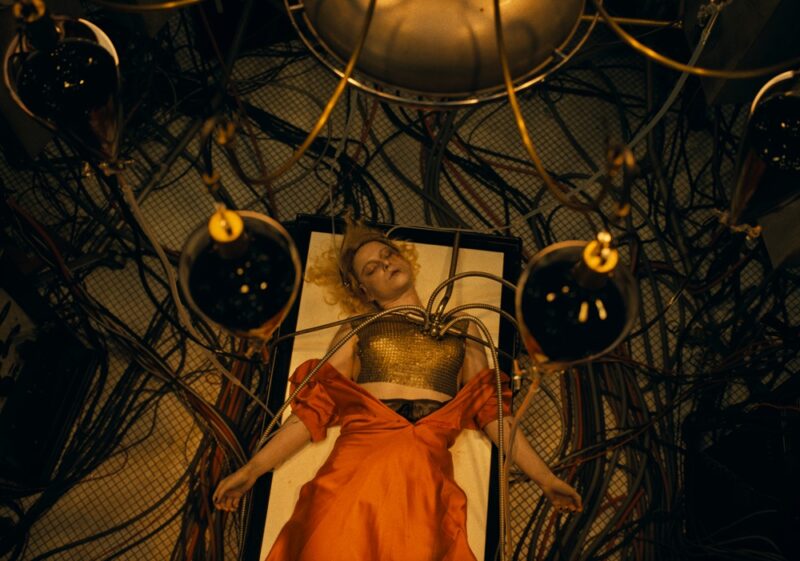
For Gyllenhaal, there was ultimately only one person who could play The Bride: Jessie Buckley. Their collaboration on The Lost Daughter forged a creative shorthand so intuitive that Gyllenhaal worried writing the role specifically for Buckley might limit it. Instead, she resisted, until the script made it undeniable.
Buckley’s power, Gyllenhaal explained, lies in her ability to hold contradictions simultaneously: ferocity and vulnerability, intelligence and irrationality, sexiness and ugliness. She allows the full spectrum of humanity into her work, and The Bride! demands exactly that.
The result is a character who feels wildly specific yet deeply relatable, because she contains multitudes.
Why Christian Bale Was the Only Frankenstein
Casting Christian Bale wasn’t about prestige, it was about emotional capacity. Gyllenhaal imagined a Frankenstein pulled closer to Mary Shelley’s original conception: deeply sensitive, intensely lonely, intellectually curious, and capable of great cruelty.
Bale, she said, could hold all of that. His Frankenstein is not just monstrous in action, but human in yearning. He can embody rage without flattening it, vulnerability without softening it. Most importantly, Bale and Buckley forged an immediate, profound connection, something Gyllenhaal believes only happens when two truly brilliant actors meet.
Their performances, she noted, involved constant surprise – an “electric live wire” she would gently guide rather than control.
A Punk Film In Every Sense of the Word
Is The Bride! punk? Gyllenhaal’s answer was a resounding yes, though not in just one way. There’s literal punk energy in the film, with visual references to figures like Sid Vicious. But there’s also a deeper punk ethos at play.
For Gyllenhaal, punk is about refusing to fit neatly into a box. It’s about centering something – or someone – traditionally pushed aside. Making a film called The Bride! and insisting it truly belongs to her is, by that definition, inherently punk.
The 1930s: Reimagined, Refracted, and Dreamed
Though the film is set in the 1930s, Gyllenhaal stressed that it’s not a strict historical recreation. It’s the 1930s “by way of downtown New York in 1981, and now.” A period filtered through imagination rather than accuracy.
The decade appealed to her for multiple reasons: the fantasy of early cinema, the rise of movie stars as objects of projection, and the tension between illusion and reality. Frankenstein’s loneliness, she explained, is soothed by a relationship with a movie star, someone he can “know” without being seen.
That idea of fantasy love versus real love – of cinematic desire versus embodied intimacy – runs throughout the film.
The Bride’s Look: Story First, Always
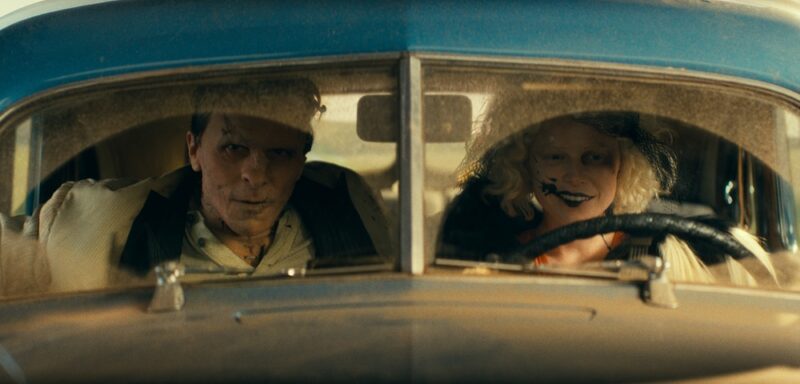
One of the most striking elements of the trailer is The Bride’s blackened mouth, a smudge that feels both violent and stylish. Gyllenhaal revealed that the look emerged collaboratively between Buckley, makeup artist Nadia Stacey, and the film’s production design.
The black substance is tied directly to the story – a mysterious, inky material used in the resurrection process that stains her skin. It’s not just aesthetic rebellion; it’s narrative residue. The result is a look that feels simultaneously experimental, gothic, and confrontational; less victim than punk icon.
Gyllenhaal was clear: everything must serve story first, but it also has to look incredible.
A Dream Ensemble Cast – Chosen Boldly
Beyond its leads, The Bride! boasts a stacked supporting cast including Annette Bening, Penélope Cruz, Peter Sarsgaard, and Jake Gyllenhaal. Maggie cast fearlessly, often simply asking the people she most admired.
Bening was a natural choice for a mad scientist. Cruz appealed precisely because she had never done anything like this before. Sarsgaard – Gyllenhaal’s husband – was cast because the character demanded someone dangerously charismatic. And Jake Gyllenhaal, her brother, was asked last, after careful consideration, resulting in a collaboration filled with joy, laughter, and creative trust.
A blend of fantasy and reality
Gyllenhaal singled out a large-scale sequence blending fantasy and reality as the most challenging part of production. Shot over five nights in the early hours of the morning, the scene involved hundreds of extras, complex choreography, music, and stunts, while accommodating the lengthy process of applying Bale’s prosthetic makeup.
Standing in a ballroom at 4am trying to orchestrate myth, emotion, and spectacle was exhausting, but also exhilarating. For Gyllenhaal, difficulty and pleasure weren’t opposites; they were intertwined.
Why It Was Made for IMAX
Perhaps the boldest technical revelation was Gyllenhaal’s experimental use of IMAX. New to the format, she approached it as a beginner, asking not what IMAX usually does, but what it could do.
Rather than using expanded aspect ratios for scale alone, Gyllenhaal tied IMAX growth to psychology. The frame expands when the film enters dream states, inner worlds, or moments of magic. In some cases, the expansion is animated, something she was told had never been done quite this way before.
Her outsider perspective, she suggested, allowed her to imagine new possibilities for the format.
That Exclamation Point Actually Means Something
The exclamation mark in The Bride! wasn’t a marketing gimmick, it was instinctive. Gyllenhaal described it as slightly “naughty,” a rebellious flourish no one told her to remove.
Thematically, it reflects a woman who returns to life with far too much unsaid. When she finally gets to speak – emotionally, existentially – it comes out with force. With urgency. With emphasis. Hence: The Bride!.
At Its Core, a Messy, Honest Love Story
For all its punk bravado and gothic spectacle, Gyllenhaal insists The Bride! is, fundamentally, a love story. Not a clean or idealised one, but an honest one.
It explores love as ecstasy and darkness, pleasure and damage. A connection between imperfect beings trying, often failing, to meet each other where they are. That messiness, she believes, is where truth lives.
The Ultimate Punk Anthem for The Bride!
When asked to name a song that encapsulates the film’s spirit, Gyllenhaal chose Siouxsie and the Banshees’ cover of Iggy Pop’s “The Passenger“. The choice is deliberate and ironic.
The Bride may have been framed historically as a passenger, but in this film, she’s driving. The story. The energy. The rebellion.
