

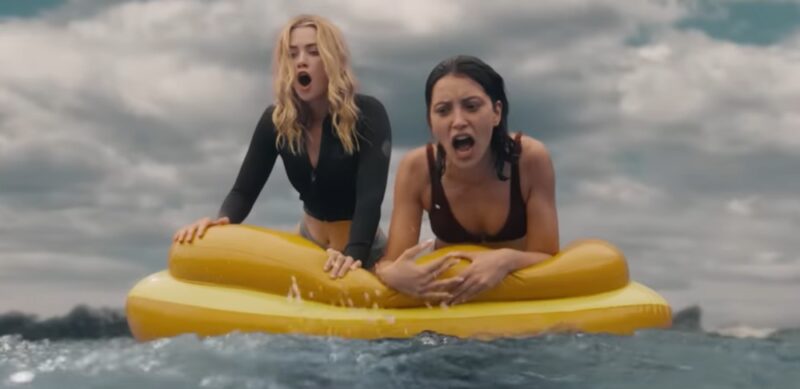
On a Brisbane soundstage transformed into open ocean, Killer Whale is quietly revealing itself to be far more than a creature feature. What the producers and creative team are building here is a film that blends old-school practical filmmaking, contemporary visual effects, and a pointed generational perspective – one aimed squarely at an audience rarely centred in the genre.
Rather than relying solely on digital environments, Killer Whale has been constructed from the ground up, quite literally. The film’s central setting – a remote atoll in the middle of the Pacific – doesn’t exist in the real world, so the production built it. Rocks, beaches, aquarium walls, feeding platforms and entire environments were fabricated, recycled, repurposed and reassembled across multiple locations and water tanks. What appears onscreen as a vast, continuous ocean landscape is actually the result of meticulous planning, physical construction, and digital extension layered on top of tangible sets.
The production design process began not with spectacle, but with clarity. Early in pre-production, the filmmakers (writer/director Jo-Anne Brechin, co-writer Katharine McPhee, and producers Steve Jaggi, Kylie Pascoe and Lionel Hicks) commissioned a detailed scale model of the atoll, creating a physical map that defined geography, distances, sightlines and character movement. That model became a constant reference point across departments – from stunts and visual effects to camera and production design – ensuring spatial logic remained consistent throughout the film. It also dictated a key creative decision: only the elements the characters physically interact with would be built. Everything else would be extended digitally, grounded in scans of the real sets.
This hybrid approach allowed the team to work efficiently within an Australian budget while still delivering scale. Every rock climbed, every surface touched, and every moment of physical danger was designed to be real. The result is a film that privileges interaction over illusion – actors (predominantly Virginia Gardner, who our on-set visitor, Peter Gray, saw in literal action, and Mel Jarnson) responding to weight, texture and resistance rather than empty space.
That philosophy extends to the film’s titular creature. Rather than creating a fully digital orca, the production commissioned a large-scale maquette and multiple physical components of the whale – most notably the head – allowing performers to act opposite something tangible. These elements are later augmented digitally, but the emotional and physical connection is anchored in something real. It’s a conscious throwback to a more tactile era of filmmaking, where practical effects carry the burden of believability.
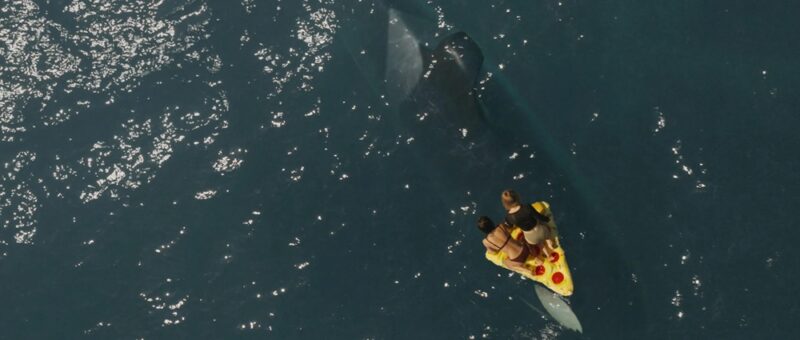
But Killer Whale isn’t just notable for how it’s made – it’s equally defined by why it’s being made. The producers are explicit about the film’s intended audience: young women. While creature features have historically been dominated by male perspectives and catered to adolescent boys, Killer Whale aims to flip that axis. Written and directed by women, the film is shaped through a female gaze, focusing on agency, empathy and consequence rather than objectification.
At the centre of the story are two young backpackers (Gardner’s Maddie and Jarnson’s Trish) whose well-intentioned attempt to free an orca from captivity unleashes devastating consequences. The whale itself is not framed as a mindless aggressor, but as a creature shaped, and damaged, by human intervention. In that sense, the film positions itself as a kind of eco-thriller, where nature’s violence is a response rather than an origin point.
That thematic framing reflects a broader generational anxiety. Beneath the surface tension lies a story about powerlessness, inherited crises and young people forced to navigate disasters set in motion long before they arrived. The producers point to this as a defining reason the film resonates with its target audience, one growing up amid climate instability, economic uncertainty and diminishing autonomy.
Even the film’s protagonist reflects this perspective. The lead character, Maddie, has a hearing impairment – an element that isn’t treated as a gimmick or a limitation, but as part of how she experiences and survives the world. It adds both representation and narrative texture, reinforcing the idea that survival in this story comes from perception, adaptation and understanding rather than brute force.
Despite its thematic weight, Killer Whale never loses sight of its genre roots. It promises spectacle, tension and visceral thrills, delivered through carefully staged water sequences, large-scale tank work and extensive visual effects. Yet the filmmakers are adamant that depth and entertainment are not mutually exclusive. Their goal is a film that plays as a sleepover scare movie on the surface, while quietly embedding ideas about captivity, consequence and control underneath.
In many ways, Killer Whale represents a rare kind of Australian production: one that merges commercial ambition with genuine craft, giving local crews the opportunity to build, sculpt, puppeteer and engineer at a scale more commonly associated with Hollywood. From repurposed swimming pools turned into ocean tanks to abandoned set pieces reborn as hero rocks, the film stands as a testament to what can be achieved through collaboration, ingenuity and belief in the material.
Standing on set, surrounded by water, steel frames, foam rock walls and fragments of an orca waiting to be brought to life, it becomes clear that Killer Whale isn’t just about a creature terrorising humans. It’s about what happens when stories, like ecosystems, are built with care – and when filmmakers trust that audiences, especially young ones, are ready for more than just teeth in the water.
Killer Whale is screening in theatres in the United States and on Digital and On Demand from January 16th, 2026. An Australian release is yet to be announced.
Our thanks to M4M Agency, Screen Queensland and Jaggi Entertainment for the set visit.
