

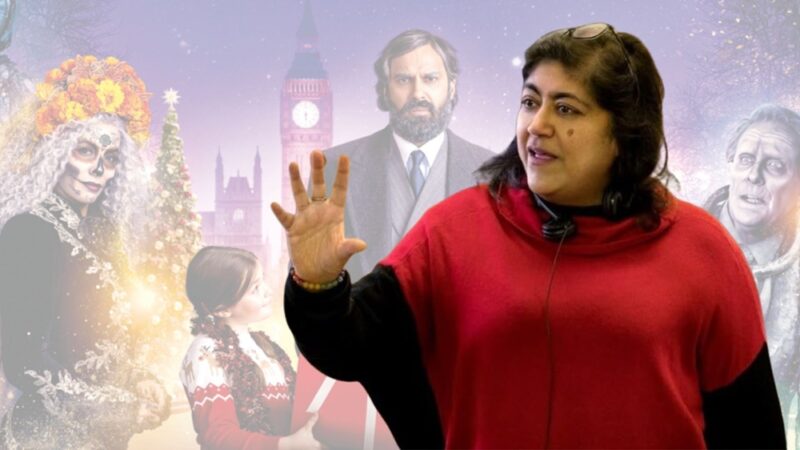
Gurinder Chadha is one of Britain’s most distinctive filmmakers, known for telling stories that reflect the rich diversity of modern life. She broke through internationally with Bend It Like Beckham, and has since directed a string of much-loved films, including Bride and Prejudice, Angus, Thongs and Perfect Snogging, and Blinded by the Light. Her work is marked by warmth, humour and a sharp sense of cultural observation.
Christmas Karma is Gurinder’s vibrant musical twist on Charles Dickens’ A Christmas Carol, set in a lively, multicultural London. Kunal Nayyar (The Big Bang Theory) plays Mr. Sood, a powerful businessman whose arrogance and greed have left him estranged from those who matter most. On Christmas Eve, he’s visited by three otherworldly guides (portrayed by Eva Longoria, Billy Porter and Boy George) who take him on a journey through his past, present and possible future. With infectious bhangra beats, soulful gospel, rap interludes and reimagined carols, Christmas Karma fuses East and West in a glittering celebration of forgiveness, community and self-discovery. The all-star ensemble also features Hugh Bonneville, Charithra Chandran, Pixie Lott and Danny Dyer.
To celebrate the film’s release in Australian theatres, Peter Gray spoke with the director about what emotional North Star guided her through the film’s multitude of layers, the importance of the film’s soundtrack, and which Ghost of Christmas… she would personally like to be visited by.
Christmas Karma fuses Dickens, Bollywood, diaspora history, migration, politics, and it’s a full blown musical spectacle. What was the emotional North Star that guides you through all of those layers?
I think it was to tell a story for today. How can I make a difference today? How can I tell a story that was relevant, interesting, perhaps told you something you didn’t know? That you are emotionally engaged with to come out the other side feeling really good about yourself and the people around you. That was my North Star. I think what Charles Dickens did was shine a light on disparities in Victorian England and how people didn’t really value the poor or think sick, and they were left on a scrap heap, really. I find that in today’s world, we have some of the same values. Poor people and families are struggling to survive. Hospitals are full of sick people, and there aren’t enough hospital beds. We are really living in a society where you have very rich people and very poor people.
Whilst it’s not Victorian England, I think it’s still a pertinent question to ask, “Is a rich CEO worth 1000 Tim Cratchits?”, as my ghost asks. As we move into that world where the wealth is in so few hands, I think Dickens is even more relevant. I just thought the questions that Dickens was asking and the story of redemption of his main character, Scrooge, was a story I could tell and could be resonant in so many ways to so many different people.
There’s that thematic of migration and trauma running underneath the glitter of the musical numbers. Is that tension of mixing joy and trauma in the same film, which could be a risk, the point of doing so? That’s why you wanted to make this, because of its juxtaposition?
Dickens’ original is quite dark. The journey that Scrooge goes on is very dark, and I had read that Dickens was quite the depressive. I mean, he was a manic depressive and he wrote “A Christmas Carol” during one of those bouts of depression. He wrote it to and find the good in humanity, so that’s what he set out to do. I just followed the novel really closely. Every scene is the same as the novel, it’s just contemporized. Plus, I have songs, and the songs carry the story forward in the same way. “Rise Up”, for example, it’s a gospel song, but it’s the same dialogue that Scrooge has with the Ghosts of Christmas Present. It’s just done in a song. And with “Pain of the Past”, the song that Boy George sings, that Gary Barlow wrote, that’s looking back and saying, “You don’t know what you’ve got. Don’t let the past destroy you.”
I think the (story’s) darkness can be interpreted in different ways. I just made mine very real, because there was a person I knew who came from Uganda as a young kid, and he didn’t really want to leave. He came during Christmas time and really struggled. His father died in a refugee camp, had a heart attack, and every Christmas that trauma came back to him. He started spending some Christmases with (our family) when I was younger, and he would ask me, “What are you doing? Why are you trying to be white?” I’d tell him how it’s Christmas and this is the tradition. He would always be the Grinch in the corner, and we’d all be pulling the crackers, putting our hats on, having our lunch, waiting for the Queen to come on the TV with the speech. That always stayed with me as a Christmas story.
Mentioning the music, you have bhangra, gospel, rap…when you’re crafting the musical language of the film, what was the first sound that you knew had to be in it? The thing without which Christmas Karma wouldn’t feel like Christmas Karma?
For me, it was that bhangra song. I came upon the idea of using “He won’t wish you a Merry Christmas,” because that works so well. He’s such a curmudgeon. In Bend It Like Beckham, I had a very famous Punjabi song that I used when Jess is crying and cleaning her football boots. The song is very beautiful. It’s about not ever forgetting where you’re from. “Get on with life, but don’t forget your roots.” That song became a TikTok sensation, with people using it for when they were travelling back to India, or when they’re doing something cultural. I asked Malkit Singh, the original singer, if he would do something for Christmas? Maybe a cover and bring that song back? He didn’t want to, because (the song) was too old. He wanted to do something new. So he wrote a new song based on that, but with Christmas lyrics. I also really wanted a catchy theme song, and I and Shaznay Lewis from All Saints, she’s my friend, I asked if she could do something that sounds like Beyonce. And she’s like, “Oh, okay?” (Laughs). I was singing “Crazy In Love” to her, and she knew it was a tall order (laughs).
But she sat down with Ben Callum in the studio, and between us we came up with the title song, “Christmas Karma”, and, my goodness, it’s so catchy. That became a fantastic theme of the film. And there’s also that little treat at the end, if you stay. I was having lunch with George Michael’s estate, I’m friends with the people who run the estate, and I told them I was doing a Christmas film. They asked if I wanted to use “Last Christmas” and I knew I didn’t have the money for that. They basically told me if I was nice to them, they might give it to me (laughs). George Michael was a big fan of Bend It…, and they said I could take the song, but do something different with it. “Why don’t you do a Bollywood version? Why don’t you do it in Hindi?” So it was their idea.
They told me George would love that. That’s how that song was born. I called up my friend, Priyanka Chopra, and I asked her to please come and do it. She told me, “I’m not a singer anymore,” but I told her it would just be a laugh. It will be fun. And, of course, she came in. We ended up with this quite beautiful version of “Last Christmas.” It’s a treat, but it was all very organic. It was never in the original (script).
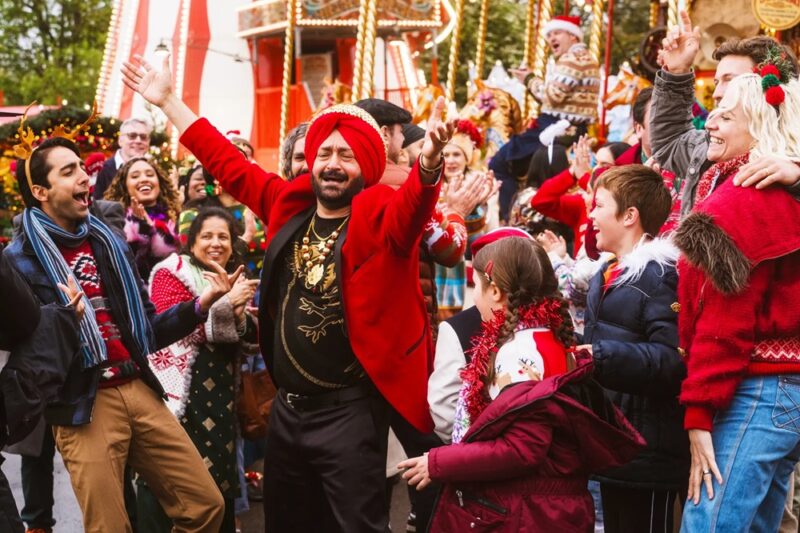
As you mentioned Shaznay Lewis before, you have her in the film for a little bit. There’s Boy George and Eva Longoria. Kunal Nayyar as Mr. Sood, this film’s Scrooge. His transformation is part political, part spiritual, and part personal. When you’re directing him, which of those three was the hardest to get right? And which surprised you in that direction as well?
When I first Kunal, I obviously knew him from The Big Bang Theory. When I met him, he’s much older (now), there’s a slight salt-and-pepper (to him), and he cuts a very different figure to that character on TV. We see repeats all the time, so it’s like he’s frozen in age. But Kunal is very serious, very sensitive, and he cuts a slightly melancholy figure. I met him and could totally see him playing my Scrooge. The second time I met him, I offered the part. He thought I was crazy, and he was really trying to talk me out of it (laughs).
He wanted to be cast as a young, sexy guy, and I said that I couldn’t see that, and if I can’t see it, I can’t get it out of my head, you know? He then just embraced it, and I think, for him, his process was so thorough, because he met people who had been through that experience. He had a folder that was thick of notes, and then we would meet for questions. He would ask me very detailed questions about scenes, tonally what I was thinking when I had written a certain scene, what was in my head?, and then he’d write copious notes again. When he came on set, my job was to make sure that he didn’t turn (nice) too early. The hardest thing in A Christmas Carol is that Scrooge should earn the turn. A lot of adaptations don’t get that bit right.
And the thing is, the audience knows what’s going to happen. We all know it’s going to, so we’re waiting for it to happen. I wanted to make sure it was earned. Was there too much grimace? Was he too mean? Not mean enough? We had to find those balances throughout each scene.
During production, was there a moment where you thought, “This is why I wanted to make this film?” Was it a song? A performance? A tiny detail no one else noticed?
I think the scenes with the Cratchits were all very moving. Little Tiny Tim. That actor is Freddie Marshall-Ellis, and he suffers from something called NF1, which is a disease that a lot of children have these days, where tumors grow at the end of your nerves, and you never know if they’re benign or not. You have to constantly be checked. And in adapting a Tiny Tim for today, I was looking for what could it be? Because in Charles Dickens’ time, it was rickets, and Freddie used to play Tiny Tim on the stage here, so when he came in to meet me I was amazed at how articulate he was. Be has NF1, and he has tumors, actually two in his brain that affect his walking, but he’s such a consummate little actor and professional. That was really moving, those scenes with him. He really understood the idea of playing a sick child. An innocent, sick child. And in that scene where he says, “God bless my doctors and God bless the NHS,” I find that so moving, because the NHS is one of the most brilliant things we have in Britain. We all need to fight for it, because if you spend time in America, like I do, you realise the preciousness of having a healthcare system.
It’s certainly one of those things that we appreciate in Australia too. And with the film having the ghosts of past, present and future, if you could send a ghost to visit young Gurinder, the one just starting out in her career, who do you think you would want to send to her? And what would they show her?
Oh, my Lord. No one has asked that question! Do you know what I would say? I would have to say the ghost of present. The role of that ghost is to celebrate life, celebrate yourself, celebrate people, be happy, and if you’re dealing with stuff, find a way to deal with it and be happy. With my films, I think I feel very privileged to have that job and to be a storyteller, and have a global audience as well. I always make sure that the stories I tell are the ones that resonate in a way that no one else can with their stories. I try to be as unique as possible. What I end up doing is capturing history, but not just for my community, but everybody at a particular time.
Christmas Karma is screening in Australian theatres from November 27th, 2025.
