

A notorious hitman who made a career killing other assassins, wants out. But walking away is not an option. Now marked for death, he unexpectedly finds himself partnering with a former target to outrun his boss.
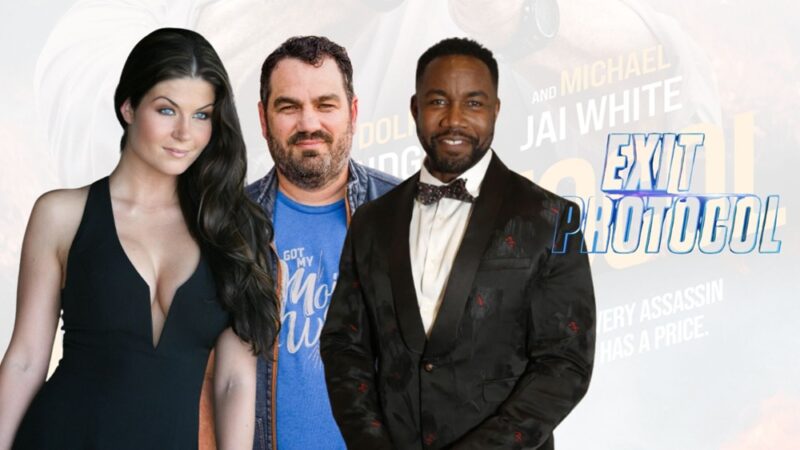
Directed by Shane Dax Taylor, and headlined by action legends Scott Martin and Dolph Lundgren, Exit Protocol is an unashamed throwback to the action films of the 80s and 90s, and it was such love that Taylor and two of the film’s ensemble cast members – Stephanie Beran and Michael Jai White – expressed during their chat with Peter Gray as the film arrives on Digital.
I love knowing from those in the genre they’re currently working in what the gateway movie was to you personally that first got you interested in action?
Shane Dax Taylor: Great question. I’m a kid of the 80s, so it was First Blood, Commando, and all those fun action films. You know, growing up then it was Steven Segal and Van Damme, and even those terrible ones. It was the perfect time in the 80s growing up and then going to Blockbuster and talking to the clerk, who was always so much older than me, and finding something that’s just as entertaining. Maybe it was bad, but it still had action. I loved it all. I’m a true action fan. So when I got the opportunity to jump into the action world as a director, it was absolutely! I’m not going to do a period piece in London. I’m not doing Shakespeare. Not that I won’t watch Shakespeare, but I’m not going to direct it.
Stephanie Beran: Mine was, what is the name of the one with Arnold Schwarzenegger and Jamie Lee Curtis? True Lies! I was maybe nine, and my mom saw that movie, and I thought it was just the best thing, My dad got home from work, and we were like, “We’re going to see it again!” I watched it again about a year ago, and it’s still a classic.
Michael Jai White: There’s a movie called Trouble Man. And that movie influenced me tremendously. There’s a guy named Robert Hooks, and he was the star of that, and it influenced me so much that I grew up to become a filmmaker, a writer, and I did a movie called Trouble Man that I starred in. It was this full circle thing. Yeah, I’d say that’s one of my big inspirations.
All such great choices. I was a Van Damme kid growing up. With the release of Exit Protocol, it feels like one of those movies we’d see in the 80s and 90s, and I like, Shane, that you’ve taken this familiar assassin concept and you’ve twisted it into something more. It’s a bit existential because you have a hitman who wants out, but can’t escape the world. What drew you to telling a story about walking away from violence, rather than reveling in it?
Shane Dax Taylor: Yeah, that’s a good question. For me, I actually came into this film when it was in prep. They were a couple weeks from shooting and the original director tragically passed away about a week before shooting. So Daniel Cummings, the production manager, and Scott Martin gave me a call saying that there was a chance this film could go away. I’d work with the entire crew on films before, and I probably would’ve said no, but under these circumstances, knowing the cast and crew, I hopped on a flight and came in. They were ready to go, so I kind of got thrown into the fire, so to speak, but, fortunately, having worked with (the crew) it made it easier. I usually write or rewrite the script, I’m part of the casting process, so to step in and see Michael Jai White is already on, and Dolph (Lundgren), I knew I could do this.
There’s something really poetic about a killer who’s forced to ally with a former target. Almost like karma is forcing a self-reflection. How much of that theme of redemption or reckoning guided your approach to directing?
Shane Dax Taylor: That’s a good one. With this story, it kind of drew me in. We’ve seen assassin movies, we know what’s going to happen, but the fact that you’ve got Scott (Martin) going against Dolph and Michael, it’s the best of the best. You don’t know what’s going to happen, or who’s going to be top dog. It was really a blast to see that. And it’s not just straight action, it was good to see the relationships between Scott and Dolph, and Michael and Stephanie. You’re not expecting those moments.
Talking about the softer, more human moments, Shane, do you storyboard major set pieces in detail? Or do you prefer to find them during rehearsal and almost as if you let the film show you want it wants to?
Shane Dax Taylor: Yeah, fantastic question. Before every scene I ever do, it doesn’t matter if it’s a big action set piece or it’s a small, intimate scene in the living room, I’ll bring the actors in. Just them and the DP and first AD to explain, and I’ll tell them to let me see what they’re going to do. I don’t want to tell them what chair they have to sit in, or in a fight sequence they have to be in a specific corner. Show me what you’re going to do, and we’ll light around that. I use the script, but it’s not like you have to say everything that’s in there (directly). As long as we get to A to Z, we’ll get there.
Going off that, was there something that you discovered about yourself or your filmmaking instincts through this project specifically?
Shane Dax Taylor: Yeah, it’s that these guys are pros. I have done some films and, no disrespect, but they weren’t with actors. I knew them, but they weren’t actors, and now it’s to the point of let Michael be Michael, or Scott, or Dolph, and let them do their thing. What is their strength? Let them do it. That was the biggest thing, just trust the process and the people.
Michael, was there anything that you learned from Isaac? Either a belief or a mindset that you didn’t expect to resonate with you personally?
Michael Jai White: Yeah, the ending of the movie, it worked itself out that way. We had a different ending, but the energy that everyone was bringing to it altered the ending of the film, which we felt was much more organic and believable. It changed before we got to filming, and I haven’t seen the film yet, but I know certain things have changed, because we all did a Think Tank kinda thing and we all asked what makes the most sense? I’ve written (before), and I know you can write things and have an intention, but then you get on set and realize (it doesn’t work). I remember I did a movie with Louis Gossett Jr. a long time ago (Captive Heart: The James Mink Story), where I was a slave, and his daughter was sold to a plantation, and we had to figure out a way to get off the plantation. There was this really dramatic scene with myself and Louis and these Quakers. We were having a debate over this map, and then arguing over where we should go, and I’m saying we need to take a bridge, or whatever. Once the director said “Action” I tried to forget everything and really used the reality.
I dropped my first line and said, “I can’t read.” My character doesn’t know how to read. It was something we (referenced) earlier, because (my character) got whipped for learning the letter R. It was one of those funny things of learning the script, but when you’re there (on set), you just gotta look at reality. That was something I never forgot. I was thinking, “Jesus, every department in this production forgot about the fact that my character can’t read because I’m a slave!” It would have been ridiculous if we continued with it, and we had to restructure. But it was something that was lent to me on this set, asking “Why would I kill this guy right now?” You know, we watch movies at home and think, “That didn’t make sense,” and you wonder how it slipped by. There’s somebody not catching the reality of it.
Stephanie, your character’s name, Wicked, is amazing in that it sort of tells us she’s not someone to be underestimated. How did you begin to find who she is beneath the exterior? Was there anything you specifically came up with, either a backstory or a character choice that gave her an energy?
Stephanie Beran: I really love to work from the inside out. For a character like that, wardrobe is so huge, makeup is so huge, hair to me, for some reason, is so huge. But it was interesting in asking, “How does one become an assassin?” What happens in your life for you to think about killing people for a living? In the scene with Michael, and we’re talking, she says that she was magna cum laude, so we know this is someone who went to college and is really smart. She has this push-pull with men. She doesn’t want to be underestimated. It was about finding out what’s underneath the surface that got her from being a normal college girl, who’s really smart, to killing people for a living.
Michael Jai White: It’s kind of written in the script. I mean, there’s indications that show what their background has been, and what I have to keep it open to is what (Stephanie) is going to bring, and what’s organic in the moment is the way I’m going to react that. That’s the fun of it, because I don’t know how (she) is going to play it. I don’t know how Dolph is going to play it until I’m there, and Scott, so that’s the fun part.
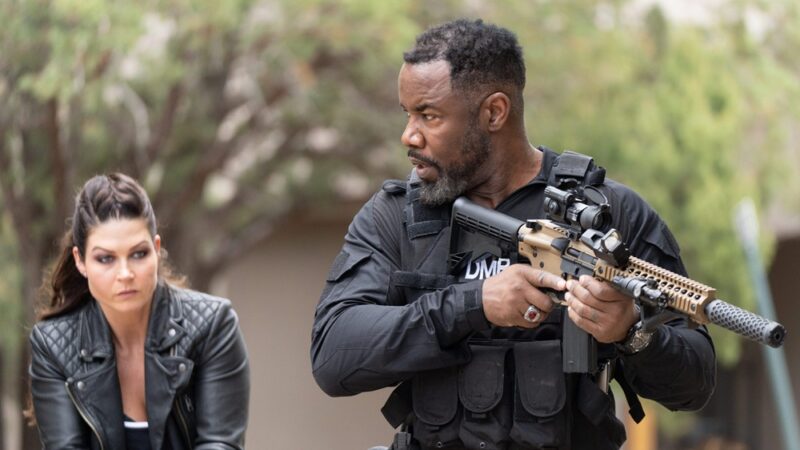
Going off that, with you and Dolph, as two actors who have lived and breathed action cinema for so long, is there an unspoken language that the two of you share?
Michael Jai White: One of the things about Dolph that I like is that he’s open to interpretation and change in the moment. He’s always doing that, because he’s a director as well. It could be that something’s written a certain way, but then the day that you shoot it, he’s like, “Let’s thing about this,” and it’s why I like working with him because he’s open to making things better. That’s exciting to me. We’ve done four or five movies together, me and Dolph, and that’s something I look forward to.
I guess there’s a temptation to play an assassin as someone purely cold or unfeeling. There’s clearly an emotional pulse underneath the violence. How do you balance that volatility and humanity?
Stephanie Beran: Scott Martin, if you don’t know, is my husband in real life. So I think really playing on that, and that these characters had a relationship at some point, you see her vulnerability, even though it’s covered by anger and an upsetness at being left at the altar, or whatever. There’s humanity. There’s some love. It was fun to play with, and (Scott) made it easy.
Do you look at her as a villain, or more as someone just surviving in a violent world with her own code?
Stephanie Beran: I definitely don’t think of her as a villain. Where she is is a product of circumstance, and in a crazy world that we’re living in she just found herself in this position. She’s really good at it, and I think she has her reasons for being there.
Michael, when you’re playing a character like that – an assassin hunting assassins – do you think about what honour means to someone who kills professionally?
Michael Jai White: I don’t want to get into a political thing, but it’s not a rare thing. It’s just called being a soldier a lot of times. There should be an honour and a code. I feel everybody who calls himself a man, it should be a code that you live by and that you will die by.
Assassins communicate as much through movement and stillness as they do dialogue. Stephanie, how did you find using your physicality to express Wicked’s danger or unpredictability? Was it like tapping into a new muscle you didn’t realised you possessed as an actor?
Stephanie Beran: Movement is really interesting. As an actor, we’re so used to seeing words on a page, right? Then you put a gun in someone’s hand and you have to be comfortable with that weapon, and be believable. I think she’s a firecracker, right? She’s this itty, bitty thing, and a woman in this field, so it’s about establishing her presence.
Michael, you’ve spoken about discipline and self-mastery in martial arts. How does that philosophy influence how you play morally conflicted characters, like Isaac?
Michael Jai White: It’s not really morally conflicted. In these scenarios, everybody’s leading their own movie, so to speak. There’s a code to this character, and that character’s bible might not look like someone else’s, you know? That’s really what it is. When it comes do to it, you have a responsibility in playing people who are based on real people. It’s the job of the actor to recreate humanity, honestly. (But) I do know people who have worked in these capacities.
Is there anything you learnt, Stephanie, from playing Wicked that you think you’ll take into your next role?
Stephanie Beran: Well, the next project that’s coming out is a Hallmark movie (laughs). Probably not her for that one. But maybe the next action movie? I like to approach every character different, right? There’s always going to be a piece of you and everyone that you’ve played with you, but I kind of just try to do my job, be in the moment in the film, and then leave it behind.
Exit Protocol is now available On Demand and On Digital in the United States.
