
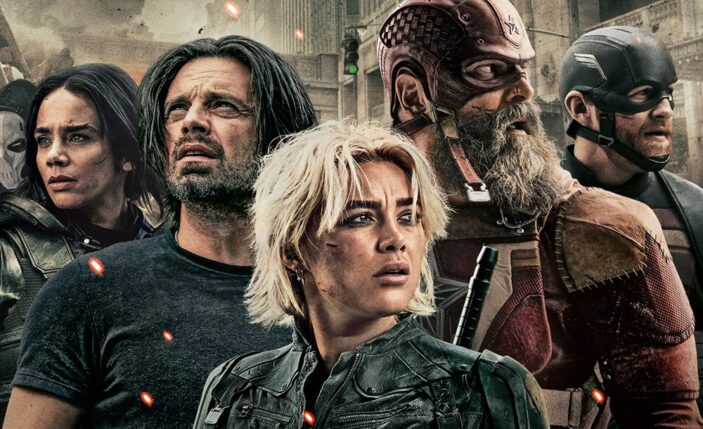
Not unlike its DC counterpart the Suicide Squad, Marvel have assembled an anti-hero-minded crew of degenerates to lead the charge for the greater good in Thunderbolts*, one of the MCU’s strongest efforts in a recent phase of mostly underwhelming, middle-ground entries that have all largely failed to live up to the expectations of a post-Endgame landscape.
Director Jake Schreier (Paper Towns, Netflix’s Beef) and screenwriters Eric Pearson (Thor: Ragnarok, Black Widow) and Joanna Calo (TV’s Hacks and The Bear) layer the film with a dark emotionality and surprising allegorical nature pertaining to depression and mental anxiety, bringing to mind a sense of gravity and maturity that the latest wave of offerings (Thor: Love and Thunder, Ant-Man and the Wasp: Quantumania, The Marvels, Deadpool & Wolverine) have largely been void of.
That’s not to say MCU movies can’t embrace a lighter mentality and have fun – after all, these are super hero outings – but Thunderbolts* (and yes, the asterisk is intentional and explained) toes the line in how it balances drama, action spectacle and genuine humour with confident footing. Given that the Thunderbolts as individuals – Yelena Belova (Florence Pugh, an absolute standout), Bucky Barnes (Sebastian Stan), John Walker (Wyatt Russell), Taskmaster (Olga Kurylenko), Bob (Lewis Pullman), Red Guardian (David Harbour) and Ghost (Hannah John-Kamen) – are all dealing with their own demons, both personal and professional, the film’s dramatic temperament is constantly weaving throughout the action set-pieces, which, themselves, are largely practical combative sequences that forego the overt CGI that has so often plagued these productions; basically, it actually looks like this film was made on physical locations and not awash in green screen disconnection.
Just why these alphas are brought together is due to CIA director-cum-Contessa Valentina Allegra de Fontaine (Julia Louis-Dreyfus, channeling some serious Veep energy that truly livens up proceedings whenever she’s on screen) and her intent on wiping out any government black spots that could smirch her reputation. The Thunderbolts – who unofficially dub themselves that due to an amusing childhood story of Yelena’s that her excitable father, Red Guardian, recounts – are those considerable spots, and as much as Valentina, and her conflicted assistant, Mel (Geraldine Viswanathan), attempt to take them out, they prove, like a cockroach, that they’re considerably difficult to rid.
Bob, whose true source of power is kept mostly hidden for a great portion of the film, is the ultimate link that Valentina seeks to utilise for her own benefit, and it’s his inward journey and moral struggle that laces the back-end of Thunderbolts*‘s 126 minutes with a truly reflective tone. It’s surprisingly poignant, and commenting on mental health in the guise of misunderstood villainy is quite the move for something as mainstream as the Marvel brand that, for the most part of its cinematic timeline, has played by a certain set of rules. Thunderbolts*, as a film, already proves itself miles ahead of its counterparts off the presence and dedication of Pugh alone, but being unafraid to address an issue that’s far more prevalent than people (specifically young men, who are so often cited as the MCU’s most devoted audience) care to admit to, elevates this actioner above its expected genre beats.
A breath of fresh air for the MCU, and hopefully an indication that the next cab off the rank – July’s Fantastic Four: The First Steps – will continue in the same quality and care that’s been afforded here, Thunderbolts* reminds us why these films had such an event-like temperament surrounding them. For now, Thunderbolts* can own the “MCU is back” banner, but even if this proves to be more of an exception than the rule, what a deviation these outcasts are.


FOUR AND A HALF STARS (OUT OF FIVE)
Thunderbolts* is screening in Australian theatres from May 1st, 2025, before opening in the United States on May 2nd.
