
Few fictional worlds have embedded themselves into the cultural consciousness quite like The Handmaid’s Tale. In the decades since Margaret Atwood first published her landmark novel, Gilead has become shorthand for a very real kind of fear – one that has only felt more immediate with time. So when she released The Testaments more than 30 years later, there was understandable scepticism. Was this a necessary continuation, or a belated add-on to a finished story? The answer, as it turns out – and as this new Disney+ adaptation confidently proves – is that there was still plenty left to say.
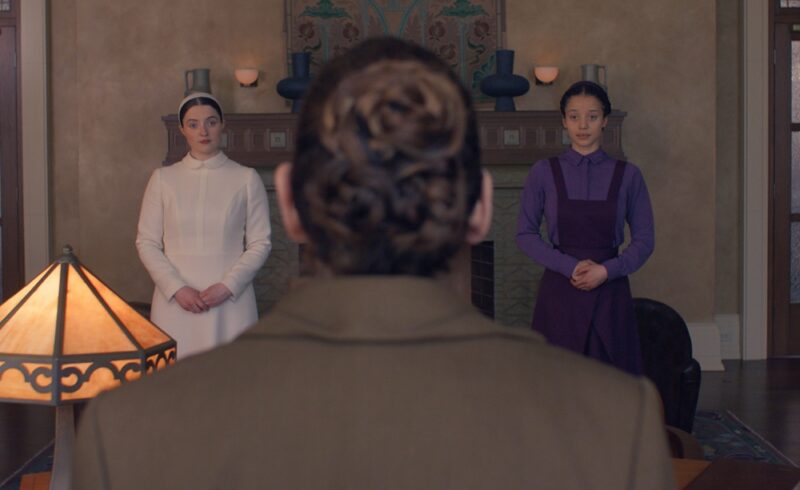
Developed once again by Bruce Miller, The Testaments doesn’t try to outdo its predecessor by going bigger or darker. Instead, it shifts perspective – and in doing so, finds something arguably more unsettling. Set a few years after the events of the original series, the story centres on Agnes (Chase Infiniti), the dutiful daughter of a high-ranking Commander, and Daisy (Lucy Halliday), a sharp-edged newcomer with secrets of her own. Their lives converge at Aunt Lydia’s austere finishing school, where young girls are groomed – under the guise of piety and protection – to become obedient wives within Gilead’s rigid hierarchy.
On the surface, this is the regime at its most polished. The corridors are immaculate, the uniforms coded in soft, status-signifying colours, and the promise of purpose is carefully packaged as privilege. But beneath that veneer lies the same machinery of control. As Agnes begins to question the life being mapped out for her – one that culminates in an arranged marriage to a much older man – and Daisy quietly disrupts the system from within, the series builds a slow, simmering tension around what happens when indoctrination starts to crack.
What makes The Testaments so compelling is this shift in vantage point. Where The Handmaid’s Tale immersed us in overt brutality, here the horror is more insidious. These girls don’t initially recognise their oppression; they’ve been raised to see it as normal, even desirable. And yet, in stolen glances, whispered conversations, and acts of quiet defiance, something instinctive pushes back. Friendship becomes subversive. Curiosity becomes dangerous. Rebellion, as the show suggests, is almost impossible to extinguish entirely.
Tonally, the series takes a surprising but effective pivot. There’s a sharper, almost satirical edge to the dynamics between the girls – “Mean Girls in Gilead” isn’t an entirely inaccurate descriptor – yet it never undercuts the stakes. If anything, it deepens them. Watching teenagers gossip, compete, and form alliances within such a suffocating system only underscores how thoroughly that system has shaped them.
The performances anchor it all. Infiniti brings a quiet, internalised conflict to Agnes, capturing the unease of someone beginning to see the cracks in a world she’s been taught to revere. But it’s Halliday who leaves the strongest impression, imbuing Daisy with a restless intelligence and emotional volatility that makes her both unpredictable and deeply compelling. Together, they embody the show’s central tension: belief versus doubt, obedience versus autonomy.
Visually, The Testaments is a striking departure. Where its predecessor grew increasingly frenetic and shadowy, this series leans into a more controlled, almost pristine aesthetic. The camera glides through carefully constructed spaces, emphasising just how curated – and therefore how artificial – this version of Gilead really is. It’s a world designed to look safe, even beautiful. That’s precisely what makes it so disturbing.
If the show occasionally falters – particularly when digging into backstory or skirting around certain thematic threads – it’s only because it sets such a high bar elsewhere. What it retains, crucially, is Atwood’s sense of urgency. The warnings embedded in this world still resonate, perhaps more loudly than ever. The rhetoric underpinning Gilead – about fertility, gender roles, and societal “correction” – doesn’t feel like distant fiction. It feels uncomfortably close.
And yet, for all its bleakness, The Testaments carries something its predecessor rarely allowed itself: the possibility of hope. Not in sweeping revolutions, but in smaller, more fragile acts – questioning, resisting, connecting. In watching these girls begin to wake up to the reality of their world, the series finds a quiet kind of optimism.
It may not hit with the same shock-to-the-system immediacy that defined The Handmaid’s Tale upon its release, but The Testaments doesn’t need to. It’s doing something different – something subtler, smarter, and, in its own way, just as vital.


FOUR STARS (OUT OF FIVE)
The Testaments will premiere its first three episodes on Disney+ (Australia) and Hulu (United States) on April 8th, 2026, with each subsequent episode airing weekly until the season finale on May 27th.
