

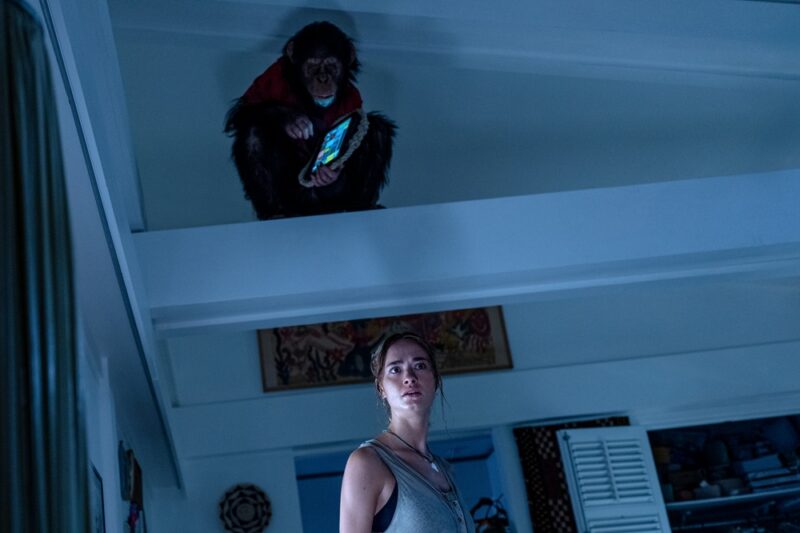
There’s something weirdly refreshing about a horror movie that doesn’t posture, doesn’t smuggle in a lecture, and doesn’t pretend it’s “elevated” because someone mutters words of perceived depth between splatter sequences. Director Johannes Roberts understands the assignment with almost admirable single-mindedness with Primate: deliver a gory creature feature with a breezy, old-school sensibility and enough practical carnage to make you audibly groan in the best possible way.
This is a film engineered for the kind of audience who still gets a warm nostalgic glow from 80s horror energy – that particular era where characters were less “people” and more “human-shaped snacks,” and the story existed purely as the flimsiest excuse to build a series of increasingly deranged set-pieces. And look, if you’re going to do a movie about a rabid chimpanzee turning feral on a group of vacationing twenty-somethings in a cliffside Hawaiian mansion, there is really only one sensible approach: go hard, go fast, and get out before anyone starts asking questions. Primate does exactly that.
The plot is as simple as it is functional. A pet chimp named Ben (performed by Miguel Torres Umba) – highly intelligent, emotionally attached, and taught to communicate through a tablet soundboard – gets bitten by a rabid animal and flips into a violent, unpredictable nightmare. That’s it. That’s the movie.
And Roberts doesn’t waste time pretending there’s going to be some grand exploration of ethics, animal rights, grief, or the nature of humanity. Mostly, Primate is a film in love with its own brutality, and it knows its audience is showing up to watch a chimp go absolutely feral in a house that’s basically designed like a luxury death trap.
The cliffside mansion setting is a gift, too. It has that heightened, slightly ridiculous “rich people architecture” vibe – glass walls, dramatic overlooks, infinity pool teetering on the edge of doom – like the house itself is already daring someone to fall off it. Horror thrives on geography, and Primate gives its violence a playground.
The cast is deliberately familiar. You can identify everyone’s function in the first five minutes: the returning daughter (Johnny Sequoyah‘s Lucy), the best friend (Victoria Wyant‘s Kate), the unwanted extra guest (Jessica Alexander‘s Hannah), the party boys (Charlie Mann and Tienne Simon‘s douchey frat duo), the potential romantic interest (Benjamin Cheng‘s Nick), the simmering family tension (Troy Kotsur and Gia Hunter as Lucy’s father and younger sister, respectively). They’re archetypes more than characters, but that’s part of the film’s throwback charm. Primate isn’t trying to build a deep emotional hangout movie before the violence hits. It’s trying to get you into position and then start swinging.
What it does do, and smartly, is mess with survival expectations. Horror fans are trained to predict who’s safe, who’s doomed, and who’s going to rise to the occasion. Primate toys with that just enough to keep you uneasy: some characters survive longer than their obnoxious personalities “deserve,” while others who feel like they’re being set up for a heroic moment get absolutely obliterated earlier than expected. There’s a mean little sense of humour to that, like the movie knows you’re guessing and wants to punish you for being smug.
Roberts has always been a director who understands clean geography and momentum, and here he applies that skill to making the violence feel punchy, immediate, and nastily physical. The gore is gnarly, wince-inducing, and frequently tactile, leaning into a practical-first approach that gives the bloodshed weight. It’s not slick CGI chaos; it’s more crunchy than that. You feel the impacts. You feel the tearing. You feel the awful, sickening creativity of the kills.
There’s a particular brand of horror joy that comes from watching a movie commit to effects that look like someone made them with rubber, syrup, and a truly concerning level of enthusiasm, and Primate taps into that beautifully. It’s often brutal in a way that makes you recoil, before you immediately laugh at yourself for doing so. That’s the sweet spot.
Narratively, Primate isn’t interested in extra detail. You can feel the film constantly choosing speed over depth, with characters making decisions because the movie needs them to, explanations delivered just enough to keep the machine moving, and emotional beats exist mostly as pit-stops between set-pieces. But this isn’t a flaw so much as it is the movie’s entire personality; Primate knows the fastest way to kill tension is to over-explain things, so it keeps the story surface-level, hits the major beats, and then gets back to what it does best.
There’s also something inherently unsettling about the villain here, because Ben isn’t a masked slasher or a supernatural entity. He’s almost recognisable, almost lovable, almost human in his intelligence, until the switch flips. The film wrings solid tension out of that transformation, turning something that was once a quirky family dynamic into a worst-case nightmare. That push-pull between affection and terror gives the film a sharper hook than it strictly needs.
If you miss the days when horror movies didn’t pretend to be vegetables, Primate is a greasy, glorious fast-food feast. Just don’t get too attached to anyone. Especially not the guy you think is going to save the day.


THREE AND A HALF STARS (OUT OF FIVE)
Primate is now screening in Australian theatres.
Image credit: Paramount Pictures.
