

Vera Miao’s feature debut, Rock Springs, is a film of undeniable importance, even when its storytelling struggles to cohere into a fully unified whole. Structured across three distinct acts – each with their own tonal and thematic weight – the film reaches for something vast: a reckoning with historical violence, inherited trauma, and the uneasy way the past seeps into the present. While each section carries purpose, the film often feels less like a single, flowing narrative than a series of compelling but uneven movements.
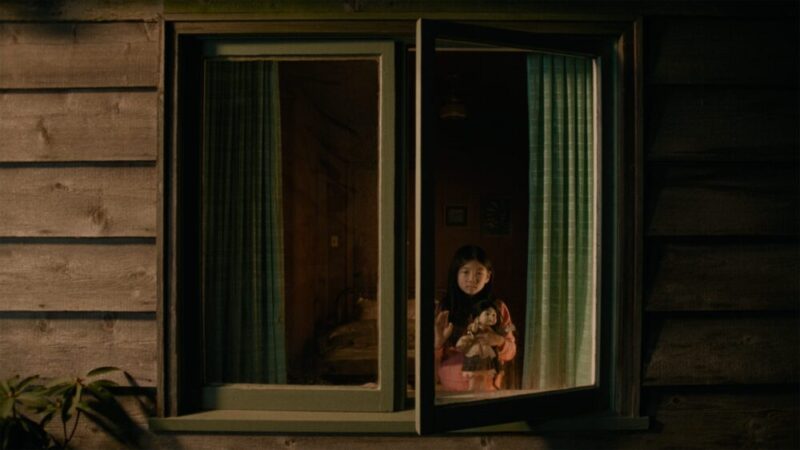
The opening act plays most comfortably within familiar genre territory. Following the death of her husband, a grieving mother (Kelly Marie Tran‘s Emily) relocates with her young daughter (Aria Kim) and grandmother (Fiona Fu) to an isolated house on the outskirts of Rock Springs, Wyoming. Miao establishes atmosphere with confidence here: the forest looms, the house groans, and a low hum of unease settles in quickly. Tran delivers a grounded, emotionally attentive performance, anchoring the film’s domestic grief even as the supernatural elements begin to stir. Yet this first section leans heavily on well-worn horror rhythms, setting expectations that the film will soon complicate – but not always successfully recalibrate.
It is the second act, centered on the 1885 Rock Springs Massacre, that gives the film its most powerful and necessary dimension. Drawing on historical record and Chinese spiritual beliefs, Miao shifts the film’s focus toward the atrocity that haunts the town, allowing the past to erupt into the present. Benedict Wong’s performance in this section is harrowing, lending visceral weight to the suffering and rage that history has left unresolved. These sequences are arresting and deeply affecting, but they also pull the film into a different register altogether – one that feels more essayistic and mournful than the haunted-house story that precedes it.
The final act attempts to reconcile these strands, pushing fully into the supernatural as the consequences of buried violence come into view. While Miao’s intentions are clear and her perspective sharply defined, the transition between modes remains uneasy. The film’s ideas about generational trauma, diasporic survival, and the cost of historical erasure are compelling, but their delivery can feel fragmented, as though the film is still negotiating how best to hold them together. Heyjin Jun’s cinematography maintains a steady sense of foreboding throughout, yet visual cohesion cannot fully smooth the narrative’s structural divides.
Ultimately, Rock Springs is an interesting, fractured work: a film whose ambition and moral urgency are impossible to dismiss, even as its storytelling resists cohesion. Miao announces herself as a filmmaker with a distinct voice and a vital point of view, and the film’s focus on the 1885 massacre alone gives it lasting significance. While it may not fully succeed as a seamless whole, Rock Springs remains a resonant and necessary act of cinematic remembrance – one that lingers less for its scares than for the history it refuses to let remain buried.


TWO AND A HALF STARS (OUT OF FIVE)
Rock Springs is screening as part of this year’s Sundance Film Festival, running between January 22nd and February 1st, 2026. For more information on tickets and session times, head to the official site here.
