


Rose McGowan has been speaking again – quietly, painfully, and with a clarity that still cuts. On the latest episode of Paul C. Brunson’s We Need To Talk podcast, the actress and activist reflected on the cost of telling the truth in an industry that rarely forgives women who do. Now 52, McGowan, one of the earliest and most visible voices of the global #MeToo movement, broke down while discussing Harvey Weinstein, whom she accused of sexually assaulting her at the 1997 Sundance Film Festival. Fighting back tears, she spoke of the disbelief that still haunts her: that Weinstein, despite everything, has likely “never spent a day in prison,” a reality she summed up with bitter precision – “Hollywood, baby.”
And yet, the conversation did not end in despair. It ended in something far more fragile and rare: hope. “I would love to still have some kind of career,” McGowan said, “to be able to do something in the arts and something creative again.” It’s a simple wish, almost devastating in its modesty – and it casts a long shadow back over the career-defining opportunity she never got to claim. Because there was a moment, not so long ago, when Rose McGowan was meant to wield a sword, headline a myth, and lead a franchise on her own terms. That film was Red Sonja. And its absence still speaks volumes.
There’s a particular kind of ache reserved for projects that almost existed – films that hovered close enough to feel inevitable, then vanished. Red Sonja is one of those ghosts. Not just a missed movie, but a missed cultural moment. On paper, it made an electrifying kind of sense. Robert Rodriguez, fresh off weaponising Grindhouse as a defiant middle finger to Miramax, aligning again with McGowan, who he had already cast with intention, loyalty, and fury, to resurrect one of fantasy cinema’s most ferocious women. Red Sonja isn’t a side character, a love interest, or a symbolic warrior; she is the title, the myth, the blade. And for a brief window in the late 2000s, the actress was poised to claim her.

The concept art alone told a story Hollywood rarely allowed women to inhabit without compromise. This wasn’t the softened, male-approved “strong female character” of studio shorthand. McGowan’s Sonja looked dangerous. Angry. Wounded. Commanding. A warrior shaped by violation but not defined by it, which is, crucially, the heart of Red Sonja’s mythology when treated with seriousness rather than exploitation. The character survives sexual violence and swears herself to strength not as spectacle, but as refusal. In McGowan, that narrative would have landed with a devastating resonance long before the world fully understood why.
That’s the cruel irony: Red Sonja would have arrived before McGowan was publicly allowed to tell her own story. Before Weinstein’s crimes were named. Before the industry’s quiet punishment of outspoken women was exposed for what it was. Before we had the language – or perhaps the courage – to see how often actresses like McGowan were pushed to the margins not for lack of talent, but for an excess of defiance.
Rodriguez knew exactly what he was doing when he cast her in Grindhouse. He has said as much. It was an act of allegiance, a provocation, an open rebuke to the machinery that had discarded her. Red Sonja would have been the escalation of that gesture: not just casting McGowan, but handing her a franchise, a mythic body, and a genre historically hostile to women who don’t soften themselves for survival. And make no mistake – this wasn’t about “comeback” casting. McGowan didn’t need saving; she needed backing. She needed the kind of toplined, swords-and-sandals epic routinely handed to men whose personal lives were never held against them. Red Sonja could have been her proof-of-concept that rage, sexuality, intelligence, and ferocity could coexist in a female-led action franchise without apology.
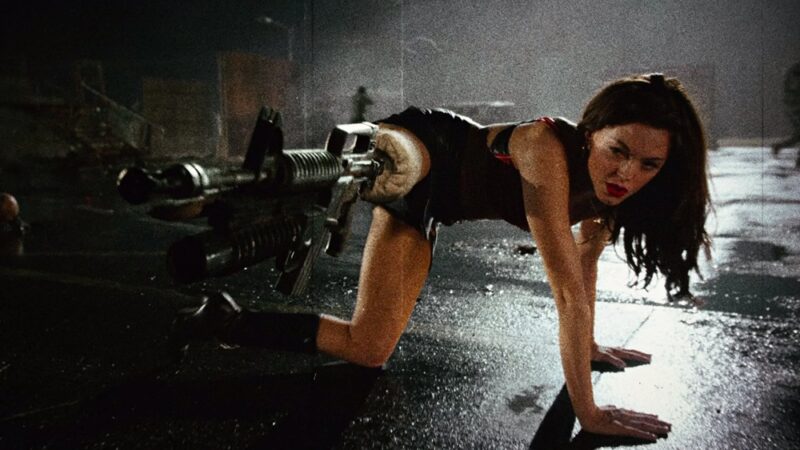
Instead, the project collapsed under the familiar weight of rights issues, financing paralysis, and – most heartbreakingly – McGowan’s own physical injury; severe nerve damage from a car crash which made sword work near-impossible. It’s almost too on-the-nose: the industry that wounded her emotionally also lost her physically, and then quietly moved on.
Later attempts to revive Red Sonja would cycle through other names, other approaches, none quite capturing what that moment promised. Because McGowan wasn’t just right for the role – the role was right for her. Her angular intensity, her refusal to smooth the edges, her lived understanding of survival and defiance would have reframed the character entirely. Not as fantasy cheesecake, but as feminist mythmaking forged in fire. In another timeline, Red Sonja becomes a cult hit, then a franchise. McGowan headlines sequels. Young women see a warrior who doesn’t ask permission to exist. Hollywood is forced, however briefly, to reckon with what it tried to erase. And the actress gets what she was always owed: power, authorship, and a legacy shaped by her strength rather than her silencing.
That particular iteration never happened. But the promise of it still matters. Because sometimes the most revealing stories aren’t the ones that made it to screen – they’re the ones the system couldn’t survive long enough to allow.
